Couverture de The Chris Abraham Show

The Chris Abraham Show

The Chris Abraham Show

De : Chris Abraham
Écouter gratuitement

À propos de ce contenu audio

tl:dr: Just a 55-year-old cisgender white male mansplaining his own self-importance. But good. Full Summary: The musings of Chris Abraham as he aspires to know the world and himself while getting healthy, losing weight, becoming fit, and running his small business while living in South Arlington, Virginia. Walk with him a while and see what's up.Chris Abraham
Les membres Amazon Prime bénéficient automatiquement de 2 livres audio offerts chez Audible.

Vous êtes membre Amazon Prime ?

Bénéficiez automatiquement de 2 livres audio offerts.
Bonne écoute !
    Épisodes
    • Session Twenty-Six: The Wachter House, a Basement of Skeletons, and the Point Where Vallaki Became Hostile Territory
      Jan 28 2026

      Session Twenty-Six picks up at a moment where survival has stopped feeling temporary. By now, the party understands that Barovia doesn’t reset between victories. Vallaki, once a place to rest and resupply, has become hostile ground. We’re no longer visitors. We’re trespassers.

      The objective is narrow and urgent: recover the Amulet of Ravenkind. Losing a relic capable of harming vampires in Strahd’s domain isn’t a setback. It’s a liability. Lady Fiona Wachter, newly installed as Vallaki’s burgomaster, is the most likely person holding it. Her family predates Strahd’s rule, and in Barovia, old families tend to survive by making old bargains.

      We enter her house through the basement. That alone says something about how this campaign has shifted.

      The cellar looks ordinary until it isn’t. Eight skeletons tear themselves out of the dirt floor, remnants of people who likely believed Vallaki was safer than the road. The fight is quick and decisive. What would have been a near-death struggle earlier in the campaign is handled with efficiency. Not confidence. Experience.

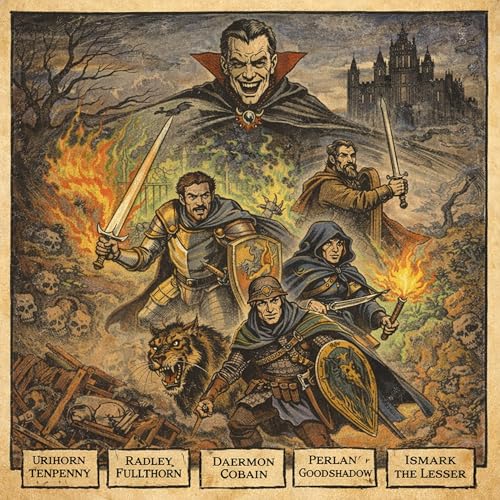
      Radley, the human fighter, has fully settled into his role as an Eldritch Knight. Early in the campaign he relied on armor and luck. Now he holds ground deliberately, mixing blade work with defensive magic. Urihorn, the halfling ranger who no longer casts a shadow, controls distance and terrain, his connection to his animal companion reinforcing a steadiness Barovia hasn’t yet taken from him. Daermon, the arcane trickster, turns positioning and timing into damage. Perlan, the monk newly arrived to the valley, already fights like someone who understands that hesitation gets you killed here.

      After the skeletons fall, we notice something worse than the combat itself: signs of frequent foot traffic worn into the dirt. A wall rotates, revealing a hidden chamber. Five chairs sit around a pentagram. No bodies. No ritual in progress. Just evidence that this house hosts meetings, not accidents.

      That’s Lady Wachter’s real danger. Not sudden violence, but organization.

      Outside the house, the tension shifts from combat to consequence. Ismark, burgomaster of Barovia Village and brother to Ireena, presses us for answers we’ve been avoiding. Until now, we’ve lied to him about his sister’s fate. Not out of cruelty, but because the truth in Barovia doesn’t bring closure. It brings reckless action.

      The lie collapses anyway.

      Radley carries that moment harder than most. He’s now the only survivor of his original party. Everyone else from those early days is dead. Burned. Taken. Left behind. He isn’t still alive because he’s exceptional. He’s alive because he adapted.

      At the end of the session, the party reaches Level 7.

      Mechanically, this is a meaningful step. Fighters gain stronger combat options. Rogues and monks become harder to pin down. Spellcasters unlock deeper resources. Everyone gains resilience and flexibility.

      Narratively, the level-up marks something quieter: we’re no longer reacting. We’re preparing.

      Session Twenty-Six doesn’t end with a win. It ends with clarity. Vallaki is compromised. Lady Wachter is entrenched. Strahd is still ahead of us.

      And whatever comes next won’t be handled politely.

      In Barovia, that’s progress.

      Afficher plus Afficher moins
      1 h
    • Green Fire on Mount Ghakis: Death, Deceit, and the Slow Collapse of Heroes in Barovia
      Jan 15 2026

      Barovia does not kill you all at once.
      It lets the mountain do the arguing.

      Sessions Twenty Four and Twenty Five began with the kind of fragile optimism that only survives when everyone is too tired to argue with it. We had stew at the Wizards of Wine. We had candles. We had a plan. Urihorn had no shadow, having traded it for a mist-token in one of Barovia’s quiet, transactional horrors. Nobody liked that, but nobody said no. That is how corruption enters a party. It doesn’t knock. It waits for exhaustion.

      Urihorn returned from the woods riding a mountain lion. Not summoned. Bonded. As if nature itself had decided he was still worth something. We left the winery and headed for Mount Ghakis, following a Tarokka prophecy that had been gnawing at us for weeks. The Amber Temple waited above the clouds. So did whatever it takes from you.

      At Tsolenka Pass, we found green fire burning in a gatehouse, an unnatural barrier that incinerated anything that touched it. Beyond it stood a lonely tower and a narrow bridge swallowed by fog. It looked like a checkpoint designed by something that hates hope.

      Two vrocks descended from the sky. Vulture demons with wings like funeral banners. Their screams stole our breath. Their spores stole our bodies. The fight was brutal and fast and unfair.

      Traxidor, our cleric, fell.

      No speech. No miracle. Just a body on cold stone while the wind kept moving.

      We cremated him in the green flame because there was nowhere else to put the dead on a mountain that eats people.

      We turned back.

      On the road to Barovia Village, we tried to save a young woman being taken to Castle Ravenloft. We attacked the guards. We cut her loose. And then the cart ran downhill. Too fast. Too heavy. It went off the road and took her with it. Good intentions do not stop physics in Barovia.

      In the village, we found water instead of wine and a new companion, Perlan Goodshadow, a monk with sense enough to listen when the world tells you it is dangerous. We lied to Ismark about his sister Ireena because telling him the truth would have killed him faster than Strahd ever could.

      He insisted we return to Vallaki.

      The guards wouldn’t let us in, so we climbed the walls like criminals, because that is what heroes become here. We slipped into Lady Wachter’s estate through the basement and were met by rising skeletons. We destroyed them quickly. Not because we were strong. Because we were changed.

      Behind a rotating wall, we found a hidden chamber. Five chairs. A pentagram. A room waiting for a meeting we were not meant to attend.

      Barovia keeps receipts.
      And we are starting to owe it things.

      That is where these sessions ended. Not with victory. With a door opening into something patient and hungry.

      And the worst part is that none of us is surprised anymore.

      Afficher plus Afficher moins
      1 h et 1 min
    • Becoming an Always-On Meshtastic Router by Accident
      Dec 29 2025

      I didn’t come to Meshtastic with a plan.

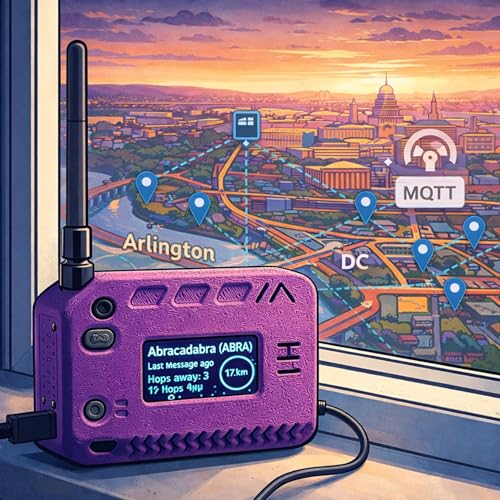
      I bought a cheap purple device off Etsy for about fifty-five dollars because I’d heard the word a few times and vaguely understood it meant LoRa mesh messaging. I wasn’t a prepper. I’m not a ham. I didn’t have a scenario in mind. The buy-in was low enough that curiosity won.

      I live on the 8th floor in Arlington Heights, with windows facing southeast. From that height, there’s a clear line of sight over a golf course and across low-rise terrain toward the Gaylord MGM. That’s not a metaphor or a thought experiment. It’s just geography. If you’re going to put a radio somewhere, elevation and openness matter.

      So I plugged it in and turned it on.

      At first, it behaved like a gadget. I paired it with my phone. Sent a few test messages. Watched nodes appear and disappear. It worked, which was reassuring, but nothing about it felt consequential. Traffic was sparse. Most activity looked like people checking in, not routing through.

      I left it on.

      That turned out to matter more than anything I did deliberately.

      Over time, it became clear that Meshtastic doesn’t reward interaction. It rewards presence. Nodes that come and go don’t contribute much beyond their own visibility. Nodes that stay up quietly start to matter in ways that aren’t obvious from the app.

      Eventually, I changed the device role from node to router. Not out of altruism, but because the device was stationary, wall-powered, and well-placed. Letting it sleep made no sense. A sleeping radio with good placement is just wasted capacity.

      That’s where the friction started.

      Router mode changes how the device behaves. Power management becomes aggressive. Bluetooth access becomes opportunistic instead of persistent. From the phone’s perspective, it feels unreliable. From the network’s perspective, it’s doing exactly what it should.

      There was a stretch where Bluetooth access felt broken. It wasn’t. The control plane was sleeping while the radio stayed active. Once I connected over USB and adjusted the settings with that in mind, the behavior made sense. Deep sleep off. Bluetooth given more patience. The display left on, because power wasn’t scarce.

      Once that was done, the device became boring.

      And boring is the goal.

      Around the same time, the local Arlington / MeshDC area started showing more consistent LongFast traffic. More ACKs. More multi-hop messages. Nodes sticking around instead of flickering in and out. Not because of anything I personally changed, but because more devices were staying online, placed well, and allowed to just exist.

      I chose the handle ABRA. Originally short for Abraham. That felt too personal. Now it’s Abracadabra, which fits better. I connected the node to MQTT so it appears on the global map, which is still quietly astonishing. A little purple radio in a window, visible via the modern web, routing messages it doesn’t need to read.

      Most of the coordination, discussion, and culture happens elsewhere anyway. Discord. Reddit. The meta layer. The mesh itself just moves packets.

      What I learned wasn’t radio theory or emergency planning. It was simpler.

      Meshtastic works best when you stop treating nodes like personal devices and start treating them like infrastructure. Infrastructure doesn’t demand attention. It needs uptime, placement, and restraint.

      I didn’t set out to build anything. I just left something on in a good place.

      Everything else followed.

      Afficher plus Afficher moins
      52 min
    Aucun commentaire pour le moment