Couverture de The Base Hits Show by Runic Tools

The Base Hits Show by Runic Tools

The Base Hits Show by Runic Tools

De : Runic Tools
Écouter gratuitement

À propos de ce contenu audio

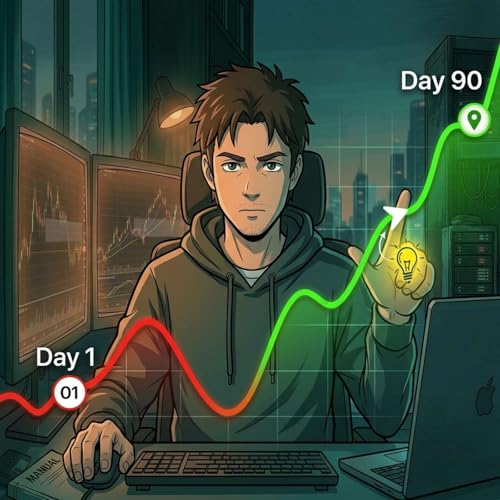
Trading isn't about home runs. It's about showing up, taking clean setups, and walking away when there's nothing there. The Base Hits Show covers trading psychology, prop firm strategy, and the boring habits that actually build funded accounts. No hype. No course pitches. Just the reps.Runic Tools
Épisodes
  • POV: You Stopped Revenge Trading
    Apr 6 2026
    It's 9:47 AM. You just got stopped out on NQ. Your hand is on the mouse. The order entry panel is right there. The second trade is right there. And today, for the first time, you don't take it. That's the whole opening of this episode. A hand that doesn't click. This episode of POV walks through what revenge trading actually feels like from the inside, not the textbook definition, but the physical, compulsive experience of it. The heat in your chest. The way the chart looks different when you're angry, every candle suddenly screaming at you like an entry. The story you tell yourself that it's a new setup, a fresh start, a clean trade, when really it's the same ticker, same direction, bigger size, and the only goal is to make the market give back what it took. Before today, there was yesterday. And yesterday was not this. Yesterday you were stopped out at 9:42. Back in by 9:44, doubled up. Down three times your original risk by 9:51. You closed the platform, walked to the kitchen, came back, opened the laptop, and took one more. By noon you were down $1,400 on what started as a $200 stop. You didn't journal it. You closed the laptop and sat in the silence of knowing you did it again. Not shock. Not surprise. Just the heavy, exhausted recognition of a pattern you've watched yourself repeat so many times that the self-criticism has worn smooth. This episode contrasts that spiral with what happened today: - The stop triggers at 9:47. The heat comes. Your hand is on the mouse. - You don't re-enter. You just sit there and watch the chart like rain. - At 10:15, a real setup forms, one that fits your rules exactly, not approximately. - You take it. Defined risk. Same size. No revenge in it. - You close the platform at 11:00, up $280. The $280 is almost beside the point. What matters is that you didn't take the second trade. That's the whole thing. The episode closes with something honest: you will slip again. There will be a Thursday in three weeks where the heat comes back and you feed it. But it won't be the same, because now you know what the other option feels like. You stop once, then slip, then stop again, and gradually the stopping becomes the default and the revenge trade becomes the exception. One day you realize you can't remember the last time you doubled down on a loss. That day doesn't feel like anything. And that's how you know it worked. This one is for the trader who revenge traded yesterday and is watching at 2 AM wondering if they'll ever stop. The answer is yes. It starts with a hand on a mouse that doesn't click. If this episode hit close to home, subscribe so you don't miss the next one.
    Afficher plus Afficher moins
    14 min
  • Your Life as Every Level of Prop Firm Trader
    Apr 5 2026
    There is a screenshot. You have seen it. Everybody who has ever bought a prop firm eval has seen it, or something like it. Someone posts their payout confirmation in a Discord server, or on Twitter, and the number is just sitting there. Real money. From trading. And something happens in your brain when you see that. This episode traces the full arc of prop firm trading, from the moment that screenshot rewires your thinking all the way to the morning you could post your own, and choose not to. Seven levels. Told honestly. No hype, no success porn, no highlight reel. What each level actually looks like: - Level 1: You buy the eval on impulse. You size up on Day 2. You blow it in three days. You buy another one that weekend. - Level 2: You have rules now. A sticky note. A journal. You make it to Day 8 before a revenge trade ends it. You buy a third eval that same night. - Level 3: You pass. The payout request takes two weeks and you check your email forty times a day. The first time real money hits your bank account from trading, you sit there staring at it. And immediately the question shifts from "can I do this" to "can I keep doing this." - Level 4: Funded but cautious. You were more profitable in the eval than you are now. Your win rate went up. Your income went down. You realize the eval was the audition. This is the performance. - Level 5: Three to five accounts running simultaneously. One blows and you do not flinch. You have a spreadsheet. You think in portfolio ROI now, not single-account P&L. The shift from "this trade" to "this process" is the difference between gambling and operating. - Level 6: Eight to ten accounts. A morning routine that looks like a small trading desk. Automated entries, payout schedules, account management processes. You are making more from prop firm payouts than your day job. You have not told your employer yet. - Level 7: This is your job now. You think about that first screenshot, the one from someone else's feed that started all of this. You could post your own now. Numbers that would change how people look at you. You do not. Not because of some rule. Because you know what a screenshot cannot show. This episode is for the trader who has bought three or more evals, blown all of them, and is sitting there right now trying to decide whether to buy another one or just stop. The answer is in the arc. The process is the point. If you want to watch the full narrated version, the video link is in the episode description. Subscribe so you do not miss the next one.
    Afficher plus Afficher moins
    23 min
  • Why Trading Feels Impossible (Until It Doesn't)
    Apr 2 2026

    If you have six indicators on your chart, watch three analysis videos before every session, and still freeze when your setup appears, this one is for you. You are not lazy. You are not undisciplined. You are doing everything you were told a serious trader should do. And it might be the exact thing destroying you. This episode follows Marcus six months before the quiet transformation you heard about in Episode 1. He is three evaluations deep, two blown accounts behind him, and working harder than almost anyone he knows. His charts look like mission control. He spends two hours preparing every morning. And he still cannot pull the trigger when his setup appears. Marcus is not failing because he lacks discipline. He is failing because his discipline is pointed at the wrong things. Zero walks through the five traps Marcus does not know he is in: - The certainty addiction: every tool he adds is a vote against uncertainty the market does not care about. - Instant feedback loops: treating every red tick as a verdict on whether he is a good trader. - Complexity as sophistication: a chart that looks serious does not produce serious results. - PnL as the scoreboard: measuring himself by an outcome he cannot control instead of the process he can. - Consumption as preparation: twelve opinions about what the market will do, poured directly into his decision-making right before he has to make decisions. The turning point is not dramatic. It is a slightly weird Tuesday. Marcus's internet goes down fifteen minutes before the open. No research, no Discord, no analyst takes. Just his chart and one setup he knows cold. He takes two trades. Follows his rules on both. It is his best session in months, and he did less that morning than he normally does before the market even opens. What follows is not addition. It is subtraction. Marcus strips his chart down, stops the pre-market ritual, limits himself to his setup and his rules. Trading gets boring. He hates it at first. Then his execution gets cleaner. His journal entries get shorter. He starts measuring days by whether he followed the plan, not by the number. The shift is not from ignorance to knowledge. It is from complexity to clarity. He stops trying to manufacture certainty and starts executing inside uncertainty. The uncomfortable closing truth: the 95 percent who find trading impossible are often more dedicated than the traders who eventually find it obvious. They just aimed their effort at the wrong target. The traders who make it did not learn more. They unlearned almost everything. The market does not reward the hardest worker. It rewards the most consistent executor. Zero narrates throughout with his usual dry, observational tone. No motivation. No lectures. Just a description of what is happening from someone who has seen it a thousand times. This episode is part of the ongoing Marcus series inside Trading Psychology. If you are watching on YouTube, subscribe so you do not miss where this story goes next.

    Afficher plus Afficher moins
    11 min
Aucun commentaire pour le moment