Épisodes

  • The Singles: The hot hits of May with Lucky Saint, Lego & Entertain or Die.
    May 11 2026

    The Singles is back with Tracksuit, taking some of the biggest marketing stories in culture right now and putting them under a bit more pressure using real brand data.

    Because the interesting part is rarely just the campaign itself. It is what the campaign reveals about the category, the audience, and the way brands are trying to grow.

    In this episode, Conor Byrne is joined by Ed Parkin and Bella Harrison from Tracksuit to explore three very different examples of brands using culture, entertainment, and timing to build relevance.


    Lucky Saint shows how alcohol-free beer has moved far beyond Dry January, using Lime Bikes, London culture, run clubs, and moderation trends to position itself as a year-round brand for active urban consumers.


    Lego demonstrates why it remains one of the most culturally flexible brands in the world, turning the FIFA World Cup into entertainment before a ball has even been kicked, while continuing to stretch beyond the toy category into fandom, collectibles, and adult audiences.


    The conversation then turns to the latest Entertain or Die Report, looking at why entertainment is increasingly becoming a commercial growth strategy rather than just a creative ambition.


    The episode also explores:

    • Why brands are now competing against Netflix, TikTok, creators, and sport for attention
    • The shift from “salesmanship” to “showmanship” in advertising
    • Why entertaining brands are outperforming commercially
    • What brands like Currys, Compare the Market, Guinness Zero, and Lego are getting right
    • How mental availability is built long before purchase moments happen

    If you want a deeper understanding of how entertainment, culture, and brand growth connect together, this episode is packed with practical examples and real-world data.


    Listen to Paul Feldwick on That's What I Call Marketing here:

    Paul Feldwick on That's What I Call Marketing


    Read the full Entertain or Die report:

    Entertain or Die Report


    Find out more about Tracksuit:

    Tracksuit

    Listen to more episodes of That's What I Call Marketing:

    That's What I Call Marketing


    Timestamps:


    02:06 – Lucky Saint and the rise of moderation culture

    03:24 – Why Lucky Saint is so culturally aware

    05:05 – Lime Bikes, London culture, and timing

    07:08 – The functional drinks category shift

    08:45 – Alcohol-free beer becoming mainstream

    10:00 – Guinness Zero vs Lucky Saint

    11:18 – Winning locally before scaling nationally

    13:22 – Brand perception and category positioning

    15:00 – Lego and the FIFA World Cup campaign

    16:01 – Why Lego works across every demographic

    18:22 – Lego’s cultural timing advantage

    20:00 – Lego, fandom, and entertainment

    21:40 – World Cup advertising and brand competition

    22:15 – Entertain or Die explained

    24:00 – Why entertainment drives commercial growth

    25:35 – Future demand and entertainment

    26:17 – Gap hires a Chief Entertainment Officer

    27:09 – What makes brands entertaining

    29:00 – Brands that entertain us today

    31:00 – Why culture matters inside companies

    Hosted on Acast. See acast.com/privacy for more information.

    Afficher plus Afficher moins
    34 min
  • S5Ep14:  Personalisation is just good prediction with CEO James Taylor
    May 5 2026

    We talk about personalisation as if it’s about the person. It isn’t. It’s about prediction.”

    That line sits at the centre of this conversation with James Taylor, CEO & Founder of A Particular Audience and once you hear it properly, it’s difficult to go back to how most marketing teams currently think about relevance. Because for years, personalisation has been framed as something close to one-to-one messaging. The idea that if we just had enough data, we could tailor every experience to the individual. It sounds right. It feels intuitive. And yet, in practice, it has largely disappointed.


    What James lays out here is a different way of understanding the problem.

    • Not who the customer is — but what they are doing.
    • Not static segments — but real-time signals.
    • Not demographics — but behaviour.


    Drawing on his experience building AI-driven recommendation systems used by global retailers, he explains how the most effective ecommerce experiences are not built around people, but around patterns. Around the relationships between products, actions, and intent. Around what millions of other customers have done before you, and what that makes likely next. This fundamentally changes how you think about websites, search, media, and even creativity.


    Along the way, the conversation explores why so many early personalisation efforts failed, how Amazon and Netflix approached the problem differently, and why most retailers are still playing catch-up despite having access to the same underlying data.

    There’s also a more grounded thread running through it — the reality of AI in practice. Not the version you see in product demos or LinkedIn posts, but the version that still requires constraints, rules, and human oversight. The version that gets things wrong. The version that can be incredibly powerful, but only when properly understood.

    For marketers, there’s a useful tension here, on one side, the promise of hyper-relevance and automation, on the other, the discipline required to make it actually work.


    This episode sits right in that space.

    ⏱️ Key Moments:

    00:00 – Why “you are not your demographic” changes everything

    02:15 – From investment banking to building AI products

    08:00 – The real meaning of personalisation (and why it’s been misunderstood)

    12:30 – Behaviour vs demographics: what actually drives relevance

    18:00 – Building a recommendation engine from scratch

    26:00 – Why most retailers still lag behind Amazon

    30:00 – How AI is changing marketing teams

    34:00 – The limits of AI (and why rules still matter)

    36:30 – “Personalisation is just good prediction”

    What you’ll take from this episode:

    • Why most personalisation strategies fail to deliver
    • How recommendation systems actually work in ecommerce
    • The difference between explicit and implicit customer signals
    • Why demographics are often a poor proxy for behaviour
    • How AI should (and shouldn’t) be used in marketing today
    • What marketers need to rethink about relevance and experience design


    Brought to you by Tracksuit

    Tracksuit is the always-on brand tracking platform helping marketers understand brand health, measure impact, and make better decisions over time.

    👉 https://gotracksuit.com

    Listen / Follow That’s What I Call Marketing:

    🎧 Spotify: https://open.spotify.com/show/7MXhujDpTzbSRRbyQFgdWp

    📩 Email: thatwhatswhatIcallmarketing@gmail.com

    Subscribe for weekly conversations with leading marketers.

    Hosted on Acast. See acast.com/privacy for more information.

    Afficher plus Afficher moins
    39 min
  • S5Ep13: Christmas in April with Pete Markey & Leanne Tomasevic powered by Electric Twin
    Apr 27 2026

    How Brands Should Really Be Planning Christmas Campaigns

    What happens when you start planning Christmas… in April?

    In this episode of That’s What I Call Marketing, Conor Byrne is joined by Pete Markey (former CMO of Boots, Marketing Week Marketer of the Year) and Leanne Tomasevic (Insights Lead at Electric Twin) to explore how brands should approach Christmas advertising — using real-time synthetic audience insights.

    Instead of guessing what consumers want, this episode puts Electric Twin’s platform to the test live, revealing how marketers can simulate audience reactions, test ideas, and sharpen creative briefs months before campaigns go live.

    The result is a grounded, practical look at:

    • What people actually want from Christmas ads in 2026
    • Why emotional storytelling still matters (but needs reframing)
    • The role of celebrities, music, and consistency
    • How to balance commercial pressure with authenticity
    • And how AI-driven research can speed up better decisions

    If you’re working on a Christmas campaign, brand strategy, or creative development, this is a genuinely useful watch.

    ⏱️ Timestamps

    00:00 – The reality of planning Christmas in April

    01:10 – What Electric Twin actually does (synthetic audiences explained)

    03:00 – Why speed matters in modern marketing decision-making

    05:30 – Live demo: Understanding the mood of the nation at Christmas

    08:30 – What consumers really want this year (family, realism, restraint)

    12:00 – Gifting trends: practicality vs meaningful connection

    14:30 – The balance between storytelling and selling

    16:00 – What people want from Christmas ads now

    18:00 – Should brands use celebrities? (and when it works)

    21:00 – The role of consistency (Kevin the Carrot, John Lewis, Coca-Cola)

    24:00 – Realism vs escapism in Christmas creative

    27:00 – How agencies can use this to build stronger briefs

    29:00 – The most memorable Christmas ads and why they last

    32:00 – Should brands reuse ads instead of making new ones?

    33:00 – Why music is critical to Christmas advertising effectiveness

    35:30 – Final thoughts: faster insight, better decisions

    🎯 Key Takeaways
    • Christmas advertising isn’t about excess — it’s about connection under constraint
    • Consumers want authenticity, not performance
    • Creative effectiveness improves when insight is iterative, not static
    • Consistency often beats novelty in building long-term brand memory
    • AI isn’t replacing research — it’s changing how quickly you can think
    🔗 Links & Resources
    • Learn more about Electric Twin: https://electrictwin.com
    • Listen to more episodes: That’s What I Call Marketing
    • Previous episode with Dr. Ben Warner (Synthetic Research deep dive)
    🎙️ About the Podcast

    That’s What I Call Marketing features conversations with leading marketers, CMOs, and industry thinkers — focused on how marketing actually works in practice.

    If you’re working on Christmas 2026 right now, get in touch with Electric Twin


    Hosted on Acast. See acast.com/privacy for more information.

    Afficher plus Afficher moins
    38 min
  • The Singles: The hot hits of April with McDonald’s, KitKat & Bieber
    Apr 21 2026

    The Singles is back with a new line-up from Tracksuit, looking at the marketing stories everyone is talking about In this episode joined by Bella & Ed we take a look at the data behind three very different moments

    1. McDonald’s shifts the conversation away from product and towards Gen Z employees, at a time when confidence in job opportunities for young people is low. It could easily have drifted into familiar employer-brand territory, but early signals suggest it is doing something more meaningful, with trust moving among younger audiences in a category where that is not easy to shift.
    2. KitKat finds itself at the centre of a global story after 12 tonnes of product are stolen, and instead of containing it, turns it into something participatory. Consumers are actively engaging, brands are joining in, and even a “KitKat” crypto coin spikes by 2000%. Most reactive marketing creates attention. Very little of it changes behaviour. This one starts to.
    3. Justin Bieber’s Coachella set works in a different way, stripping everything back and building the performance around YouTube. Nearly 6 million people stream it, and it splits opinion in a way that keeps it moving. It takes something familiar and presents it in a way that forces people to reprocess it, which is often where attention sustains rather than fades.

    Along the way, the conversation gets into why authenticity is showing up differently in production, how nostalgia actually works when brands get it right, and why participation is becoming more valuable than passive reach.


    05:00 – McDonald’s: trust, Gen Z and employer brand

    10:30 – KitKat: heist, participation and brand response

    15:50 – Justin Bieber: YouTube, nostalgia and polarisation

    20:30 – Nostalgia in advertising and brand memory

    25:00 – Always-on tracking and what the data shows


    Don't forget to check out the new Entertain or Die report at Tracksuit


    COMING SOON - TWICM Training course will launch, stay tuned

    Hosted on Acast. See acast.com/privacy for more information.

    Afficher plus Afficher moins
    28 min
  • S5Ep12: Meet The Young Lions Headed to Cannes
    Apr 13 2026

    The first Cannes Sessions episode of That’s What I Call Marketing is here and we kick off the series by interviewing three Irish IAPI Young Lions winner teams heading to Cannes: Darragh Spain and Fardosa Flanagan (Young Marketer, 123.ie/Intact Insurance), Ciara and Niamh (Film, Droga5), and Emily and Rhea (Digital, Omnicom Media). They discuss why they entered, how they tackled the 48-hour brief, research and insight methods, time management, prototyping and AI tools for film, adapting to an older target audience, presentation pressure, reactions to winning, and how they’re preparing for Cannes through past work review, equipment planning, bootcamps, and confidence. The Cannes Sessions are brought to you by The Digital Voice.


    These interviews shine a spotlight on their exceptional talents and the creative potential that exists within the next generation of marketing leaders, lets support and celebrate these future leaders as they prepare to bring home some medals from one of the most prestigious events in the marketing world.


    01:05 Young Lions Explained

    01:40 Meet the Winning Teams

    02:43 Darragh and Fardosa Intro

    03:19 Cracking the Brief

    04:33 Research and Insights

    06:55 Teamwork Under Pressure

    08:21 Shortlist to Presentation

    10:11 Winning the Call

    11:29 Preparing for Cannes

    12:55 Niamh and Ciara Win

    13:35 Film Category Workflow

    15:45 Agency Advantage

    16:21 Why Enter Young Lions

    17:07 Choosing a Category

    17:22 Learning Film Skills

    18:06 Upskilling With AI

    18:52 Planning For Cannes

    19:35 Storytelling Edge

    21:07 Why Enter Young Lions

    22:24 Team Dynamic Under Pressure

    24:03 Choosing The Digital Route

    24:51 Cracking The Age Group

    25:39 Winning Call Reaction

    26:42 Cannes Prep And Mindset


    Sponsored by The Digital Voice, the amplification agency working with global ad tech and martech brands across press, thought leadership, content, social, events, and creative.

    Hosted on Acast. See acast.com/privacy for more information.

    Afficher plus Afficher moins
    32 min
  • S5Ep11: Descript CEO on What Actually Grows A Product.
    Mar 31 2026

    Laura Burkhauser, CEO of Descript, explains the surprising truth about what actually grows a product.


    Most marketing advice assumes growth comes from better targeting, smarter funnels, or stronger loyalty. Laura sees it differently.


    In this episode, we get into what actually drives product growth — and why some of the most widely accepted ideas in marketing and SaaS don’t hold up when you look at real behaviour. From why freemium often fails, to why loyalty doesn’t grow your business (but still matters), to what AI will and won’t change — this is a grounded, operator-level view of how products actually scale.


    If you work in marketing, product, or growth, this will likely challenge a few default assumptions.


    In this episode, we cover:

    • Growth doesn’t come from loyalty — it comes from penetration
    • Most freemium models don’t work the way companies think they do
    • “Target audiences” often aren’t real, connected communities
    • AI will amplify creativity, not replace it
    • Customer care is one of the last real competitive advantages


    02:00 – What Descript actually is and who it’s for

    04:30 – Product vs product marketing: the career fork that shapes everything

    07:30 – Why big tech can slow you down (and what startups get right)

    10:00 – Moving from product leader to CEO — what actually changes

    13:30 – The freemium myth: why it didn’t work the way they expected

    15:00 – “Are we dating or not?” — a better model for product growth

    16:30 – How products actually get discovered (SEO, content, and reality)

    18:00 – Why most “target audiences” aren’t real communities

    20:30 – The shift from founder-led to customer-led companies

    22:00 – What customers are actually good at telling you (and what they’re not)

    24:30 – Why customer care is a competitive advantage (and why most companies cut it)

    25:00 – Loyalty isn’t growth — but it might be your moat

    26:00 – How to actually achieve penetration in a crowded market

    28:00 – The challenge of building a product for “everyone”

    30:00 – AI, content, and the future of podcasting — what’s real vs hype

    33:00 – Why most AI-generated content won’t work

    34:30 – The “Finding Nemo” moment AI still hasn’t had

    36:00 – Scaling a company without losing creativity

    37:00 – Why “intrepid” might be the most important mindset for modern teams


    About Laura Burkhauser

    Laura Burkhauser is the CEO of Descript, one of the most widely used platforms for podcasting, video editing, and content creation. She has held senior product leadership roles at companies including Amazon and Twitter, and is known for her product-first approach to growth.


    Listen / Watch more episodes:

    https://www.thatswhaticallmarketing.com/


    Thanks to our partner on this episode the always on brand tracking dashboard Tracksuit


    If you enjoyed this, subscribe for more conversations with CMOs, founders, and marketing leaders on how growth actually happens.

    Hosted on Acast. See acast.com/privacy for more information.

    Afficher plus Afficher moins
    40 min
  • S5 Ep10: Inside Saatchi & Saatchi, with CEO Claire Hollands
    Mar 25 2026

    Inside Saatchi & Saatchi. Sit down with the CEO of one of the most iconic agencies in advertising, a name that carries both weight and expectation, to understand how CEO Claire Hollands leads for today.


    This is a conversation about ambition. Not in the abstract, but in how it shows up in the work, in the culture, and in the relationship between agencies and clients.


    We get into how Saatchi & Saatchi is positioning itself around growth, why creativity still holds commercial power (even if the industry occasionally forgets it), and how agencies are rethinking their value, from billable hours to business outcomes.


    There’s also a clear view on where things are shifting: the role of AI, the reality of pitching, and why agencies need to be more deliberate about the clients they choose.


    Running through all of it is leadership, how you make decisions without perfect information, how you build a culture of high challenge and high support, and how you balance legacy with the need to move forward.


    What you’ll learn:

    • Why agencies need to reposition themselves around growth, not outputs
    • How creativity still drives commercial performance and where it gets undervalued
    • What actually builds trust between agencies and clients
    • Why most pitch processes are flawed and what better looks like
    • How to think about agency value, pricing, and remuneration
    • The difference between growth brands and transformation brands and why it matters
    • What “high challenge, high support” looks like in practice
    • How great leaders make decisions without having all the answers
    • What AI is changing in agencies and what it isn’t
    • Why hiring for attitude and curiosity matters more than experience


    Timestamps

    00:03:00 – Finding your people in the industry

    00:06:00 – Why account management sits at the centre of the agency

    00:07:00 – Building trust in client relationships

    00:12:00 – How decisions are really made at senior level

    00:15:00 – Culture, values, and collective ambition

    00:19:00 – High challenge, high support: what it means in practice

    00:23:00 – Managing pressure across career and family

    00:25:30 – Where the agency world is heading

    00:29:30 – The evolving agency model

    00:32:00 – The role and reality of pitching

    00:33:30 – What needs to change in pitch processes

    00:37:30 – Hiring for attitude, not just skill

    00:39:00 – What excites Claire about what’s next


    About the podcast

    That’s What I Call Marketing is a podcast for marketers who care about how brands grow, how advertising works, and how the industry is evolving through conversations with the people shaping it.

    Hosted on Acast. See acast.com/privacy for more information.

    Afficher plus Afficher moins
    42 min
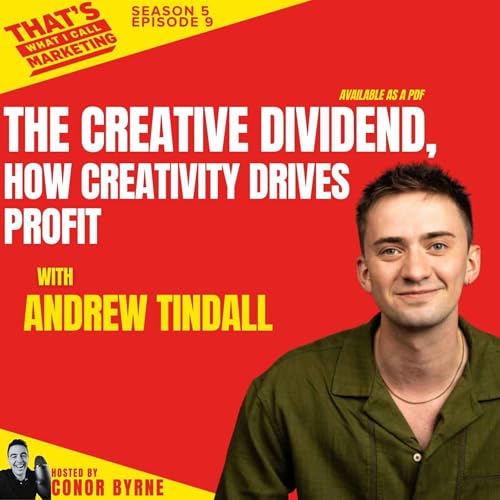
  • S5 Ep9: Andrew Tindall: The Creative Dividend, How Creativity Drives Profit
    Mar 10 2026

    In this episode of That’s What I Call Marketing, Conor Byrne speaks with Andrew Tindall, Chief Growth Officer at System1, about his new publication/pdf The Creative Dividend. Built using global Effie case study data and creative testing from over 250,000 respondents, the research explores a simple but uncomfortable truth: most advertising fails to deliver profitable growth. Andrew explains why creativity has been undervalued in modern marketing, why many campaigns generate revenue but not profit, and why the industry’s biggest problem may actually be a lack of creative confidence. The conversation also explores the relationship between emotion, distinctiveness, media investment, pricing power and brand growth and what marketers should actually do differently. If you care about marketing effectiveness, advertising creativity, and long-term brand growth, this is a fascinating deep dive.


    Topics Covered

    • Why only 9% of advertising campaigns report profit growth

    • The concept of creative confidence

    • What the Creative Dividend actually means

    • Why distinctiveness beats differentiation

    • Why advertising cannot create loyalty

    • The link between emotion and profit

    • Why many campaigns are designed to fail

    • The tension between creative quality and media investment


    Timestamps

    05:00 What The Creative Dividend is trying to solve

    06:32 Why global Effie data matters for marketing effectiveness

    07:17 Has creativity been undervalued in advertising?

    08:59 The crisis of confidence in marketing creativity

    10:16 Why many organisations see creativity as a risk

    11:21 The role of the client in protecting great ideas

    12:17 Why businesses avoid creative risk

    13:00 The shocking statistic: only 9% of campaigns report profit growth

    14:17 Are marketers measuring the wrong outcomes?

    15:21 The importance of pricing power in marketing

    16:45 How creativity enables brands to charge more

    19:16 What the “Creative Dividend” actually means

    21:00 The four drivers of creative effectiveness

    22:00 Why 83% of campaigns are designed to fail

    23:06 Why great creative fails without media support

    24:16 The power of long-term creative platforms

    26:00 Consistency vs freshness in advertising

    28:46 What surprised Andrew most in the research

    29:07 Why distinctiveness matters more than differentiation

    29:48 Why advertising doesn’t create loyalty

    30:00 Distinctiveness vs emotion: efficiency vs effectiveness

    31:41 Why emotional advertising drives profit

    32:44 Why revenue alone isn’t success in marketing

    34:00 The debate about gated content in marketing research

    39:00 AI, marketing knowledge and the future of learning


    Links Mentioned
    • The Creative Dividend (download the pdf): https://system1group.com/the-creative-dividend
    • Tracksuit https://www.gotracksuit.com
    • That’s What I Call Marketing Podcast https://www.thatswhatIcallmarketing.com
    • Green Hat Episode (gated content discussion): https://open.spotify.com/episode/72D5zXtNRzzNgdjYytRQdI?si=r2kbvHU3QqWVh6sM6na7wg OR https://podcasts.apple.com/au/podcast/s3-ep39-the-b2b-power-shift-what-marketers-must-do/id1615415427?i=1000672178838

    Hosted on Acast. See acast.com/privacy for more information.

    Afficher plus Afficher moins
    43 min