Épisodes

  • Success is Never Accidental Episode 85 - Luis Salavarria
    Oct 24 2026

    Success isn't just about what you know. It's about taking action, learning from experience and surrounding yourself with the right people.

    In my latest Success Is Never Accidental podcast, I speak with Luis Salavarria, real estate investor, wealth manager and founder of American Asset Legacy.

    Starting out in a new country without the language, contacts or network, Luis built a successful investment career through determination, resilience and a willingness to learn.

    One of his messages particularly resonated with me:

    "Invest in the person first, and then in the project."

    We also explore managing risk, communicating your value and why real success is about much more than financial wealth.

    My challenge to you this week:

    Which of your financial goals have you allowed to slip, and what ONE practical step could you take to get back on track?

    I hope you enjoy the conversation and take away some valuable insights.

    Afficher plus Afficher moins
    40 min
  • Success is Never Accidental- Episode 84- Carol Ring
    Oct 10 2026


    Success is Never Accidental- Episode 84- Carol Ring

    Culture Is More Than People

    What if some of the “people problems” in your organisation aren’t really people problems at all?

    That was one of the most thought-provoking ideas from my recent Success Is Never Accidental conversation with Carol Ring, workplace culture strategist, executive coach, speaker and best-selling author.

    Carol brings more than 30 years of executive and operational experience, including leading the turnaround of a billion-dollar regional telecommunications business. Her latest book, People Problems Solved: 9 Accelerators the World’s Top CEOs Use to Drive Results, challenges leaders to think differently about workplace culture.

    Look Beyond the Individual

    We can be quick to label someone as disengaged, difficult or underperforming. But Carol reminded us that sometimes what appears to be a people problem is actually a symptom of the culture and systems surrounding that person.

    She encouraged leaders to look beyond their people and ask:

    Do our policies encourage ownership and buy-in?
    Does our physical environment support people to perform at their best?
    Do staff have the technology and systems they need to do their jobs effectively?

    Sometimes we need to stop trying to fix the person and start looking at the environment in which we are asking them to perform.

    Help People Play to Their Strengths

    We also explored the importance of values and alignment.

    People are generally happier and more fulfilled when they have a sense of purpose, when their values align with those of the organisation and when they have opportunities to use their strengths.

    As leaders, we have a responsibility to help people recognise those strengths and find meaningful ways to use them.

    That means making supervision, appraisal and development conversations about more than training needs.

    Ask:

    What are you really good at?

    What do you enjoy?

    Where could you contribute more?

    Those simple questions can open very different conversations.

    Recognise Behaviours — Not Just Results

    Key Takeaways

    • Not every people problem is actually a people problem — examine the culture and systems too.
    • Help people identify and use their strengths and interests.
    • Review whether your policies, environment and technology enable people to perform well.
    • Recognise and reward behaviours as well as results.
    • Make recognition specific so people know exactly what they are doing well.

    Your Challenge

    This week, ask yourself:

    What ONE thing could I change that would improve the culture within my team?

    It might be a policy, the working environment, an ineffective system or simply the way you recognise your people.

    And then consider:

    Who deserves recognition this week — and specifically, what do I want to recognise them for?

    Culture isn't simply what we say we value. It is what leaders consistently encourage, recognise and reward.

    And remember — Success Is Never Accidental.


    Join thousands of leaders who are learning what really drives success.

    Afficher plus Afficher moins
    43 min
  • Success is Never Accidental- EP 83- Michelle Arentz
    Sep 28 2026

    I’m delighted to share my latest episode of Success Is Never Accidental conversation with Michelle Arentz, founder of Strategic Talent.

    Michelle calls herself the “Workforce MD” — getting to the root cause of workforce problems rather than simply treating the symptoms.

    Her approach to getting unstuck starts with three deceptively simple questions:

    1️⃣ What’s working?
    Start with strengths. What can we build upon?

    2️⃣ Where are we stuck?
    Ask yourself. Ask your team. Then really listen.

    3️⃣ What could we do differently?
    Not more. Differently.

    I particularly like that last question.

    As leaders, it is easy to look at what everyone else needs to change. Sometimes the more powerful question is:

    “What could I do differently?”

    Michelle also makes an important point about feedback: don’t ask for it unless you are genuinely prepared to hear the answer and respond.

    🎧 In this episode we explore getting unstuck, understanding what motivates people, aligning talent with opportunity, and creating workplaces where people feel heard.

    My challenge to you:
    Think of one situation where progress has stalled.

    What’s working?
    Where are you stuck?
    What could you do differently?

    Afficher plus Afficher moins
    48 min
  • Success Is Never Accidental EP 82 : Dr Lilli Cooper
    Sep 5 2026


    Success Is Never Accidental: Dr Lilli Cooper

    Why Looking After Yourself Is Not SelfishOne of the greatest myths in leadership and professional life is that technical expertise alone leads to success. It doesn't.


    Whether you are a surgeon, teacher, social worker, nurse, executive or business owner, your ability to perform consistently under pressure depends just as much on your mindset, emotional resilience and self-awareness as it does on your qualifications.

    This week's Success Is Never Accidental podcast with Dr Lilli Cooper reinforced that message powerfully.

    A highly accomplished plastic surgeon, Lilli's perspective changed dramatically after experiencing anxiety during a surgical procedure herself, followed later by the challenge of returning to work after cancer treatment. Those experiences exposed something surprising: throughout years of elite surgical training, there had been almost no focus on managing stress, developing emotional resilience or knowing how to seek support when things became difficult.

    Rather than accepting that reality, Lilli chose to change it. She trained as a coach so she could help surgeons and other professionals perform at their best while protecting their wellbeing.

    Her story highlights challenges that exist far beyond medicine.

    Many people seek coaching because they are overwhelmed by competing demands, struggling with confidence, preparing for interviews or presentations, recovering after difficult workplace events, or simply trying to rediscover enjoyment in their work.

    These are conversations I have every week with leaders across health, social care, education and the voluntary sector.

    One practical discussion we had centred on managing priorities. Tools such as the Eisenhower Matrix—deciding what to do, delegate, schedule or delete—can bring immediate clarity. Equally valuable is creating a "stop doing" list, identifying activities that drain energy without adding value.

    But productivity is only part of the equation.

    High performance also requires deliberate daily disciplines: celebrating small wins, practising gratitude, protecting time for recovery, and investing in activities that replenish your energy rather than simply consuming it.

    One of the most important parts of our conversation focused on coping with adverse events.

    In professions where decisions profoundly affect other people's lives, setbacks can carry a heavy emotional burden. Yet research consistently shows that many professionals struggle to ask for help.

    That is why structured reflection, peer support, coaching and thoughtful debriefing are so important. I was encouraged to hear about the Royal College of Surgeons' national Support Improvement Collaborative, helping surgeons learn and recover following adverse events. There is much that other professions could learn from this approach.

    Perhaps Lilli's most important message was also the simplest:

    Invest the time to understand yourself, then design a life that fills you up rather than drains you.

    It is advice that applies whether you lead a team of hundreds or simply want to become the best version of yourself.

    Success is rarely determined by what happens to us.

    More often, it is shaped by how well we understand ourselves, how intentionally we manage our energy, and how willing we are to seek support when we need it.

    My challenge for you this week is this: put yourself first.

    Not because it is selfish.

    Because the people who depend on you deserve the very best version of you—and that begins with looking after yourself.

    If this conversation resonates with you get in touch with Lilli at https://lillicooper.co.uk/ or find her on Linked In.

    For more information on CORE leadership skills please visit my website at www.lynnepeyton.com/core

    Communication Optimisation Relationships Evaluation

    Afficher plus Afficher moins
    37 min
  • Success Is Never Accidental EP 81 : Rodney McAree
    Aug 29 2026


    Success Is Never Accidental EP 81 : Rodney McAree

    What Football Teaches Us About Leadership & ResilienceSome stories capture the meaning of

    Success Is Never Accidental particularly well. Rodney McAree’s is one of them.

    Rodney has spent his working life in professional football, beginning as a young player with Liverpool before playing professionally in England and Northern Ireland and later moving into management. In 2007, he played and scored in the Irish Cup Final for his hometown club, Dungannon Swifts, only to lose on penalties.

    Eighteen years later, in 2025, he returned to the same final as manager and led Dungannon Swifts to victory, securing the Irish Cup for the first time in the club’s history.

    Eighteen years. The same competition. The same club. A very different ending.

    It is a powerful reminder that success is rarely a straight line.

    Talent is only the beginning

    Rodney’s experience reinforces that natural ability is only one part of success. Passion and ambition matter, but so do discipline, hard work and consistently high standards.

    The people around us matter too. Family, managers, mentors and experienced colleagues can all shape our development. Talent may open the door, but our environment often determines what happens next.

    We remember how leaders make us feel

    Rodney reflected on the managers who influenced him most. Interestingly, they did not all lead in the same way.

    One made him feel genuinely valued. Another created a strong sense of camaraderie and belonging. Others inspired him through their standards and expectations.

    There is an important lesson here: there is no single leadership style that guarantees success.

    Effective leaders learn from others while developing an approach that is authentic to them. Lead the individual, not just the team

    Rodney describes his own management style as honest, positive and encouraging, with one overriding principle: the team comes first.

    That requires difficult decisions and, at times, difficult conversations. Negativity cannot simply be ignored because, left unchecked, it can influence the whole group.

    Equally, not everyone should be managed in the same way.

    The established performer may need something very different from the talented individual waiting for an opportunity. Some people respond to challenge; others need encouragement, reassurance or greater responsibility.

    You cannot get the best from people if you do not understand what brings out their best.

    That principle applies far beyond football. Strong leadership means knowing the personalities, strengths, ambitions and motivations within your team and adapting your approach accordingly.

    Key Takeaways

    • Success is rarely linear. Setbacks do not determine where you ultimately end up.
    • Talent is not enough. Discipline, hard work and high standards matter.
    • People matter. Mentors, colleagues and leaders can significantly influence our development.
    • People remember how leaders make them feel. Feeling valued and part of something bigger can transform performance.
    • Different people require different leadership. Know your people and what motivates them.
    • Deal with problems early. Unresolved negativity can quickly become a team issue.
    • Put the team first. Leadership sometimes requires difficult decisions for the benefit of the wider group.

    Todays Challenge: Think about the team you currently lead.

    Who needs encouragement?

    Who needs to be stretched?

    Who needs to feel more valued?
    Who is ready for an opportunity?
    And is there an issue you need to address before it begins to affect the wider team?

    This week, choose one person or one issue and take action.

    Rodney McAree’s journey from the disappointment of the 2007 cup final to lifting the trophy as manager 18 years later is a reminder that setbacks are rarely the end of the story.

    Keep learning. Keep developing. Keep leading.

    Because Success Is Never Accidental.

    For more information on CORE leadership skills please visit my website at www.lynnepeyton.com/core

    Communication Optimisation Relationships Evaluation

    Afficher plus Afficher moins
    33 min
  • Success Is Never Accidental EP 80 Patricia Lewsley-Mooney
    May 25 2026

    This week I am delighted to share a very special milestone — the 80th episode of Success Is Never Accidental.

    Reaching this point feels significant, and I want to sincerely thank every guest who has so generously shared their wisdom, experiences and leadership insights over the years, as well as all of you who continue to listen, watch, support and encourage the podcast journey. Your engagement and feedback mean a great deal.

    In Episode 80, I am joined by Patricia Lewsley-Mooney CBE, whose lifelong commitment to public service, children’s rights, inclusion and social justice has left an extraordinary impact across Northern Ireland and beyond. Patricia’s leadership combines conviction, practicality and persistence in a way that is both inspiring and deeply grounded.


    Some of the key themes from our conversation include:

    • The importance of bringing positive energy and focus as a leader
    • Why practical action matters just as much as vision
    • Building collaboration across differences to create meaningful change
    • Leading with values, fairness and inclusion at the centre
    • Understanding that sustainable change happens step by step
    • Remaining open-minded, resilient and persistent even when facing resistance

    One particularly powerful reflection from Patricia reminds us that dignity and inclusion are often found in the simple everyday experiences many people take for granted.

    As always, I hope the conversation encourages reflection on your own leadership journey and the difference each of us can make through persistence, compassion and collaboration.

    Thank you again for being part of the Success Is Never Accidental community.

    Afficher plus Afficher moins
    47 min
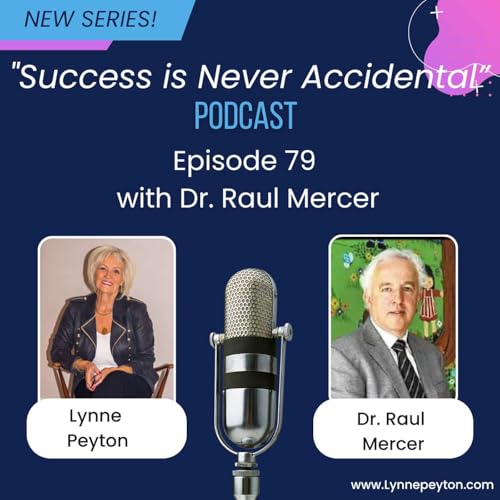
  • Success Is Never Accidental EP 79 - Raul Mercer
    May 11 2026

    I am pleased to share the latest episode of Success Is Never Accidental featuring Dr. Raul Mercer — an internationally respected leader in children’s health, public health policy, and children’s rights.

    Dr. Mercer’s work spans clinical practice, global policy, and academic leadership, with collaborations involving WHO, UNICEF, the Lancet Commission, University College London, and major international child development initiatives.

    In this conversation, we explore:

    • The importance of collective leadership and global collaboration
    • Why effective leaders must think systemically across sectors
    • The role of respect and partnership in driving meaningful change
    • Creating environments that enable wellbeing and innovation
    • Why children’s rights must move beyond policy statements into everyday practice

    This episode offers practical leadership reflections for anyone working in health, education, social care, public policy, or organisational leadership.

    One particularly powerful challenge from Raul:
    Where are children’s voices currently absent in decision-making — and what can we do to change that?

    I hope you find the discussion thought-provoking and valuable.

    Afficher plus Afficher moins
    51 min
  • Success is Never Accidental EP 78
    Apr 27 2026

    I wanted to share the latest episode of Success Is Never Accidental, which was a particularly meaningful one for me.

    Recently I had the opportunity to host a very distinguished ambassador for children’s rights in our studio in Newry, Northern Ireland.

    Dr Ali Shaar is an expert in child health and public health in Palestine and a founder member of the International Network on Peacebuilding among Young Children. His work focuses on shaping national and international policy, actively promoting children’s rights and creating more stable societies.

    Our conversation explores the importance of international collaboration, the need for countries to learn from one another, and the critical role of children as active participants in building peace.


    It is a thoughtful and, at times, challenging discussion, with clear relevance across leadership, policy, and community settings.

    As always, I would value your reflections.


    Afficher plus Afficher moins
    20 min