Épisodes

  • Pluto, The Kuiper Belt & The Gates to Interstellar Space
    Oct 3 2026

    Hey! I'd love to hear your thoughts, send me a voice note.

    Pluto, the Kuiper Belt & The Gates to Interstellar Space | Solar System Odyssey

    Eleven worlds behind us, and now we reach the place where the map itself starts to run out — the edge where "planet" stops being a useful word, and the solar system quietly dissolves into something stranger: a frozen frontier of ice, rock, and forgotten worlds, stretching toward the door out of everything we call home.

    Imagine a world so far from the sun that Pluto takes 248 Earth years to complete a single orbit — meaning it hasn't even finished one full year since its discovery in 1930. A place where sunlight is 1,600 times fainter than on Earth, where the sun itself would look like just an unusually bright star. And yet, against every expectation of a frozen, dead rock, NASA's New Horizons flyby in 2015 revealed mountains of water ice, a heart-shaped nitrogen glacier the size of Texas, and evidence of possible ongoing geological activity — a "dwarf" that refused to be simple.

    Socho — think about it. Pluto was a planet for 76 years, reclassified to a "dwarf planet" in 2006 not because it changed, but because we finally understood the neighborhood it belongs to. It isn't a lonely outlier. It's one resident of an entire unseen district — the Kuiper Belt, a vast ring of icy bodies beyond Neptune, home to hundreds of thousands of objects, including Eris, Makemake, and Haumea, worlds we're only beginning to name.

    This is where the story stops being about individual worlds and starts being about scale itself. Beyond the Kuiper Belt lies the theorized Oort Cloud, a spherical shell of icy debris so distant it may extend nearly a light-year from the sun — almost a quarter of the way to the nearest star. Bingo — somewhere out there, in that cloud, the sun's gravitational grip finally loosens enough for interstellar space to begin. Not a wall. A gradient, fading into the dark.

    Not so fast, though — this frontier still guards genuine unknowns. Is there a hidden "Planet Nine" out there, its gravity subtly bending the orbits of distant Kuiper Belt objects, still unseen by any telescope? Voyager 1, launched in 1977, is the only human-made object to have actually crossed into interstellar space, confirmed in 2012 — and it's still transmitting, a single mechanical voice speaking back to Earth from beyond the boundary this very episode is named for.

    Ancient astronomers had no way to imagine this far — their skies ended at Saturn, the last point of light visible without a telescope. Pluto itself wasn't found by accident, but through decades of mathematical searching for a hypothesized "Planet X," believed responsible for irregularities in Neptune's orbit — until Clyde Tombaugh, in 1930, comparing photographic plates by hand, night after night, finally spotted it moving where nothing should have been.

    Here's the part worth sitting with, at the true edge of this odyssey: everything we've explored across eleven episodes — the scorched first world, the twin gone wrong, the only home, the red hope, the unfinished belt, the giants and their moons, the sideways survivor, the windy sentinel — all of it is still just the sun's own neighborhood. Beyond this point, there is no more "ours." Just the dark between stars, waiting the way it always has, indifferent to whether we ever reach it.

    Read the mind of God, and out here, at the true edge, you'll find the sentence trails off — not because there's nothing more written, but because we haven't traveled far enough yet to read it.

    This is where our solar system ends. It's also where the next question begins.

    Researched and written by me. Voice and visuals produced with AI, so I can go deeper on every world in this series.

    🎧 Episode 12 of Solar System Odyssey — a Fall in Cosmos series. Thank you for falling in cosmos with me, one world at a time.

    Keywords: Pluto explained, Kuiper Belt podcast

    Afficher plus Afficher moins
    25 min
  • Neptune: The Windy Sentinel of Our Solar System
    Sep 30 2026

    Hey! I'd love to hear your thoughts, send me a voice note.

    Neptune: The Windy Sentinel of Our Solar System | Solar System Odyssey

    Ten worlds behind us, and now we reach the very edge of the classical solar system — the last true planet, standing guard nearly 4.5 billion kilometers from the sun. Neptune wasn't discovered by looking up and noticing something out of place. It was discovered by mathematics alone, predicted to exist before anyone ever saw it — a planet found on paper before it was found in the sky.

    Imagine a world so far from the sun that sunlight itself takes over 4 hours to arrive, where noon feels like a deep, permanent twilight — and yet this distant, dim world hosts the fastest winds ever recorded on any planet in the solar system, screaming across its atmosphere at nearly 2,100 kilometers per hour, faster than the speed of sound on Earth. Neptune shouldn't have this much energy to spare. It does anyway.

    Socho — think about it. Uranus's mystery was too little internal heat. Neptune's mystery is the opposite: despite sitting even farther from the sun, it radiates about 2.7 times more energy than it receives, generating a genuine internal heat source that scientists still can't fully explain. Two ice giants, similar in size and composition, behaving like two completely different worlds.

    Neptune wears its violence in constant motion — the Great Dark Spot, a storm system roughly the size of Earth itself, was spotted by Voyager 2 in 1989 and had vanished entirely by the time Hubble looked again just five years later, replaced by new dark spots elsewhere. Bingo — this is a planet where even its storms refuse to sit still long enough to be studied twice.

    Not so fast, though — Neptune still guards one of the strangest relationships in this entire odyssey: Triton, its largest moon, orbits backward, against the direction of Neptune's own rotation, which almost certainly means Triton wasn't born here at all — it was captured, likely a former Kuiper Belt object pulled permanently into Neptune's grip. And Triton itself is active, venting nitrogen geysers across its icy surface, one of the coldest, strangest moons ever observed up close, again, only once, by Voyager 2 in that same single flyby in 1989.

    Ancient skywatchers never saw Neptune at all, not even as a faint point of light — it's invisible to the naked eye entirely. It took Urbain Le Verrier's calculations in 1846, based purely on irregularities in Uranus's orbit, to predict almost exactly where an unseen planet's gravity must be pulling from. Johann Galle pointed a telescope at that precise spot the same night and found Neptune waiting, within one degree of the prediction — mathematics reaching out into the dark and finding a planet before human eyes ever confirmed it was there.

    Here's the part worth sitting with: Neptune is the only planet in this odyssey that humanity reasoned into existence before we ever witnessed it — proof that some truths don't need to be seen first to be real. Sometimes the universe rewards the ones willing to trust the math into the dark, long before the light catches up. Read the mind of God, and here, you'll find it written not in observation, but in the quiet certainty of an equation, solved correctly, pointed at the right patch of sky.

    Researched and written by me. Voice and visuals produced with AI, so I can go deeper on every world in this series.

    🎧 Episode 11 of Solar System Odyssey — a Fall in Cosmos series. Subscribe, and let's fall in cosmos, together.

    Keywords: Neptune planet explained, Solar System Odyssey podcast, Neptune winds fastest, Triton moon backward orbit, Neptune discovery mathematics, Urbain Le Verrier, Great Dark Spot Neptune, Voyager 2 Neptune, ice giant explained, planetary science podcast, astronomy podcast series, space exploration podcast, science and philosophy podcast, astrophysics for beginners

    Afficher plus Afficher moins
    19 min
  • Uranus: The Sideways Giant of Our Solar System.
    Sep 27 2026

    Hey! I'd love to hear your thoughts, send me a voice note.

    Uranus: The Sideways Giant of Our Solar System | Solar System Odyssey

    Nine worlds behind us, and now we reach the one that seems to have given up on the rules everyone else in this odyssey has followed. Every planet we've visited spins more or less upright, like a top standing on a table. Uranus doesn't. It rolls through its 84-year orbit lying almost completely on its side, dragging its rings and moons around with it like a wheel rolling down a hill instead of a top spinning in place.

    Imagine a planet knocked over so violently, early in its life, that it never got back up — most planetary scientists believe a Mars-sized or larger object struck Uranus with such force that it tipped the entire planet roughly 98 degrees off its axis, permanently. One single collision, billions of years ago, still deciding how this world experiences day and night today.

    Socho — think about it. Because of that tilt, Uranus doesn't have seasons the way Earth does. It has 21-year-long periods of unbroken daylight at one pole, followed by 21 years of total darkness at the same pole, and this pattern has been repeating for over four billion years, indifferent to whether anyone was ever there to notice.

    Uranus carries its violence quietly compared to Jupiter's storms or Saturn's speed — it's the coldest planetary atmosphere in the solar system, colder even than Neptune, which sits much farther from the sun. Bingo — that's a genuine mystery hiding in plain sight: Uranus should be warmer than it is, based on its internal heat alone, and nobody fully knows why it isn't.

    Not so fast, though — this "sideways giant" still guards real, unresolved questions. Why does it radiate almost no excess internal heat, unlike every other giant planet in this series? Is there truly a liquid diamond ocean deep in its interior, as some models suggest, formed under pressures that turn carbon into raining gemstones? Voyager 2 remains the only spacecraft to have ever visited Uranus, in a single flyby back in 1986 — everything else we know is inference, waiting on a dedicated mission that hasn't happened yet.

    Ancient skywatchers never saw this world at all — Uranus sits at the very edge of naked-eye visibility, and it took until 1781, and William Herschel's telescope, for anyone to recognize it as a planet rather than a faint, unmoving star. It was the first planet discovered in recorded history rather than known since antiquity — proof that even a solar system we thought was fully mapped could still be hiding something.

    Here's the part worth sitting with: Uranus is what happens when a single violent moment reshapes an entire identity, permanently — and yet it still orbits, still holds its rings, still keeps its 28 moons in tow, sideways and all. Sometimes survival doesn't mean recovering the way you were. Sometimes it means continuing, tilted, and still counting as whole. Read the mind of God, and here, you'll find it written not in balance, but in how completely a system can adapt to imbalance and keep going anyway.

    Researched and written by me. Voice and visuals produced with AI, so I can go deeper on every world in this series.

    🎧 Episode 10 of Solar System Odyssey — a Fall in Cosmos series. Subscribe, and let's fall in cosmos, together.

    Keywords: Uranus planet explained, Solar System Odyssey podcast, Uranus sideways tilt, Uranus rings moons, Voyager 2 Uranus flyby, coldest planet solar system, William Herschel discovery, ice giant explained, planetary science podcast, astronomy podcast series, space exploration podcast, science and philosophy podcast, astrophysics for beginners, planetary geology podcast

    Afficher plus Afficher moins
    22 min
  • Saturn: Crown Jewel of Our Solar System
    Sep 24 2026

    Hey! I'd love to hear your thoughts, send me a voice note.

    Saturn: Crown Jewel of Our Solar System | Solar System Odyssey

    Eight worlds behind us, and now we reach the one every telescope points at first — not because it's the biggest, not because it's the most violent, but because nothing else in the sky looks quite so deliberately beautiful. Saturn wears rings made of a trillion pieces of ice and rock, some no larger than a grain of sand, others the size of a house, all held in place by nothing but physics and patience.

    Imagine a planet so light it would actually float if you dropped it into a bathtub large enough to hold it — Saturn's density is lower than water, the only planet in the solar system that can make that claim. And yet this same "lightweight" world commands a ring system spanning nearly 175,000 miles across, while standing barely a kilometer thick in most places. Scale like that shouldn't make sense. It does anyway.

    Socho — think about it. Those rings aren't ancient leftovers from the solar system's birth, the way we once assumed. Data from the Cassini mission suggests they may be far younger, possibly just 100 million years old — meaning dinosaurs walked the Earth in a solar system where Saturn had no rings at all. What you're picturing when you picture Saturn might be one of the newest features in this entire odyssey, not one of the oldest.

    Saturn doesn't just wear beauty — it hides violence and mystery in equal measure. Winds in its atmosphere reach 1,800 kilometers per hour, and a perfectly hexagonal jet stream churns at its north pole, a six-sided storm pattern that shouldn't exist in nature, yet has persisted for decades. Bingo — sometimes the universe hands us geometry so precise it looks engineered, and it still isn't.

    Not so fast, though — Saturn's real treasures may not be the planet at all, but two of its 146 known moons. Titan, thick with an atmosphere denser than Earth's, holds rivers, lakes, and rain — not of water, but of liquid methane, the only other place in the solar system with stable liquid on its surface. Enceladus, smaller and icier, shoots geysers of water vapor from its south pole into space, hinting at a subsurface ocean that could, right now, hold the conditions for life. NASA's Cassini spacecraft spent 13 years orbiting this system before deliberately diving into Saturn's atmosphere in 2017, ending its mission by becoming part of the very planet it spent over a decade revealing to us.

    Ancient skywatchers saw Saturn without any of this, and still gave it the weight of an entire era — Babylonian astronomers associated it with their god of agriculture and time, Roman astronomers named it after the same, Saturn, father of Jupiter himself in their mythology, the god eventually overthrown by his own son, echoed strangely in the fact that Jupiter, the planet, is more massive than Saturn today. In 1610, Galileo saw something strange around Saturn but lacked the resolution to understand it — he described it as "ears," never realizing he'd become the first human to glimpse rings around another world.

    Here's the part worth sitting with: Saturn is proof that grandeur doesn't require density, violence, or mass to dominate a scene. Sometimes the most commanding presence in a room — or a solar system — is the one that simply understood elegance, and let that be enough. Read the mind of God, and here, you'll find it written in ice, light, and impossibly thin rings holding their shape across a hundred thousand miles.

    Researched and written by me. Voice and visuals produced with AI, so I can go deeper on every world in this series.

    🎧 Episode 9 of Solar System Odyssey — a Fall in Cosmos series. Subscribe, and let's fall in cosmos, together.

    Keywords: Saturn planet explained, Solar System Odyssey podcast, Saturn rings explained, Titan Enceladus moons, Cassini mission Saturn, Saturn hexagon storm, ringed planet facts, ancient astronomy Saturn.

    Afficher plus Afficher moins
    23 min
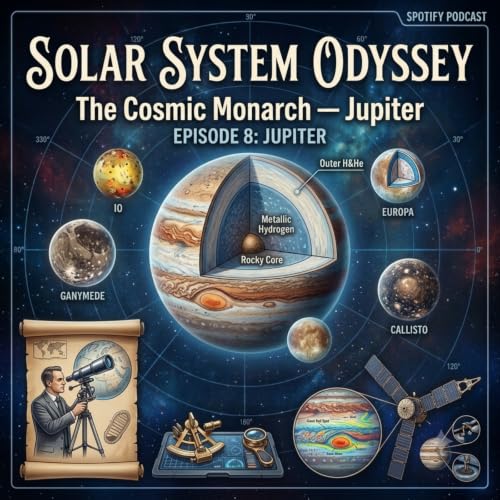
  • Jupiter: Cosmic Monarch of Our Solar System
    Sep 21 2026

    Hey! I'd love to hear your thoughts, send me a voice note.

    Jupiter: The Cosmic Monarch | Solar System Odyssey

    Seven worlds behind us, and now we reach the one that almost wasn't a planet at all. Jupiter isn't just the largest world in our solar system — it's more massive than every other planet combined, twice over. If it had gathered just a little more mass during formation, it might have ignited into a second, smaller sun. Instead, it became something almost as commanding: a king that never quite claimed the throne.

    Imagine a storm larger than Earth itself, raging continuously for at least 190 years, with winds tearing across it at 640 kilometers per hour — the Great Red Spot isn't weather in any sense we experience. It's a permanent scar of violence, older than most nations on this planet, still spinning.

    Think about it — every planet before this one, we could imagine standing on. Not this one. Jupiter has no true surface at all. Descend far enough and the atmosphere doesn't end, it just thickens into a churning ocean of metallic hydrogen, under pressure so extreme that hydrogen itself starts behaving like a liquid metal, generating the most powerful magnetic field of any planet in the solar system.

    Jupiter doesn't just dominate through size — it dominates through gravity itself. It's the reason the asteroid belt never finished becoming a planet, the reason countless comets have been flung out of the solar system entirely, and the reason others, like Shoemaker-Levy 9 in 1994, were pulled in and torn apart on impact, live, in front of our own telescopes. That's not a metaphor for power. That's power, demonstrated.

    And yet Jupiter's real treasures aren't the planet itself — they're the 95 known moons orbiting it. Europa, hiding a liquid ocean beneath its icy shell, possibly more water than every ocean on Earth combined. Io, the most volcanically active body in the entire solar system, its surface repainted by eruptions faster than any geologist can map it. This isn't a planet. It's practically a solar system of its own, held in orbit around one dominant king.

    Here's what science still hasn't fully answered: what's actually happening at Jupiter's core. Does it even have a solid core at all, or does rock dissolve into that metallic hydrogen ocean entirely? NASA's Juno mission has been diving closer to Jupiter than any spacecraft before it specifically to find out — and every pass sends back data that complicates the picture further, rather than simplifying it.

    Ancient skywatchers had no telescopes, no way to see the storms or moons — yet they still recognized something commanding in that steady, bright wanderer. Babylonian astronomers associated it with their king of gods, Marduk. Roman astronomers named it after the king of their own pantheon, Jupiter — a name that's outlasted the empire that gave it. And in 1610, Galileo pointed a primitive telescope at it and discovered four moons orbiting another world for the first time in human history — a single observation that helped dismantle the idea that everything in the universe circled Earth.

    Here's the part worth sitting with: Jupiter never became a star, never had the mass to ignite. It spent 4.6 billion years as close to that threshold as any planet ever gets, and stayed a planet anyway. Sometimes the most powerful thing in a system isn't the one that burns brightest — it's the one whose gravity quietly shapes everything else without needing to.

    Researched and written by me. Voice and visuals produced with AI, so I can go deeper on every world in this series.

    🎧 Episode 8 of Solar System Odyssey — a Fall in Cosmos series. Subscribe, and let's fall in cosmos, together.

    Keywords: Jupiter planet explained, Solar System Odyssey podcast, Great Red Spot, Jupiter moons Europa Io, Juno mission NASA, largest planet solar system, Jupiter magnetic field, gas giant explained.

    Afficher plus Afficher moins
    23 min
  • The Asteroid Belt: The Untold Story of scattered Debris.
    Sep 18 2026

    Hey! I'd love to hear your thoughts, send me a voice note.

    The Asteroid Belt: The Untold Story of scattered Debris.

    Six worlds in, and we finally reach the gap — the wide, rubble-strewn stretch between Mars and Jupiter that most solar system tours skip past entirely, as if it's empty space between the "real" planets. It isn't empty. It's a graveyard, a nursery, and an untold origin story, all scattered across millions of fragments no one bothered to name.

    Imagine a region containing over a million known asteroids, ranging from house-sized boulders to Ceres, a dwarf planet large enough to be round under its own gravity — and yet, if you gathered every single object in the entire belt together, it would still add up to less than 4% of the mass of our own Moon. This isn't a destroyed planet, despite what science fiction loves to claim. It's a planet that never got the chance to form at all.

    Socho — think about it. Every asteroid out there is a fossil, a piece of the original disk of dust and gas that built Mercury, Venus, Earth, and Mars, except frozen in its unfinished state — because Jupiter's gravity kept stirring the region too violently for these fragments to ever come together into a world.

    The belt isn't as crowded as movies make it look, but it isn't gentle either. Vesta carries a crater so massive it blasted off enough material to seed a whole family of meteorites that have landed on Earth. Ceres hides bright salt deposits and possibly a subsurface layer of brine, making it one of the more surprising ocean-world candidates in the entire solar system. Bingo — a "leftover" region turning out to hold some of the most chemically interesting real estate we've found.

    Not so fast, though — the asteroid belt still holds an uncomfortable, active mystery: which of these fragments are on a path that eventually crosses Earth's orbit. NASA's DART mission already proved in 2022 that we can physically alter an asteroid's trajectory by slamming a spacecraft into it — turning the ancient threat of impact into, for the first time in our species' history, a problem with an actual engineering solution.

    Ancient skywatchers had no idea this belt existed — the first asteroid, Ceres, wasn't even discovered until 1801, by Giuseppe Piazzi, initially mistaken for a new planet entirely. But the deeper irony is older: astronomers for centuries assumed there simply had to be a "missing planet" in that gap, following the neat mathematical pattern of planetary spacing known as the Titius-Bode law — and in a strange way, they were right that something belonged there. It just never finished becoming one.

    Here's the part worth sitting with: the asteroid belt is proof that not every beginning gets to become something whole — and that "unfinished" doesn't mean "meaningless." These fragments carry the rawest, least-altered material from the solar system's birth, more chemically pristine in some ways than the planets that succeeded. Sometimes the untold stories carry the oldest truths. Read the mind of God, and here, you'll find it written in rubble, not in worlds.

    The asteroid belt isn't a gap between planets. It's the origin story none of the planets got to finish telling.

    🎧 Episode 7 of Solar System Odyssey — a Fall in Cosmos series. Subscribe to journey through the solar system, one world at a time.

    Keywords: asteroid belt explained, Solar System Odyssey podcast, Ceres dwarf planet, Vesta asteroid, DART mission NASA, asteroid impact threat, Titius-Bode law, planetary science podcast, astronomy podcast series, space exploration podcast, history of asteroid discovery, near Earth asteroids, astrophysics for beginners, science and philosophy podcast, planetary geology podcast

    Afficher plus Afficher moins
    22 min
  • Mars: Ancient Water & The Search for Past Life
    Sep 16 2026

    Hey! I'd love to hear your thoughts, send me a voice note.

    Mars: Ancient Water & The Search for Past Life | Solar System Odyssey

    Five worlds in, and this is the one humanity keeps returning to — not because Mars is beautiful, or forgiving, but because it might once have been us. A world that could have had oceans, rivers, and rain, now reduced to red dust and silence. Mars isn't just the next planet in this odyssey. It's the closest thing we have to a mirror of a road not taken.

    Imagine standing on a surface carved by ancient river deltas and dried lakebeds, on a planet that today can't hold liquid water on its surface at all. Mars once had an atmosphere thick enough to keep water flowing — and lost most of it to space, stripped away when the planet's magnetic field shut down and the solar wind was finally let in, unopposed.

    Socho — think about it. Somewhere under that dust are minerals that only form in water, sediment layers laid down by rivers that no longer exist, and rocks that may be holding a four-billion-year-old record of a habitable world we arrived at just a little too late to see alive.

    Mars wears its history in layers, almost like a diary. Olympus Mons, the largest volcano in the entire solar system, nearly three times the height of Everest. Valles Marineris, a canyon system so vast it would stretch across the continental United States. Bingo — this is a planet that didn't just have water once. It had geology violent and grand enough to rival anything Earth has ever produced.

    Not so fast, though — the biggest question about Mars still has no answer. Did life ever actually start here? NASA's Perseverance rover is right now caching rock samples in Jezero Crater — an ancient river delta — specifically so a future mission can bring them back to Earth and settle the question directly. We're not guessing anymore. We're collecting the evidence.

    Ancient skywatchers saw Mars differently, but were drawn to the same thing we are now — its unmistakable red glow. Babylonian astronomers tracked it as an omen tied to war and conflict, Egyptian priests called it "Her Desher," the red one, and Greek and Roman astronomers eventually named it after their god of war. None of them knew they were looking at a planet that might once have looked like home.

    Here's the part worth sitting with: Mars may be the only place in the solar system where we get to ask "what if" and actually go find out. Not a hypothetical. A real search, happening right now, in real rock, on a real planet. If we ever find that life started twice in one solar system, everything we think we know about how rare we are changes overnight. Read the mind of God, and on Mars, we may finally get to check our answer.

    Mars isn't just the red planet. It's the question our entire species is currently trying to answer — did water, once, mean life here too?

    🎧 Episode 6 of Solar System Odyssey — a Fall in Cosmos series. Subscribe to journey through the solar system, one world at a time.

    Keywords: Mars planet explained, Solar System Odyssey podcast, Mars ancient water, search for life on Mars, Perseverance rover Jezero Crater, Mars atmosphere loss, Olympus Mons Valles Marineris, planetary science podcast, astronomy podcast series, space exploration podcast, ancient astronomy history, astrobiology Mars, Mars sample return mission, astrophysics for beginners, science and philosophy podcast, planetary geology podcast

    Afficher plus Afficher moins
    21 min
  • Earth: Our Only Home
    Sep 13 2026

    Hey! I'd love to hear your thoughts, send me a voice note.

    Earth: Our Only Home | Solar System Odyssey

    Four planets in, and we finally arrive somewhere we don't need a spacecraft to explore. After Mercury's scars and Venus's fury, Earth should feel ordinary by comparison. It isn't. Out of every world in this series — every world we know of, anywhere — this is the only one where the story doesn't end in silence.

    Imagine a planet sitting in exactly the right band of distance from its star, where water can exist as liquid instead of vanishing into vapor or locking into ice. Not too close to burn like Venus. Not too far to freeze like Mars. A margin so narrow it's almost uncomfortable to think about — and somehow, we landed right inside it.

    Socho — think about it. Every ocean, every breath of oxygen, every heartbeat happening on this planet right now exists because of a habitable zone a few million kilometers wide, in a galaxy that stretches a hundred thousand light-years across. That's not just luck. That's a thread this thin holding up everything we are.

    Earth carries its own violent history too, just better hidden under green and blue. A molten birth. A collision with a Mars-sized world that likely tore off the material that became our Moon — a wound that gave us tides, stabilized our tilt, and made complex life possible at all. Bingo — the same kind of impact that scarred Mercury and resurfaced Venus is the reason Earth has seasons and a night sky worth watching.

    Not so fast, though — Earth guards its own unresolved mystery, the biggest one in this entire series: how did chemistry become biology? We can trace plate tectonics, magnetic fields, and atmospheric evolution in remarkable detail, but the exact moment non-living matter crossed into life remains one of science's deepest open questions — one missions to Mars and icy moons like Europa are partly designed to help us understand, by searching for how it might have happened elsewhere too.

    Every ancient culture that ever looked up was really just Earth trying to understand itself — Vedic astronomers mapping cycles of sun and season, Egyptian priests aligning temples to solstices, Polynesian navigators reading stars to cross entire oceans without instruments. Long before satellites, humanity was already doing what this series does: trying to place one small world in context against everything above it.

    Here's the part worth sitting with: of every planet and moon we've studied, sent probes to, or dreamed about, this is still the only one where the story has narrators. Mercury can't wonder about itself. Venus can't ask why it turned out the way it did. We can. Read the mind of God, and for now, you'll only find it written in one place — here.

    Earth isn't just another stop in this odyssey. It's the reason there's an odyssey at all — the only world we've found that looked back up and started asking questions.

    🎧 Episode 5 of Solar System Odyssey — a Fall in Cosmos series. Subscribe to journey through the solar system, one world at a time.

    Keywords: Earth planet explained, Solar System Odyssey podcast, habitable zone explained, Earth Moon formation, giant impact hypothesis, origin of life on Earth, planetary science podcast, astronomy podcast series, space exploration podcast, ancient astronomy history, plate tectonics Earth, Earth magnetic field, astrobiology podcast, astrophysics for beginners, science and philosophy podcast, planetary geology podcast

    Afficher plus Afficher moins
    21 min