Épisodes

  • A Public Relations Podcast: Smoke Signal - Measurement Month with Mark Weiner: Begin Simply, Simply Begin
    Nov 8 2023

    It is PR Measurement Month! This year, we speak renowned measurement leader and author Mark Weiner. Here’s a bit about Mark to set the scene: 

    • His latest book PR Technology, Data and Insights was named one of the top three PR books for 2022. 
    • He is a member of the exclusive Arthur Page Society
    • The Institute for Public Relations  awarded him Lifetime Achievement Award in 2018
    • He is a member of the PR News all of Fame

    This year our theme builds on the Public Relations Institute of Australia 2023 Conference theme Ignite to Spark. For Mark his ‘spark’ in many ways came down to a sign he saw outside a coffee shop in California – Begin Simply, Simply Begin. This neatly frames Mark’s advice on measurement and evaluation of PR: there are so many obstacles and challenges but begin simply, simply begin and learn as you go.

    For Mark, the key to proving the value of PR is to understand the priorities and preferences of the people who make the budgeting decisions and from there identifying what metrics matter. 

    Often, communicators assume they know what the executive want without asking them directly. Mark puts it like this: “You are three quarters of the way home if you negotiate properly, understand what is meaningful to them, what is measurable and what is reasonable Once you have that you eliminate a lot of obstacles and traps.”

    Mark talks through how using a marketing mix model, bringing in data from all disciplines, can be the way to talk the language of business. In Mark’s experience, advertising gets 70% of the budget and delivers approximately $1.10 in terms of sales; price promotion gets 28% and these loses 25 cents on the dollar; PR gets the remaining 2% of budget and delivers $8 on every dollar. Where is the PR for that! 

    One of the symptoms of not properly measuring is that PR hasn’t earned the trust of executives in the C Suite. And if you’re ever asked about the value of PR again, here’s a quote to shoot back across the boardroom table:

    “PR is the only form of marketing communication that lifts all boats. So when PR, when earned media coverage in particular, is positive and prominent, sales are easier and advertising works better. And the alternate is true, when the news is prominent and negative, it creates harm.”

    Afficher plus Afficher moins
    40 min
  • A Public Relations Podcast: Smoke Signal - Communicating your ESG narrative
    Sep 20 2023

    In this episode I am joined by Dan Wilcock, Sustainability and Governance Manager for the UN Global Compact Network Australia.

    The UN Global Compact Network may be the biggest movement you haven't heard of. 

    A special initiative initially set up by then UN Secretary General, Kofi Annan, it is a call to companies everywhere to align their operations and strategies with 10 universal principles in the areas of human rights, labour, environment, and anti-corruption, and take action in support of the UN Sustainable Development Goals.

    With more than 18,000 companies across 160 countries, it is the world's largest corporate sustainability initiative. 

    In this discussion we take a dive into all the different terms out there - greenwashing, bluewashing, whitewashing,  green hushing – and what they really mean for PR and comms professionals.

    Dan wraps all these terms up into the neat package of ESG-washing and says the reason we are seeing more of this now is that there has been a real increase in appetite for ESG information and that is coming from every direction – customers, employees, boards, supply chain partners, finance providers – all these groups now have an active interest in what a business is doing on ESG. 

    This has been accompanied by a rise of misinformation. An online sweep or corporate websites by ACCC put it at more than half of businesses had made concerning claims about their environmental credentials. For Dan there’s a spectrum from puffery through to outright fabrication, with the majority being sloppiness and hyperbole – which doesn’t excuse it. 

    The UN Global Compact Network just completed a series of consultations with the Australian business community on ESG which found:

    • We’re in a transition period, there is a lot happening very fast. Businesses need to upskill and likely mistakes will be made.
    • Businesses are consumers too. A third of businesses they spoke to had also fallen victim to greenwashing
    • Reporting and disclosure is very much in flux – there’s a way to go for organisations to streamline data gathering, and delivery of the right narrative
    • 93 percent of our respondents said green hushing had been considered as a potential approach as a result of the attention that it's getting right now.
    • The business community is looking for more detailed guidance from regulators. (Check this guidance from ACCC giving eight principles for trustworthy environmental and sustainability claims)

    For Dan it is about developing a bit of confidence, closing the capacity gap and being informed - businesses should not fear regulatory action from making legitimate and truthful environmental and sustainability claims.

    And why does all this matter? Because business will only get harder for companies that aren't aware of their impact and aren't transparent about their impact.

    Afficher plus Afficher moins
    25 min
  • A Public Relations Podcast: Smoke Signal - The Rise and Rise of Martech
    Jun 18 2023

    In this episode of Smoke Signal, I am joined by Scott Brinker, a.k.a Chief Martech, author of the Marketing Technology Landscape Supergraphic. 

    Scott is in the envious position where is hobby and passion has become his career and vice versa. 

    First launched in 2011 with 150 tools, the latest 2023 version, released last month, featured an unbelievable 11,038 tools and technologies. 

    This exponential rise in Martech is mirrored in Commtech.

    “Everything that marketing does is now connected or driven or powered some way by something digital but that was not always the case,” Scott says. “Back in the day, even senior marketing executives we're highly dubious about tech.  

    “That is where the Martech Map was conceived, to show marketers the range of different software that was probably already being used in their organisation… and there’s a lot of them.”

    Scott sees both supply and demand factors leading to this significant growth over the years. 

    “Technology has essentially have lowered the barriers to entry. If someone has an idea for what they believe is going be a valuable software tool for marketers, they can get into the market with it. 

    “But there's the other side of this too. I can't think of any other profession that has gone through so much change and so much expansion of scope over this past decade… So marketers as a result, are always open to  technology that's going to help.

    “There's this symbiosis where there are lots of Marchech startups a year to tackle these new challenges, and a lot of demand among marketers to figure out how do we how do we do this.

    It is not a podcast in 2023 without speaking about AI. So what impact with AI have on this Martech Map?

    “It is  going to be incredibly disruptive to the existing Martech Map because I do think  a lot of things are going to change. One of the things AI is doing in the software world is yet another thing to dramatically reduce the barrier to entry. 

    “Generally, I do not know. I am absolutely fascinated to see how this plays out. But I feel pretty confident it's going to be a lot of change in this industry.”


    Afficher plus Afficher moins
    24 min
  • A Public Relations Podcast: Smoke Signal - The tech-revolution in PR
    Apr 5 2023

    PR Futurist Stuart Bruce features in this episode of Smoke Signal Podcast, sharing his insight on how tech is impacting the practice of public relations.

    Regardless of what you call it - CommTech, CommsTech, PRTech, one thing is clear, technology is impacting the practice of public relations at an exponential rate. Whether it is to enhance, augment, make us more efficient, there seems to be an app, website or tool for every aspect of our role.

    The challenge we face though, as Stuart points out, is that PR professionals are notoriously slow at embracing technology. There is a list of examples - blogs, social media, SEO – where we’ve been late to the party.

    Referencing a quote from long-serving Microsoft communication professional Tom Murphy, at a conference at which Stuart was in the audience: “PR people don’t need to worry about big data because they haven’t even mastered small data yet.” That was circa 2005 and for Stuart believes it is still very much true today.

    Stuart gives listeners a first exclusive insight into a yet-to-be-released global survey his firm Purposeful Relations has just completed into attitudes of PR people to tech. It finds around 40% of people are using excel to manage contacts = further evidence PR people don’t embrace tech.

    Talk about CommTech naturally falls into discussing AI and the launch of ChatGPT which has brought the role of technology in PR to the fore. Stuart is astounded by the varying degree of different attitudes when it comes to AI with some at a peak of inflated expectations and others in a trough of disillusionment (citing the ICCO survey that found 25% of PR leaders say they will never use AI).

    While ChatGPT has been grabbing the headlines, looking forward, Stuart is most excited about the launch of Microsoft Copilot – the integration of AI into the day-to-day tools we are all using presents a phenomenal opportunity for PR professionals… The flip side of that is if you look at how most people us Word, PowerPoint or Excel, they can’t even use the basic features.

    The challenge (and opportunity) for PR professionals is two-fold: using CommTech and AI to improve what you are doing – make it faster, better, easier; and on the others side it is really understanding the ethical implications  and being knowledgeable enough to advise your organisation on where and how to use AI. Here, Stuart suggests taking a look at the Aletheia Framework which was developed by Rolls Royce as an open-source toolkit for assessing ethical issues and trustworthiness in using AI within an organisation.

    As a PR futurist, Stuart knows it is way too difficult to predict the future. Especially in the case of AI which, as Bill Gates says in this letter, is as big an innovation as the personal computer, the Internet, and the mobile phone. But what he does know is that as PR professionals we need to stay up to date, we have to experiment, and we must keep an open mind about doing things differently. 

    Afficher plus Afficher moins
    31 min
  • A Public Relations Podcast: Smoke Signal - AI in PR
    Feb 1 2023

    It is only February and it almost feels like we can already call it – 2023 will be the year of AI.

    It has been impossible not to get caught up in the ChatGPT tsunami that has made headlines, swamped social media feeds and seemingly replaced the weather as the most popular piece of small talk before meetings.

    Not to add to the deluge, but rather to cut through the hype and the noise, in this episode I speak to UK based digital and data PR expert Andrew Bruce Smith.

    Andrew is Chair of the UK’s Chartered Institute of Public Relations AI in PR Panel and in this episode he tells us that in the past two months there’s been over a quarter of a million media articles on ChatGPT globally and over five million social media impressions. It certainly has certainly enjoyed a charmed PR run.

    AI has been the next big thing for the last decade. And on November 30 last year that actually came true, literally overnight, with the launch of ChatGPT. PR and comms professionals have been obsessed by how ChatGPT can write but Andrew explains the use cases go far beyond content – it can be a media trainer, plan crisis comms scenarios or be our research assistant.

    And while it has captured the headlines and made everyone pay attention, Andrew is quick to point out that ChatGPT is just one of a universe of AI tools that have the potential to transform the role of PR and communications. He recommends practitioners check out https://futuretools.io/ - a free online searchable database of AI tools to help you explore the many different AI tools that may be of use in your role.

    Andrew makes a point that seems to have been missed in the noise surrounding ChatGPT. If we truly believe PR is not just about communication, that is, not just what organisations say, but more importantly what organisations do, then the role of the PR professional in this AI world is two-fold: we need to understand the opportunity for using these tools in our role as communicators, and also, perhaps more importantly, the reputational, moral and ethical implications for organisations using these technologies.

    While welcoming the introduction of ChatGPT as marking the democratisation of AI. Andrew is also quick to caution about the ethical challenges, warning that it is clear all these amazing technologies can be good or bad with the ease at which misinformation and disinformation can be weaponised being quite scary.

    Will AI transform PR, and our organisations, or just be another tool in the kit bag of PR professionals? Andrew gives shares his views in what no doubt will be an ongoing discussion and debate for a long time to come 

    Afficher plus Afficher moins
    44 min
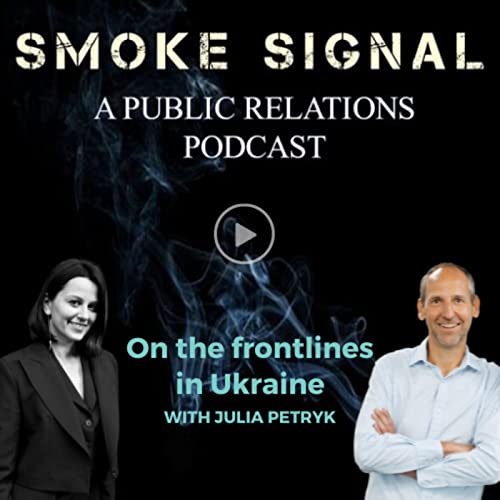
  • A Public Relations Podcast: Smoke Signal - On the frontlines in Ukraine: Communicating under the fog of war
    Dec 13 2022

    Most PR practitioners are used to managing issues. In fact, many thrive most when they are in the midst of a major crisis. But what about war? That is the situation that has faced Julia Petryk, Head of PR at MacPaw, since Russia invaded Ukraine at the start of 2022.

    MacPaw, is a software development company that has apps installed on one in every 5 Mac computers worldwide.  It has 30 million users and 500 staff with its headquarters being in Kyiv, Ukraine.

    “PR as a business function is so critical and when you’re facing difficulties like a war it is becomes so obvious…. I would like to inspire others –even though they may not work under such stressful conditions - that PR does matter.” 

    Creating the PR Army

    The Ukrainian PR Army was formed on day one of the invasion with the single aim of using our weapon for fighting for truth – the word. Since then it has been fighting against Russian propaganda, fighting misinformation and fighting for truth.

    “With the PR Army we found the most effective way of fighting for truth is by giving access to the truth – through eyewitnesses, and through experts.”

    Working from the bathtub

    During air raid attacks, Ukrainians are advised to go to a bomb shelter. If it is not possible then they work in hallways or bathrooms – as they don’t have windows.

    To bring much deserved attention to this stark reality faced by Ukrainians today a mock creative agency has been created - Bathtub Creative as a communication campaign to raise awareness and funds.

    The power of purpose

    Julia is working under such stressful conditions yet maintains motivated to do so much because of an underlying alignment of purpose in what she is doing.

    “I am doing everything that I do for my very selfish goal that my grandchildren have the option to live in Ukraine. I want to preserve my country for future generations for the future. It really drives me and gives me so much energy.”

    How can we help? 

    Julia calls any and all help appreciated. She urges people to check out the Ukrainian PR Army and the Bathtub Creative website, visit the MacPaw Foundation and if you can donate time, expertise, money – resources are desperately needed.

    And here is a very heartfelt thank you from the people of Ukraine https://www.youtube.com/watch?app=desktop&v=PqYSGrGz6HU 

    Afficher plus Afficher moins
    48 min
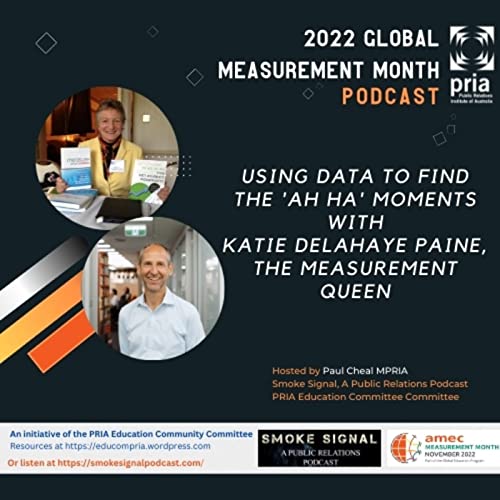
  • A Public Relations Podcast: Smoke Signal - Measurement Month with Katie Paine: Using data to find the 'aha' moments
    Nov 13 2022

    It is November so that means one thing – it is AMEC Measurement Month. In conjunction with The Public Relations Institute of Australia this episode features an in-depth discussion with measurement pioneer, Katie Paine.

    This year’s Measurement Month theme is Measure What Matters.

    Katie coincidentally wrote a book by that same title way back in 2011 and says what matters today as a communication professional is that you are making a difference to the bottom line in a way that senior leadership expects you to contribute. That doesn’t necessarily mean making a sale, it may be increasing credibility or increasing trust.
     
    The big ah ha moment that set Katie on her lifelong measurement journey was the realisation that communication people speak in words and everyone else speaks in numbers; so our job is to translate it.

    How do we do that? Katie suggests starting with something concrete. A product launch, an event, something that has a specific measurable goal, and a project you can carve out and measure the impact of communication on the business goals. A week before the launch, sign up for a free trial of a media listening tool, use Google Forms to do a survey right before and right after the initiative.  Measure something very discrete and concrete that doesn’t take a long time to set up. Show those to metrics to senior leadership and you will get funded for your next project.

    The good news today, according to Katie, is that measurement is much more sophisticated with the combination of media analysis, survey research, web analytics, social analytics coming together in an integrated dashboard where practitioners able to show how they are doing relative to the organisational objectives. Check out The Communication Dividend as an Australian innovation doing just this.

    Listen to this podcast even if your eyes glaze over at the thought of measurement as Katie has a great turn of phrase. Here’s a few of my favourite from our chat:

    • Measurement is the vaccine for the stupid stuff - the advantage of having measures of success based on goals and objectives is that you can say this decision gets made based on our business objectives;
    • Analyse your data from the worst to the best - you find out more from failure than you do from success so be sure to find out what didn’t work;
    • The problem with AVEs or impression is they give big numbers that confuse the c-suite…  they are like sperm, lots of them out there but very few of them do what they are intended to do;
    • I think the biggest mistake PR people have done with measurement is saying look how well I have done and insisting on all the charts going up and to the right;
    • Don’t tell people what you think they want to hear, tell them what they need to hear. Do it in a way that cuts through all the charts and number. You are storytellers, tell a story with the data.


    After three decades writing and speaking on measurement and evaluation, Katie hopes that we can start to spend less time worrying about how to set up and do measurement and more time actually using the data to find insight and give better advice. The problem in the past was getting the data, today there is no shortage of data, there is a shortage of insights. Practitioners need to dive into the data to find the ‘ah ha’ moments.

    Afficher plus Afficher moins
    41 min
  • A Public Relations Podcast: Smoke Signal Episode 38 - It is time to call BS: spin has no place in being green
    Oct 2 2022

    In this episode of Smoke Signal I continue to take a deep dive into climate communications. I am joined by Belinda Noble, who is President and Founder of Comms Declare – an Australian coalition across the communication, marketing, media and advertising sectors united to drive positive climate action.

    “Comms Declare wants marcomms to be respected and trusted... We want people’s talents to be used to promote solutions that make the world a better place… Our end game is to make fossil fuels as socially unacceptable as tobacco” - Belinda Noble, Founder Comms Declare  

    Belinda first took up arms against the role of PR and communications in promoting fossil fuel clients post the Black Friday Bushfires in 2019. She decided it was time for action and founded Comms Declare which today is very much part of a global push to call out the PR, marketing and advertising  sectors for their role in helping shape the climate change debate. 

    The focus on the PR sector in particular has gained significant momentum over the past year:

    • Edelman – the world’s largest independent PR agency - handed a petition at the time of COP26 calling on it to resign all fossil fuel clients 
    • A US Congressional hearing was held earlier this year into the role of public relations firms in preventing climate action with an accompanying a report detailing "deceptive" and "misleading" tactics they use for their client campaigns. 
    • And just in recent weeks the UN Secretary General Antonio Guterres used a speech at the UN General Assembly in New York to call out the “public relations machine raking in billions to shield the fossil fuel industry from scrutiny” 

    Comms Declare recently released a report that quantified the impact of the PR, comms and advertising industry on climate change. The F-List named GRACosway as the PR/Lobbyist agency responsible for the highest volume of scope 3 emissions – that is the emissions of their clients, which include the likes of Santos, BHP, and Glencore – totalling 20,612,667 tonnes of CO2 equivalent  which is on par with Kenya.

    In this discussion, we discuss one of the key issues and challenges for PR practitioners – greenwashing: that is providing misleading, or outright false, information about the impact a company is having on the environment. Comms Declare is tackling that head on and calling out culprits such as: Santos which is currently being taken to court to prove its claims to be reaching net zero by 2040; Ampol for claiming to offer a carbon neutral fuel; and Glencore’s recent brand campaign titled “Advancing Everyday Life” - which Belinda explains is co-opting all the imagery of the renewable industry but does not mention their main commodity, coal – as just a few of the many examples So we would see that as greenwashing as well.

    “When it comes to green claims, and particularly emissions, which is so serious and the implications of inaction are so hideous and almost can’t be contemplated  to be leaving out half the picture and putting yourself forward as an environmentally friendly company I would say is quite a misrepresentation of the facts... No one is perfect and no one is expecting perfection but if you say you are going to hit net zero you better."

    Afficher plus Afficher moins
    20 min