Épisodes

  • Building the Coalition After Next at the Speed of Machine | Maj Gen John Howard MNZM, NZDF(Ret)
    Nov 2 2026

    What does intelligence look like in a world of accelerating threats, geopolitical instability and information overload?

    In this episode of Siren Investigates, Siren CEO John Randles sits down with Major General John Howard, John Howard, MNZM, former NZDF Chief of Defence Intelligence and former Deputy Director for Commonwealth Integration at the DIA, whose career spans more than four decades across military operations, strategic planning and defence intelligence. His roles included Chief of Defence Intelligence for New Zealand and Deputy Director for Commonwealth Integration at the US Defense Intelligence Agency.

    Their conversation explores the changing nature of conflict and the growing challenge of making good decisions when events, information and technology are moving faster than ever.

    Major General Howard discusses the risk of an“escalation spiral”, the search for pathways towards de-escalation, and why the effects of conflict can continue through global energy, trade and supply chains long after the immediate crisis. As he puts it,“nothing happens in isolation.”

    The discussion also explores how open-source intelligence (OSINT) is transforming intelligence gathering, the importance of finding faint signals before they become obvious threats, and why intelligence-led thinking has relevance far beyond defence and national security.

    They discuss:

    AI and intelligence analysis at the “speed of machine”

    Escalation, de-escalation and the interconnected nature of modern conflict

    Moving from data to actionable intelligence

    The growing strategic importance of OSINT

    Finding faint signals in increasingly complex information environments

    Intelligence tradecraft, trust and analytical confidence

    The danger of groupthink and confirmation bias

    Why analytical diversity matters

    Bringing intelligence-led decision-making into the boardroom

    Why leaders need to plan rather than simply react to the next crisis

    And one message runs throughout the conversation:

    “Hope is not a strategy.”

    For Major General Howard, the plan itself is not necessarily the most important thing. It is the planning that matters, because planning gives organisations the ability to adapt, shift resources and respond as circumstances change.

    Siren Investigates explores how intelligence, investigation and technology can help keep people, assets and networks safe.

    #SirenInvestigates #OSINT #Intelligence #NationalSecurity #ArtificialIntelligence #Geopolitics #OpenSourceIntelligence

    Afficher plus Afficher moins
    53 min
  • Food and the Fight for Global Security
    Oct 15 2026

    What is food fraud, and why should it be considered a global security issue?

    In this episode of Siren Investigates, we explore the hidden world of food fraud and the vulnerabilities that exist across global food and agricultural value chains, from fraudulent seafood and honey to the manipulation of provenance, documentation and supply routes. The discussion examines why food fraud is far more than mislabelling, and how it can intersect with organised crime, financial crime, human trafficking and wider security risks.

    The conversation also looks at the challenge of tracing goods from farm to fork, particularly where products pass through multiple producers, intermediaries, processors, brokers, ports and countries before reaching consumers. The episode explores how weaknesses in traceability can create opportunities for fraudulent goods to enter legitimate supply chains.

    A major theme is the role technology could play in creating greater trust.

    The discussion considers blockchain and distributed ledger technology, digital identity and what the guest describes through the law-enforcement concept of a“chain of custody” for goods. Rather than simply making information public, the episode explores the idea of “translucency”, where information is available to authorised parties when deeper investigation or verification is required.

    The episode also explores where Siren can contribute: helping investigators bring different datasets together to uncover relationships and anomalies that may not be visible within individual systems. The conversation discusses connecting supply-chain data with information about companies, directors, financial relationships, commodity trading and other sources to build a much fuller picture of potentially transnational networks.

    Afficher plus Afficher moins
    56 min
  • The Man Who Changed Police Technology
    Aug 4 2026

    What does it take to change policing technology forever?

    In this episode of Siren Investigates, host John Randles sits down with Bob Griffin—founder of Coplink, former CEO of IBM i2, former CEO of Ayasdi (now SymphonyAI Sensa), and Chairman of Siren.He has served with organizations such as the Intelligence and National Security Alliance (INSA), the National Cyber Forensics and Training Alliance (NCFTA), and other public safety and national security initiatives.

    Few people have had a greater influence on modern intelligence and law enforcement technology. Throughout his career, Bob has helped shape the platforms that investigators rely on to connect data, uncover criminal networks, and protect communities around the world.

    Together, John and Bob explore:

    - Why information sharing became one of the biggest challenges in policing?

    - The lessons learned from major investigations and global events

    - The role of AI in modern investigations—and why AI should support human judgement, not replace it

    - How technology can deliver true situational awareness for investigators?

    - Why Bob chose to join Siren as Chairman and invest in the company's vision for the future of investigations?

    Bob also shares the moment he first saw Siren's technology and realised it represented the vision he had been pursuing throughout his career.

    Whether you're in law enforcement, intelligence, public safety, defence, cybersecurity, fraud investigations, or simply interested in the future of AI-powered investigations, this episode offers rare insight from one of the industry's most influential leaders.

    Subscribe for more conversations with the people shaping the future of investigations and intelligence technology.

    Afficher plus Afficher moins
    46 min
  • Siren Investigates Building The Internet in Space 👨‍🚀👨‍🚀⭐🪐
    May 29 2026

    In this episode of the Siren Investigates Podcast, John Randles, CEO of Siren, sits down with John Mackey, CEO of MBryonics and Ruth Mackey CISO, to explore how an Irish deep-tech company is helping shape the future of global communications, space infrastructure and security.

    Broadcasting from Galway, the conversation dives into the origins of MBryonics, a pioneering company developing optical and photonic communication systems for space-based networks. From adaptive optics research at the University of Galway to winning advanced communications programs with DARPA and the European Space Agency, the Mackey siblings share the remarkable journey of building a globally significant space-tech company from the West of Ireland.

    The discussion explores the rise of optical satellite communications, the race to create an “internet of space,” Europe’s growing focus on dual-use technologies and how AI, photonics, and secure communications are reshaping both commercial and defense infrastructure.

    The episode also examines:

    🪐 The convergence of AI, satellite intelligence, and global connectivity

    🪐 Ireland’s opportunity to become a strategic player in the European space economy

    🪐 The realities of building sovereign manufacturing and supply chain resilience

    🪐 Why space infrastructure is becoming critical to national security

    🪐 The future of communications between Earth, satellites and even the Moon

    A fascinating conversation on innovation, geopolitics, manufacturing and the technologies that will define the next generation of global connectivity.

    Afficher plus Afficher moins
    47 min
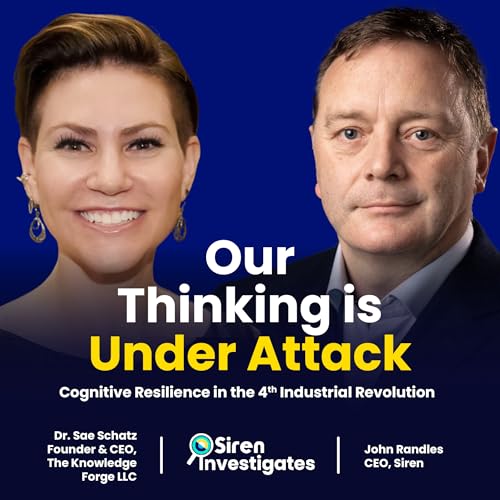
  • Our Thinking Is Under Attack 🥷💫🌐 Cognitive Resilience in the 4th Industrial Revolution 🚀🏭 🤖✨
    Feb 26 2026

    In this episode of Siren Investigates, John Randles sits down with Dr. Sae Schatz, Founder and CEO of The Knowledge Forge, former Director at the U.S. Department of Defense Advanced Distributed Learning Initiative and co-author of Engines of Engagement.

    Together, they explore a critical question of our time:

    Will AI make us better decision-makers or systematically degrade our thinking?

    We are now living through the Fourth Industrial Revolution (4IR), a convergence of digital, physical, and biological systems. Generative AI, hyper-personalization, deepfakes, cognitive overload, and synthetic media are reshaping how humans learn, decide, trust, and perceive reality itself. 🚀🏭🤖✨

    Dr. Schatz breaks down:

    🥷 What cognitive warfare really means

    💫 How attention became the core commodity of the digital age

    🤨 Why we are “information rich but trust poor”

    🤖 The rise of AI-enabled scams, ransomware-as-a-service, and deepfake fraud

    🥷 The psychology behind misinformation and emotional contagion

    💻 “Work slop” and the hidden productivity tax of generative AI

    👉 The concept of trusted wayfinding in an era of overload

    🧠 How organizations can build cognitive resilience

    This conversation exposes how information operations are evolving from propaganda into full-spectrum cognitive manipulation, from the Rohingya crisis in Myanmar to hybrid warfare doctrines inside NATO.

    They discuss:

    🟡 Dual-process theory (System 1 vs. System 2 thinking)

    🟡 The paradox of choice and decision fatigue

    🔵 Emotional contagion algorithms

    🟣 The “liar’s dividend” effect

    🔵 AI-enabled hyper-personalization targeting individuals

    🟣 The shift from the attention economy to the trust economy

    If you work in intelligence, investigations, cybersecurity, defense, public policy, or leadership — this episode is essential viewing.

    Because the battlefield is no longer just physical. It’s cognitive.

    🎙 About Siren Investigates

    The podcast exploring how we keep people, assets, and networks safe in an era of accelerating technological change.

    Afficher plus Afficher moins
    55 min
  • 💸💸 🔎 Follow The Money - How Financial Data Can Expose Human Trafficking ⛓️‍💥
    Jan 14 2026

    ⛓️‍💥 Human trafficking is often hidden in plain sight but it leaves financial evidence. In this episode of Siren Investigates, John Randles is joined by Robert Reed, Chief Operating Officer of the International Bank of Chicago and founder of Reed Advancements, to explore how financial data, compliance systems, and investigative technology can be used to uncover and disrupt human trafficking networks. Drawing on decades of experience across global banking, AML, and forensic investigations, Robert explains how trafficking activity surfaces in transaction data, why traditional compliance approaches fall short, and how enhanced data analytics, AI, and cross-sector collaboration can save lives when used effectively. In this episode, they discuss: ⛓️‍💥 How human trafficking activity appears in financial transactions and behavioural patterns ⛓️‍💥 Why “following the money” remains one of the most effective ways to expose exploitation ⛓️‍💥 The role banks play in detecting trafficking through AML and SAR reportingReal-world examples where data analysis directly led to shutting down illicit operations ⛓️‍💥 How technologies like AI and entity resolution can accelerate investigations ⛓️‍💥 Why data collection alone is not enough—and why data utilisation matters What regulators, corporations, and everyday citizens can do to help combat trafficking This is a powerful conversation about the human reality behind financial data and how investigators, technologists, and institutions can work together to protect vulnerable people and dismantle criminal networks. Listen now to understand how financial intelligence can be a force for good

    Afficher plus Afficher moins
    45 min
  • 🥷☠️ Cybercrime Explained - How Cyber Techies and Investigators Win Together 🧑🏽‍💻👮
    Dec 16 2025

    Listeners will gain practical insight into:

    👮 The life cycle of a cybercrime investigation within a police agency

    🧑🏽‍💻 How digital evidence, data preservation, and case law shape investigative decisions

    👮🧑🏽‍💻 Why cybercrime is a team sport, requiring close collaboration between sworn investigators, civilian analysts, prosecutors, and international partners

    ⚖️ How Mutual Legal Assistance Treaties (MLATs) and Europol’s Joint Cyber Action Taskforce (JCAT) are used in real investigations

    🌐 What successful public-private partnerships look like in cyber investigations

    The episode also delivers career-focused guidance for law enforcement officers and agencies developing cyber units. Kenrick explains why agencies must balance investigative skills with technical expertise, how civilianisation strengthens cyber teams, and what training pathways best prepare investigators for handling large-scale digital evidence and complex prosecutions. He offers candid advice for officers transitioning into cyber roles and for agencies looking to mature their cybercrime investigative model.

    Looking ahead, the conversation explores the growing impact of AI in cybercrime, the challenges of evidence scale and complexity, and the tools investigators need to shorten investigative timelines and keep pace with sophisticated threat actors. This episode is essential listening for police leaders, cybercrime investigators, intelligence units, digital forensics teams, prosecutors, and law enforcement professionals seeking a grounded, experience-driven understanding of how cybercrime is investigated and how the next generation of cyber investigators is being built.

    Afficher plus Afficher moins
    1 h
  • 🇪🇺⚔️✨Sovereignty, Security and Strategy - Europe’s New Battlefield? 🌐👑
    Nov 5 2025

    In this powerful episode of Siren Investigates, host John Randles sits down with Vice Admiral (Rtd) Mark Mellett, former Chief of Staff of Ireland’s Defence Forces, to unpack the shifting foundations of European security and sovereignty. With decades of leadership experience across the UN, NATO, and Irish Defence Forces. The conversation opens with a fundamental question: what does sovereignty mean in today’s interconnected Europe? Mark argues that sovereignty is like property—you only own it if you can defend it. He warns that many European nations, including Ireland, have “free-ridden” on decades of peace without investing adequately in defense or resilience. Drawing on history from post–World War II recovery to the Russian invasion of Ukraine, Mark explains how Europe’s sense of security has been eroding for years, and why 21st-century threats require both **military strength and societal awareness

    Topics Covered

    🌐 How Europe must redefine sovereignty in an era of hybrid warfare

    🌐 The rise of AI and innovation as force multipliers in defense

    🌐 Why strategic autonomy and collaboration are vital for Europe’s future

    🌐 Ireland’s role in a new security landscape and the urgent need to act

    🌐 Climate change as the next frontier of geopolitical conflict

    🔍 Siren Investigates explores the technology and intelligence shaping how we keep people, assets, and networks safe.

    Afficher plus Afficher moins
    55 min