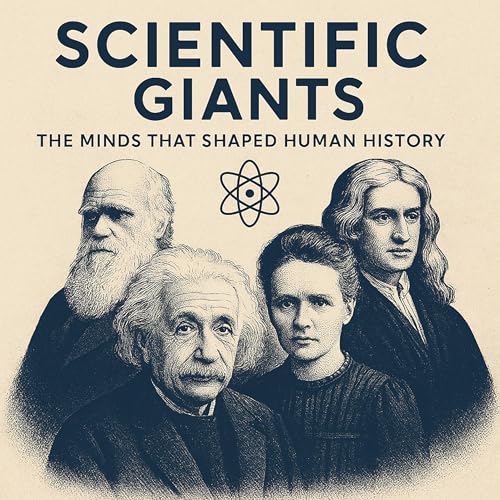
You're listening to "Scientific Giants Who Changed the World." Each episode stands beside one mind and follows a thread of curiosity until it ties to the world we inhabit. Today we descend into a converted shed on the rue Lhomond in Paris, where winter seeps through walls that were never meant to shelter precision work. The air tastes of coal smoke and chemicals. A glass tube glows faintly in the corner—not from any lamp, but from something inside it, something that shouldn't shine at all. At a workbench scarred by acid and heat, a woman in a stained laboratory coat stirs a boiling mass with an iron rod nearly as tall as she is. Her hands will ache tonight; they ache most nights now. She is Marie Curie, and in this cold shed she will make the invisible visible, she will name two elements that rewrite the periodic table, and she will do it at a cost her body will spend decades paying.
Begin with what brought her to that shed, because the radiance makes more sense if we know what she was willing to suffer to reach it. She was born Maria Skłodowska in 1867 in Warsaw, a city that had been erased from maps by the powers that carved Poland into portions. Her father taught mathematics and physics in a school that the Russian authorities watched; her mother ran a boarding school and died of tuberculosis when Maria was ten. The family was educated, pious in a quiet way, and poor in the manner of people who sell furniture to pay for books. Maria was the youngest of five children, slight and serious, with a hunger to learn that her teachers noticed and her circumstances obstructed. Women could not attend university in Russian Poland. If she wanted an education that matched her appetite, she would have to leave.
But leaving required money, and money required years. She made a pact with her older sister Bronisława: Maria would work as a governess and send money so Bronya could study medicine in Paris; when Bronya finished, she would return the favor. For six years Maria lived in other people's households, teaching children their letters and sums, stealing hours after the family slept to read mathematics and physics by candlelight in cold rooms where her breath made clouds. In one household she fell in love with the eldest son; his parents ended it with the contempt that land and old names reserve for the hired help. She learned what it meant to be bright and useful and disposable all at once. She kept working. She kept sending money. She kept her part of the bargain.


 11 min