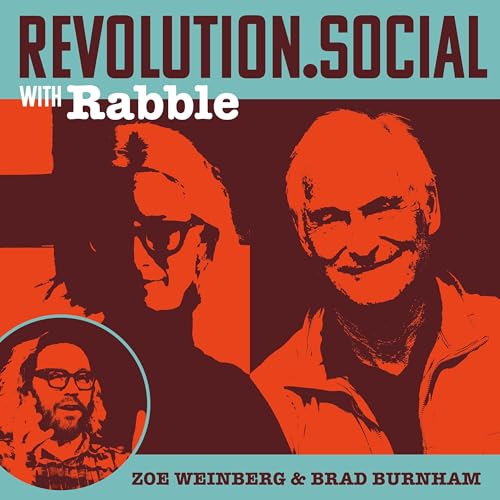
Couverture de Revolution.Social

Revolution.Social

Revolution.Social

De : Rabble a.k.a. Evan Henshaw-Plath
Écouter gratuitement

3 mois pour 0,99 €/mois

Après 3 mois, 9.95 €/mois. Offre soumise à conditions.

À propos de ce contenu audio

A podcast about the future of social media and reclaiming our digital communities. Revolution.Social is hosted by technologist and community advocate Rabble, a.k.a. Evan Henshaw-Plath — who was Twitter’s first employee and hired Jack Dorsey. In weekly interviews, Rabble will interview thought leaders, technologists, academics, and more about the need for a new social media "bill of rights." Just as the original Bill of Rights protected individual freedoms from government overreach, we need fundamental protections from corporate control and surveillance capitalism. This is the start of a conversation about what developers are building, how they're building it, and what consumers need to be asking for. Guests will include Jack Dorsey (former CEO & co-founder of Twitter); Kara Swisher (host of On with Kara Swisher, co-host of Pivot); Cory Doctorow (science fiction author & former editor of Boing Boing); and Taylor Lorenz (founder of User Mag, host of Power User).© 2025 revolution.social. All rights reserved. Economie Politique et gouvernement Sciences politiques
Les membres Amazon Prime bénéficient automatiquement de 2 livres audio offerts chez Audible.

Vous êtes membre Amazon Prime ?

Bénéficiez automatiquement de 2 livres audio offerts.
Bonne écoute !
    Épisodes
    • Social Media Should Be Public Infrastructure (with Ben Cerveny)
      Jan 15 2026
      "My thesis is that humans invent things all the time, and for the first 30 years, we call them technology," says Ben “Neb” Cerveny, president of the Foundation for Public Code. "And then if they work, we call them infrastructure." Ben was part of the original team that built one of the defining Web 2.0 platforms, Flickr, and he even gave Flickr its name. Currently, he is applying what he learned from building digital communities to the next wave of software, web services, and urban planning; Foundation for Public Code, he says, has helped convince most of Europe’s governments that tech solutions don’t need to be privately owned and controlled. Today on Revolution.Social, Ben and Rabble discuss the loss of human curation, which made early social media special; why software has just as much “terroir” as film or food; and how we might govern digital spaces by consensus. They also talk about the origins of Flickr, why Facebook is the fast food of social media, and how to build social platforms with civic intentionality. ⁠⁠Follow Rabble on Bluesky⁠⁠ ⁠⁠Follow the podcast⁠⁠ This episode was produced and edited by Eric Johnson from ⁠⁠LightningPod⁠⁠, and executive produced by Alice Chan from ⁠⁠Flock Marketing⁠⁠. To learn more about Rabble’s social media bill of rights, and sign up for our newsletter, visit ⁠⁠⁠https://revolution.social/
      Afficher plus Afficher moins
      51 min
    • AI Slop Is Killing the Joy of the Internet (with Bridget Todd)
      Jan 8 2026
      Bridget Todd is the host of the podcast There Are No Girls on the Internet, a fellow at Harvard's Berkman Klein Center, and a longtime commentator on how platforms shape culture. And she says the rise of AI-generated videos has turned her — an OG superfan of Vine — against short-form video altogether. "I can't trust that any of these are real cats doing cute things," Bridget says. "It's completely turned me off of a kind of content that I've been enjoying for decades." Today on Revolution.Social, Bridget and Rabble discuss what diVine needs to do to bring back the joy of Vine; how AI slop triggers real physiological responses, even when we know it's fake; the disconnect between Silicon Valley's AI enthusiasm and everyone else's horror; and why movements like #MeToo and Black Lives Matter might not be possible in today's algorithmic landscape. They also explore the moral panic around kids online, why legislation aimed at "protecting children" often harms them most, and what it would take to build an internet rooted in love and joy instead of extraction. ⁠Follow Rabble on Bluesky⁠ ⁠Follow the podcast⁠ This episode was produced and edited by Eric Johnson from ⁠LightningPod⁠, and executive produced by Alice Chan from ⁠Flock Marketing⁠. To learn more about Rabble’s social media bill of rights, and sign up for our newsletter, visit ⁠⁠https://revolution.social/
      Afficher plus Afficher moins
      1 h et 1 min
    • [Re-Air] What's Next for Jack Dorsey After Twitter and Bluesky
      Jan 1 2026
      Happy new year to all! Today, we're re-airing the first episode of Revolution.Social, an interview with Jack Dorsey. We'll be back next week with a new interview about the future of social media. Twitter never should have been a traditional tech company, says Twitter co-founder and former CEO Jack Dorsey. Instead, it should have been designed as a protocol — like email, or podcasting. “That was the pure expression of it from day one,” Dorsey says. “And it was never really allowed to be that because it was on this fast track to becoming a public company.” Today on Revolution.Social, Dorsey explains why it’s still possible to build a successful business on top of open protocols and decentralized social platforms like Nostr. He and Rabble also discuss why Jack doesn’t regret encouraging Elon Musk to buy Twitter; why he left Bluesky; the problem with centralized AI firms; and the evolution of cryptocurrencies such as Bitcoin. ⁠Follow Rabble on Bluesky⁠ ⁠Follow the podcast⁠ This episode was produced and edited by Eric Johnson from ⁠LightningPod⁠, and executive produced by Alice Chan from ⁠Flock Marketing⁠. To learn more about Rabble’s social media bill of rights, and sign up for our newsletter, visit ⁠⁠https://revolution.social/
      Afficher plus Afficher moins
      49 min
    Aucun commentaire pour le moment