Couverture de Revise and Resubmit - The Mayukh Show

Revise and Resubmit - The Mayukh Show

Revise and Resubmit - The Mayukh Show

De : Mayukh Mukhopadhyay
Écouter gratuitement

À propos de ce contenu audio

In Revise and Resubmit, a dynamic AI duo— Nikita and Pavlov — guides you through the fascinating world of academic research. Whether they’re debating emerging trends, revisiting theories, or exploring the latest innovations, their conversational style makes scholarly insights accessible and engaging for academics. Papers chosen by Mayukh. Powered by Google NotebookLM.Mayukh Mukhopadhyay
Épisodes
  • Securing a calibrated marketing budget (Jiang et al 2026) | FT50 JM
    Mar 1 2026

    English Podcast Starts at 00:00:00

    Bengali Podcast Starts at 00:19:24

    Hindi Podcast Starts at 00:32:41

    Danish Podcast Starts at 00:44:17


    Reference

    Jiang, J., Tuli, K. R., & Kumar, N. (2026). SECURING A CALIBRATED MARKETING BUDGET. Journal of Marketing. https://doi.org/10.1177/00222429261431239


    ‌Youtube Channel

    ⁠https://www.youtube.com/@weekendresearcher⁠

    Connect over linkedin

    https://www.linkedin.com/in/mayukhpsm/


    Welcome to Revise and Resubmit 🎙️✨ the place where serious scholarship meets the messy, human backstage of how big decisions actually get made.

    Because here is the thing about a “budget” in a multinational corporation. On paper, it looks like math. In real life, it looks like a relationship. It is a story told in numbers, yes, but also in trust, worry, persuasion, and the quiet politics of who believes whom when the stakes are high 📊🧠.

    Today’s episode dives into a brand-new article, published online on 27 February 2026 in the Journal of Marketing, a truly prestigious outlet and proudly part of the FT50 journal list 🏛️🏆. The paper is titled “Securing a calibrated marketing budget” by Junqiu Jiang, Kapil R. Tuli, and Nirmalya Kumar.

    What they do, with the patience of careful listening and the clarity of sharp theory, is shift our gaze away from the usual question, “What is the optimal marketing budget?” and toward the more uncomfortable one: “How does a marketing budget survive the journey through the organization?” 🧩

    Their idea of a calibrated marketing budget, or CMKB, is disarmingly practical. It is not just a number you defend once and forget. It is iterative, participative, and built to align promised performance with allocated resources, again and again, until it is sturdy enough to carry the weight of expectation. And in that process, the CMO is not merely presenting forecasts. The CMO is sending signals to the CEO, signals about quality and signals about intent 🔎🤝.

    Quality signals sound like the language of competence: granularity that shows you have done the work, opportunity elaboration that shows you see the upside clearly, threat mitigation that proves you are not naïve about competitors or shocks. Intent signals sound like the language of reassurance: cultivated endorsements that say, “Others believe this too,” and relinquishment that says, “I am not gaming you, I am sharing control.” The study even distinguishes between Growth Focused and Constrained CMKBs, showing that what persuades in one context can fall flat in another ⚖️📈📉.

    If that makes you slightly uneasy, good. Because it suggests that budgeting is not a sterile exercise in allocation. It is a live negotiation about uncertainty, accountability, and what kind of future the firm is willing to fund.

    If you’re enjoying these conversations, subscribe to Revise and Resubmit on Spotify and follow us on YouTube at “Weekend Researcher” 🎧📺. You can also find the show on Amazon Prime and Apple Podcast 🍏🎙️.

    And a sincere thank you to the authors, Junqiu Jiang, Kapil R. Tuli, and Nirmalya Kumar, and to SAGE Publications for publishing this important work in the Journal of Marketing 🙏📚.

    So here is the question I can’t stop thinking about 🌀: when a CMO “secures” a calibrated marketing budget, are they really securing resources, or are they securing belief?

    Afficher plus Afficher moins
    55 min
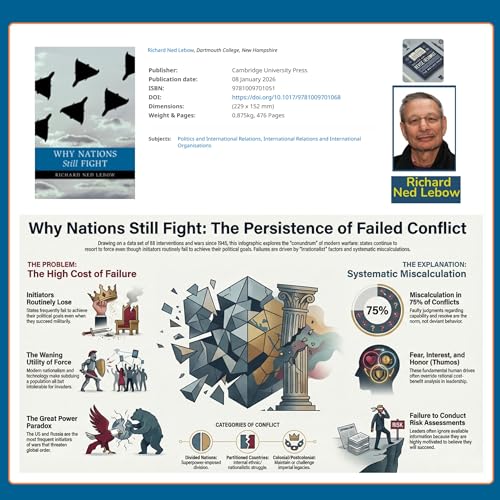
  • Why Nations Still Fight (Lebow 2026) - Weekend Book Review
    Feb 28 2026

    English Podcast starts at 00:00:00

    Bengali Podcast Starts at 00:19:31

    Hindi Podcast Starts at 00:29:46

    Danish Podcast Starts at 00:47:46


    Reference

    Lebow, R. N. (2026). Why Nations Still Fight. Cambridge: Cambridge University Press. https://doi.org/10.1017/9781009701068


    Youtube channel link

    https://www.youtube.com/@weekendresearcher

    Connect on linkedin

    https://www.linkedin.com/in/mayukhpsm/


    Welcome to Revise and Resubmit, and this is your “Weekend Book Review” 📚✨

    Some books don’t just explain the world. They quietly rearrange it, like furniture moved in the dark, so that when you wake up you keep bumping into new corners of your own certainty. Tonight, I’m sitting with a question that feels both old and embarrassingly current: if war is so ruinously expensive, so publicly condemned, and so frequently unsuccessful for the people who start it, why do nations still reach for it anyway? 🕯️🌍

    The book on my desk is Why Nations Still Fight by Richard Ned Lebow, published on 08 January 2026 by Cambridge University Press. Lebow is not a pundit passing through the scene. He is Professor Emeritus of International Political Theory at King’s College London’s War Studies department, an Honorary Fellow at Pembroke College, Cambridge, and the James O. Freedman Presidential Professor Emeritus at Dartmouth. He’s also a Fellow of the British Academy. And I love this detail: alongside all that gravitas, he writes short stories, murder mysteries, and counterfactual historical fiction. That range matters, because this book is about the stories nations tell themselves before they light the match 🔥🧠

    This work follows his earlier Why Nations Fight (2010), but it carries the weight of a long view. Lebow draws on an original dataset of interventions and wars from 1945 to today, and he walks us through eighty-eight cases of interstate conflict with short, sharp case studies. His argument is unsettling in its simplicity: wars often begin not with clear-eyed strategy, but with miscalculation, lazy or performative risk assessment, and the kind of cultural and political arrogance that makes leaders think reality will politely cooperate.

    And then he pushes harder. He says a lot of our familiar realist and rationalist theories simply don’t fit what we keep seeing. Nations do not always fight for security in a neat, rational calculus. They fight for something messier, something human. Lebow leans on thumos, the hunger for status, prestige, and sometimes revenge. The pursuit of being seen. The refusal to be slighted. The need to prove you still matter ⚔️👀

    He also doesn’t let great powers off the hook. In his account, states like the United States and Russia stumble into interventions that they expect to control, only to discover that force is a poor substitute for foresight, and that winning militarily can still mean losing politically. Again and again.

    In this episode, I’ll walk you through what Lebow is really claiming, what it challenges in the way we study war, and what his “irrationalist” turn might open up for how we forecast the future of conflict 📈🧩

    Before we begin, my sincere thanks to Richard Ned Lebow and Cambridge University Press for bringing this book into the conversation 🙏📘

    If you enjoy “Weekend Book Review,” please subscribe to the podcast on Spotify, and subscribe to my YouTube channel, Weekend Researcher 🎧▶️ You can also find the show on Amazon Prime Music and Apple Podcast.

    So here’s the question I want to start with, and I want you to hold it close as we go: if nations keep losing, keep regretting, and keep insisting they’re rational, what exactly are they still fighting for? 🤔🌑

    Afficher plus Afficher moins
    1 h et 15 min
  • Bilderberg People (Richardson et al 2011) - Weekend Classics
    Feb 27 2026

    English Podcast starts at 00:00:00

    Bengali Podcast Starts at 00:14:44

    Hindi Podcast Starts at 00:36:34

    French Podcast Starts at 00:55:23


    Reference

    Richardson, I., Kakabadse, A., & Kakabadse, N. (2011). Bilderberg People: Elite Power and Consensus in World Affairs (1st ed.). Routledge. https://doi.org/10.4324/9780203807842


    Youtube channel link

    https://www.youtube.com/@weekendresearcher

    Connect on linkedin

    https://www.linkedin.com/in/mayukhpsm/


    🎙️ Welcome to Revise and Resubmit, and to our episode series, Weekend Classics. I am glad you are here.

    There is a particular kind of silence that arrives when powerful people agree with each other. It is not the silence of secrecy, exactly. It is the silence of doors that close softly, of name tags that do not reach the public eye, of sentences that begin as questions and end as policy. And every time I hear that silence, I think about the rest of us, standing outside it, trying to guess what is being decided in rooms we will never enter.

    📚 Today, on Weekend Classics, I am reviewing a book that does something rare. It walks toward the guarded garden without pretending it has discovered a hidden tunnel. Bilderberg People: Elite Power and Consensus in World Affairs (2011), published by Routledge, is not interested in conspiracy theatre. It is interested in something both quieter and more unsettling: the ordinary human mechanics of influence, the subtle calibrations of status, belonging, and persuasion, and the way consensus can be crafted until it feels like common sense.

    🕴️ The authors, Ian Richardson, Andrew Kakabadse, and Nada Kakabadse, come to this subject with an unusual blend of credentials and curiosity. Richardson is anchored in scholarship at Stockholm University Business School and Cranfield, but he also carries the lived memory of entrepreneurship in Europe’s digital information sector. He understands, in other words, how regulation, innovation, and power can shake hands in private and then show up in public wearing clean gloves.

    Andrew Kakabadse, a globally recognized authority on leadership and governance at Cranfield, has spent a career studying boardrooms and the rituals of decision making across continents. And Nada K. Kakabadse, Professor of Management and Business Research at the University of Northampton and a prolific scholar of governance, ethics, strategy, and the social impact of ICT, brings an eye for how institutions justify themselves, especially when accountability feels… negotiable.

    🔍 What makes this book compelling is its method and its mood. Through exclusive interviews with attendees of the Bilderberg meetings, it asks what elite networking actually looks like when you strip away the smoke machine. It suggests that elite consensus is not a spontaneous harmony of brilliant minds. It is a product, shaped by relationships, hierarchy, and the soft power of who gets heard, who gets deferred to, and who learns the language of enlightened agreement.

    🌍 And here is the part that stays with me: the tension between private diplomacy and democratic accountability is not an abstract dilemma in these pages. It is a lived condition of modern life. The world is interconnected, yes, but it is also unevenly audible. Some voices travel further, faster, and with fewer questions asked.

    So as we step into this Weekend Classics review together, let me ask you something I cannot stop wondering 🧠✨ If consensus is built behind closed doors through subtle relationships rather than open debate, then what would real public accountability even look like in a world run on private agreement?

    🙏 My thanks to the authors, Ian Richardson, Andrew Kakabadse, and Nada Kakabadse, and to Routledge for bringing this work into print.

    🎧 If you enjoyed this episode, please subscribe to the podcast on Spotify, and subscribe to my YouTube channel, Weekend Researcher. You can also find Revise and Resubmit on Amazon Prime Music and Apple Podcast.


    Afficher plus Afficher moins
    1 h et 9 min
Aucun commentaire pour le moment