Épisodes

  • Securing a calibrated marketing budget (Jiang et al 2026) | FT50 JM
    Mar 1 2026

    English Podcast Starts at 00:00:00

    Bengali Podcast Starts at 00:19:24

    Hindi Podcast Starts at 00:32:41

    Danish Podcast Starts at 00:44:17


    Reference

    Jiang, J., Tuli, K. R., & Kumar, N. (2026). SECURING A CALIBRATED MARKETING BUDGET. Journal of Marketing. https://doi.org/10.1177/00222429261431239


    ‌Youtube Channel

    ⁠https://www.youtube.com/@weekendresearcher⁠

    Connect over linkedin

    https://www.linkedin.com/in/mayukhpsm/


    Welcome to Revise and Resubmit 🎙️✨ the place where serious scholarship meets the messy, human backstage of how big decisions actually get made.

    Because here is the thing about a “budget” in a multinational corporation. On paper, it looks like math. In real life, it looks like a relationship. It is a story told in numbers, yes, but also in trust, worry, persuasion, and the quiet politics of who believes whom when the stakes are high 📊🧠.

    Today’s episode dives into a brand-new article, published online on 27 February 2026 in the Journal of Marketing, a truly prestigious outlet and proudly part of the FT50 journal list 🏛️🏆. The paper is titled “Securing a calibrated marketing budget” by Junqiu Jiang, Kapil R. Tuli, and Nirmalya Kumar.

    What they do, with the patience of careful listening and the clarity of sharp theory, is shift our gaze away from the usual question, “What is the optimal marketing budget?” and toward the more uncomfortable one: “How does a marketing budget survive the journey through the organization?” 🧩

    Their idea of a calibrated marketing budget, or CMKB, is disarmingly practical. It is not just a number you defend once and forget. It is iterative, participative, and built to align promised performance with allocated resources, again and again, until it is sturdy enough to carry the weight of expectation. And in that process, the CMO is not merely presenting forecasts. The CMO is sending signals to the CEO, signals about quality and signals about intent 🔎🤝.

    Quality signals sound like the language of competence: granularity that shows you have done the work, opportunity elaboration that shows you see the upside clearly, threat mitigation that proves you are not naïve about competitors or shocks. Intent signals sound like the language of reassurance: cultivated endorsements that say, “Others believe this too,” and relinquishment that says, “I am not gaming you, I am sharing control.” The study even distinguishes between Growth Focused and Constrained CMKBs, showing that what persuades in one context can fall flat in another ⚖️📈📉.

    If that makes you slightly uneasy, good. Because it suggests that budgeting is not a sterile exercise in allocation. It is a live negotiation about uncertainty, accountability, and what kind of future the firm is willing to fund.

    If you’re enjoying these conversations, subscribe to Revise and Resubmit on Spotify and follow us on YouTube at “Weekend Researcher” 🎧📺. You can also find the show on Amazon Prime and Apple Podcast 🍏🎙️.

    And a sincere thank you to the authors, Junqiu Jiang, Kapil R. Tuli, and Nirmalya Kumar, and to SAGE Publications for publishing this important work in the Journal of Marketing 🙏📚.

    So here is the question I can’t stop thinking about 🌀: when a CMO “secures” a calibrated marketing budget, are they really securing resources, or are they securing belief?

    Afficher plus Afficher moins
    55 min
  • Why Nations Still Fight (Lebow 2026) - Weekend Book Review
    Feb 28 2026

    English Podcast starts at 00:00:00

    Bengali Podcast Starts at 00:19:31

    Hindi Podcast Starts at 00:29:46

    Danish Podcast Starts at 00:47:46


    Reference

    Lebow, R. N. (2026). Why Nations Still Fight. Cambridge: Cambridge University Press. https://doi.org/10.1017/9781009701068


    Youtube channel link

    https://www.youtube.com/@weekendresearcher

    Connect on linkedin

    https://www.linkedin.com/in/mayukhpsm/


    Welcome to Revise and Resubmit, and this is your “Weekend Book Review” 📚✨

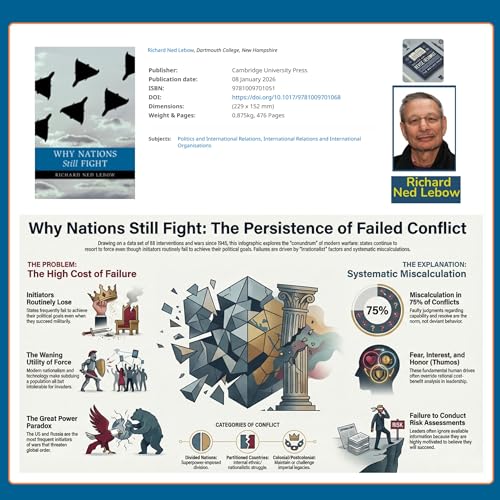
    Some books don’t just explain the world. They quietly rearrange it, like furniture moved in the dark, so that when you wake up you keep bumping into new corners of your own certainty. Tonight, I’m sitting with a question that feels both old and embarrassingly current: if war is so ruinously expensive, so publicly condemned, and so frequently unsuccessful for the people who start it, why do nations still reach for it anyway? 🕯️🌍

    The book on my desk is Why Nations Still Fight by Richard Ned Lebow, published on 08 January 2026 by Cambridge University Press. Lebow is not a pundit passing through the scene. He is Professor Emeritus of International Political Theory at King’s College London’s War Studies department, an Honorary Fellow at Pembroke College, Cambridge, and the James O. Freedman Presidential Professor Emeritus at Dartmouth. He’s also a Fellow of the British Academy. And I love this detail: alongside all that gravitas, he writes short stories, murder mysteries, and counterfactual historical fiction. That range matters, because this book is about the stories nations tell themselves before they light the match 🔥🧠

    This work follows his earlier Why Nations Fight (2010), but it carries the weight of a long view. Lebow draws on an original dataset of interventions and wars from 1945 to today, and he walks us through eighty-eight cases of interstate conflict with short, sharp case studies. His argument is unsettling in its simplicity: wars often begin not with clear-eyed strategy, but with miscalculation, lazy or performative risk assessment, and the kind of cultural and political arrogance that makes leaders think reality will politely cooperate.

    And then he pushes harder. He says a lot of our familiar realist and rationalist theories simply don’t fit what we keep seeing. Nations do not always fight for security in a neat, rational calculus. They fight for something messier, something human. Lebow leans on thumos, the hunger for status, prestige, and sometimes revenge. The pursuit of being seen. The refusal to be slighted. The need to prove you still matter ⚔️👀

    He also doesn’t let great powers off the hook. In his account, states like the United States and Russia stumble into interventions that they expect to control, only to discover that force is a poor substitute for foresight, and that winning militarily can still mean losing politically. Again and again.

    In this episode, I’ll walk you through what Lebow is really claiming, what it challenges in the way we study war, and what his “irrationalist” turn might open up for how we forecast the future of conflict 📈🧩

    Before we begin, my sincere thanks to Richard Ned Lebow and Cambridge University Press for bringing this book into the conversation 🙏📘

    If you enjoy “Weekend Book Review,” please subscribe to the podcast on Spotify, and subscribe to my YouTube channel, Weekend Researcher 🎧▶️ You can also find the show on Amazon Prime Music and Apple Podcast.

    So here’s the question I want to start with, and I want you to hold it close as we go: if nations keep losing, keep regretting, and keep insisting they’re rational, what exactly are they still fighting for? 🤔🌑

    Afficher plus Afficher moins
    1 h et 15 min
  • Bilderberg People (Richardson et al 2011) - Weekend Classics
    Feb 27 2026

    English Podcast starts at 00:00:00

    Bengali Podcast Starts at 00:14:44

    Hindi Podcast Starts at 00:36:34

    French Podcast Starts at 00:55:23


    Reference

    Richardson, I., Kakabadse, A., & Kakabadse, N. (2011). Bilderberg People: Elite Power and Consensus in World Affairs (1st ed.). Routledge. https://doi.org/10.4324/9780203807842


    Youtube channel link

    https://www.youtube.com/@weekendresearcher

    Connect on linkedin

    https://www.linkedin.com/in/mayukhpsm/


    🎙️ Welcome to Revise and Resubmit, and to our episode series, Weekend Classics. I am glad you are here.

    There is a particular kind of silence that arrives when powerful people agree with each other. It is not the silence of secrecy, exactly. It is the silence of doors that close softly, of name tags that do not reach the public eye, of sentences that begin as questions and end as policy. And every time I hear that silence, I think about the rest of us, standing outside it, trying to guess what is being decided in rooms we will never enter.

    📚 Today, on Weekend Classics, I am reviewing a book that does something rare. It walks toward the guarded garden without pretending it has discovered a hidden tunnel. Bilderberg People: Elite Power and Consensus in World Affairs (2011), published by Routledge, is not interested in conspiracy theatre. It is interested in something both quieter and more unsettling: the ordinary human mechanics of influence, the subtle calibrations of status, belonging, and persuasion, and the way consensus can be crafted until it feels like common sense.

    🕴️ The authors, Ian Richardson, Andrew Kakabadse, and Nada Kakabadse, come to this subject with an unusual blend of credentials and curiosity. Richardson is anchored in scholarship at Stockholm University Business School and Cranfield, but he also carries the lived memory of entrepreneurship in Europe’s digital information sector. He understands, in other words, how regulation, innovation, and power can shake hands in private and then show up in public wearing clean gloves.

    Andrew Kakabadse, a globally recognized authority on leadership and governance at Cranfield, has spent a career studying boardrooms and the rituals of decision making across continents. And Nada K. Kakabadse, Professor of Management and Business Research at the University of Northampton and a prolific scholar of governance, ethics, strategy, and the social impact of ICT, brings an eye for how institutions justify themselves, especially when accountability feels… negotiable.

    🔍 What makes this book compelling is its method and its mood. Through exclusive interviews with attendees of the Bilderberg meetings, it asks what elite networking actually looks like when you strip away the smoke machine. It suggests that elite consensus is not a spontaneous harmony of brilliant minds. It is a product, shaped by relationships, hierarchy, and the soft power of who gets heard, who gets deferred to, and who learns the language of enlightened agreement.

    🌍 And here is the part that stays with me: the tension between private diplomacy and democratic accountability is not an abstract dilemma in these pages. It is a lived condition of modern life. The world is interconnected, yes, but it is also unevenly audible. Some voices travel further, faster, and with fewer questions asked.

    So as we step into this Weekend Classics review together, let me ask you something I cannot stop wondering 🧠✨ If consensus is built behind closed doors through subtle relationships rather than open debate, then what would real public accountability even look like in a world run on private agreement?

    🙏 My thanks to the authors, Ian Richardson, Andrew Kakabadse, and Nada Kakabadse, and to Routledge for bringing this work into print.

    🎧 If you enjoyed this episode, please subscribe to the podcast on Spotify, and subscribe to my YouTube channel, Weekend Researcher. You can also find Revise and Resubmit on Amazon Prime Music and Apple Podcast.


    Afficher plus Afficher moins
    1 h et 9 min
  • Paying your fair share (Nathan et al 2026) | FT50 JAE
    Feb 26 2026

    English Podcast Starts at 00:00:00

    Bengali Podcast Starts at 00:16:07

    Hindi Podcast Starts at 00:36:11

    French Podcast Starts at 00:53:26


    Reference

    Nathan, B., Perez-Truglia, R., & Zentner, A. (2026). Paying your fair share: Perceived fairness and tax compliance. Journal of Accounting and Economics, 101838. https://doi.org/10.1016/j.jacceco.2025.101838


    ‌Youtube Channel

    ⁠https://www.youtube.com/@weekendresearcher⁠

    Connect over linkedin

    https://www.linkedin.com/in/mayukhpsm/


    Welcome to Revise and Resubmit 🎙️✨ the show where serious research meets real life, and where the footnotes often point straight back to the heart.

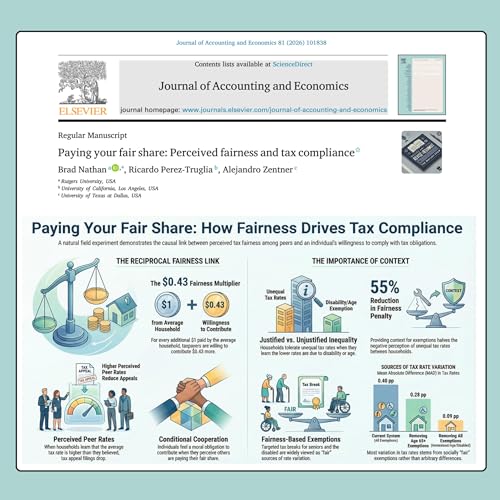
    Picture a quiet street in Dallas County. Lawns trimmed. Mailboxes upright. Neighbors waving like they always do. And then, somewhere between the grocery receipt and the school pickup, a thought sneaks in that can change everything: “Am I paying more than everyone else?” 🤔💸 Not “Do I owe taxes?” but “Is this fair?” Because taxes are never only numbers. They are stories we tell ourselves about belonging, responsibility, and whether the system is treating us like a sucker or like a citizen.

    Today’s episode dives into a brand-new paper published online on 20 February 2026, titled “Paying your fair share: Perceived fairness and tax compliance” by Brad Nathan, Ricardo Perez-Truglia, and Alejandro Zentner 📄🔍 in the Journal of Accounting and Economics, a prestigious FT50 journal 🏛️📚.

    Here is the human hinge of the study. The authors run a natural field experiment around U.S. property taxes, using an information-disclosure intervention that shifts what households think other people pay. Not a lecture. Not a moral scolding. Just a nudge of knowledge. And what happens when people believe the average taxpayer is paying more? They see the system as fairer, and they become less likely to file a tax appeal ✅🧾. The numbers are striking: for every additional $1$1 people believe the average household pays, a taxpayer is willing to contribute about $0.43$0.43 more. That is not just compliance. That is conditional cooperation, the quiet bargain of community 🤝🏘️.

    But fairness, as always, has context. In the experiment, people learn the average rate, but not the reasons it differs from theirs. Then the survey comes in with the twist: when households learn others might pay lower rates because of exemptions, like disability or advanced age, they tolerate inequality more readily ❤️‍🩹👵. Many support those breaks, yet a meaningful share still prefers the clean symmetry of equal rates, no matter the story. It is a reminder that “fair” can mean “equal,” and “fair” can also mean “merciful,” and those two meanings sometimes wrestle in the same mind ⚖️🧠.

    If you want research that speaks to policy, to psychology, and to the everyday friction of comparing yourself to the neighbors, you are in the right place 🔔🎧.

    Subscribe to Revise and Resubmit on Spotify, and also follow us on YouTube at “Weekend Researcher” ▶️📌. You can also listen on Amazon Prime and Apple Podcast 🍎🎙️.

    And with sincere thanks to the authors, Brad Nathan, Ricardo Perez-Truglia, and Alejandro Zentner, and to Elsevier, the publisher of this article 🙏📘, let me leave you with a question that lingers: if your willingness to pay depends on what you believe others pay, what does that say about taxes, and what does it say about us? ❓✨

    Afficher plus Afficher moins
    1 h et 19 min
  • Detachment and Attachment (Zhao et al. 2026) | FT50 JoM
    Feb 25 2026

    English Podcast Starts at 00:00:00

    Bengali Podcast Starts at 00:16:53

    Hindi Podcast Starts at 00:40:27

    French Podcast Starts at 00:59:35


    Reference

    Zhao, H. H., Wang, M., Yuan, Y., Ni, D., Zheng, X., & Lam, S. S. K. (2026). Detachment and Attachment: A Dual-Pathway Model of Leader Succession Rituals. Journal of Management, 0(0). https://doi.org/10.1177/01492063261419057


    ‌Youtube Channel

    ⁠https://www.youtube.com/@weekendresearcher⁠

    Connect over linkedin

    https://www.linkedin.com/in/mayukhpsm/


    Wel­come to Revise and Resubmit 🎙️✨ the show where serious research still gets to feel like a human story, the kind you can recognize in your own bones.

    Think about the moment a leader leaves. Not the org chart update, not the email with the careful subject line, but the quieter aftershock. The familiar voice is gone. The old habits linger in conference rooms like perfume. People smile, people clap, people say “exciting times,” and meanwhile everyone privately wonders, “What exactly are we allowed to believe in now?” 👀🗝️

    Today we are stepping into that in-between space with a paper that treats succession as more than a handoff. It treats it as a ritual. The article is titled “Detachment and Attachment: A Dual-Pathway Model of Leader Succession Rituals” by Helen H. Zhao, Mo Wang, Yue Yuan, Dan Ni, Xiaoming Zheng, and Simon S.K. Lam, published online on 23 February 2026 in the Journal of Management, which is not just respected, but prestigious and firmly on the FT50 list 🏛️📚.

    Here is the idea, told plainly but with its full weight. When organizations change leaders, they often reach for rituals to tame uncertainty and make the transition feel real. The authors map six of these rituals, and you can almost see them play out like scenes:

    • Artifact adoption 🧩: the new leader takes up symbolic objects or practices

    • Endorsement act 🤝: the new leader gets publicly validated

    • Welcome ceremony 🎉: the community formally receives the new leader

    • Artifact return 📦: symbols of the prior era get handed back or set aside

    • Closure act 🔒: the ending is marked, not merely implied

    • Farewell ceremony 👋: the former leader is publicly released

    And the twist, the satisfying clarity, is the dual-pathway model: some rituals build attachment to the new leader, while others help people detach from the former one. This is not only qualitative insight either. The authors begin by listening closely and naming what is happening, then they test it in a real firm during acquisition-driven succession, and then again with an experiment across working adults. Across those studies, certain rituals stand out as especially powerful: endorsement acts, welcome ceremonies, and farewells 🎯.

    If you like episodes that move from symbolism to evidence, from felt experience to tested mechanism, you are in the right place. Subscribe to Revise and Resubmit on Spotify ✅🎧 and follow the YouTube channel Weekend Researcher ▶️🔔. You can also find the show on Amazon Prime and Apple Podcast 🍎📻.

    And as we open this conversation about how organizations say hello and goodbye, ask yourself this: when the next leader arrives, will your workplace only introduce them, or will it also give everyone permission to let the old one go? ❓🕯️

    Thanks to the authors, Helen H. Zhao, Mo Wang, Yue Yuan, Dan Ni, Xiaoming Zheng, and Simon S.K. Lam, and thanks as well to SAGE Publications for publishing this research in the Journal of Management.

    Afficher plus Afficher moins
    1 h et 26 min
  • The Disquiet of Quiet Quitting (Magrizos et al 2026) | FT50 HRM
    Feb 24 2026

    English Podcast Starts at 00:00:00

    Bengali Podcast Starts at 00:16:02

    Hindi Podcast Starts at 00:35:38

    French Podcast Starts at 00:55:00


    Reference

    Magrizos, S., L. E. Aydinliyim, D. Roumpi, C. M. Porter, J. M. Phillips, and J. E. Delery. 2026. “ The Disquiet of Quiet Quitting: Definitional Clarity, Theoretical Pathways, and Future Research.” Human Resource Management 1–18. https://doi.org/10.1002/hrm.70061


    ‌Youtube Channel

    ⁠https://www.youtube.com/@weekendresearcher⁠

    Connect over linkedin

    https://www.linkedin.com/in/mayukhpsm/


    Welcome to Revise and Resubmit 🎙️📚 where we take big, prestigious research and make it feel like something you can hold in your hands, turn over, and actually use.

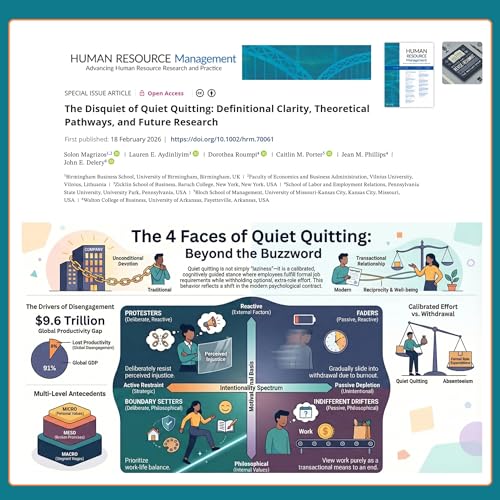
    Quiet quitting. Two words that sound like a whisper, yet somehow land like a headline. It is the office chair that stops rolling forward. It is the extra mile quietly reclaimed. It is not a tantrum, not a vanishing act, not necessarily burnout. It is something more precise and more unsettling: a calibrated decision to do the job, but stop donating the self.

    Today, we are stepping into a truly prestigious venue: Human Resource Management, an FT50 journal. 🏛️✨ And we are doing it through a timely review published online on 18 February 2026: “The Disquiet of Quiet Quitting: Definitional Clarity, Theoretical Pathways, and Future Research,” by Solon Magrizos, Lauren E. Aydinliyim, Dorothea Roumpi, Caitlin M. Porter, Jean M. Phillips, and John E. Delery.

    What I love about this piece is that it refuses to let quiet quitting stay as a social-media mood. It asks for definitional clarity, then earns it. Drawing from 11 papers in a special issue, the authors map what quiet quitting is and what it is not, and they insist we take its many faces seriously. 🧩🔍 Deliberate versus passive. Reactive versus value-driven. Narrow versus broad in scope. Not one story, but a set of stories we have been lumping together because it felt easier.

    Then comes the part that lingers: the 2 × 22 typology of quiet quitters. Four characters walking around modern work life like they have always been here, only now they have names. Protesters ✊, Faders 🌫️, Boundary Setters 🧘, and Indifferent Drifters 🧊. Different motives, different levels of intentionality, different signals about fairness, well-being, and what “sustainable engagement” even means when everyone is tired of pretending.

    If this is not just a trend but a message, then the real question becomes: what exactly is your workplace hearing when someone stops doing the “extra,” and what are you hearing about yourself when you feel relieved to stop? 🎧🤔

    Before we dive in, subscribe to Revise and Resubmit on Spotify and follow the YouTube channel Weekend Researcher 📌🎥. You can also listen on Amazon Prime and Apple Podcast 🍎🎙️.

    And with sincere thanks to the authors and to the publisher, Wiley Periodicals LLC, for bringing this important review to Human Resource Management 🙏📄: when you hear “quiet quitting,” who do you picture first, a Protester, a Fader, a Boundary Setter, or an Indifferent Drifter, and why?

    Afficher plus Afficher moins
    1 h et 14 min
  • Micro-Processes of Constrained Innovation (Doms et al 2026) | FT50 JMS
    Feb 23 2026

    English Podcast Starts at 00:00:00

    Bengali Podcast Starts at 00:16:48

    Hindi Podcast Starts at 00:37:38

    French Podcast Starts at 00:53:56


    Reference

    Doms, H., Weiss, M. and Hoegl, M. (2026), Micro-Processes of Constrained Innovation: A Field Study of Constraint-Handling Practices in Base of the Pyramid Innovation Projects. J. Manage. Stud.. https://doi.org/10.1111/joms.70065


    ‌Youtube Channel

    ⁠https://www.youtube.com/@weekendresearcher⁠

    Connect over linkedin

    https://www.linkedin.com/in/mayukhpsm/


    🎙️✨ Welcome to the podcast Revise and Resubmit ✨🎙️

    The show where we step inside the pages of the world’s most prestigious management research and ask not just what was published… but why it matters.

    Today, we turn our attention to a remarkable article published online on 20 February 2026 in the Journal of Management Studies 📘. This is no ordinary outlet. It sits proudly on the FT50 list, the gold standard of academic journals, a place where only the most rigorous and thought-provoking scholarship finds a home.

    The paper is titled Micro-Processes of Constrained Innovation: A Field Study of Constraint-Handling Practices in Base of the Pyramid Innovation Projects by Helene Doms, Matthias Weiss, and Martin Hoegl.

    And here is the question that hums beneath their work:
    What if constraints are not the enemy of innovation… but its quiet architect? 🛠️🌍

    The authors take us into the lived realities of sixty innovation projects at the base of the pyramid across Africa and India. These are places where scarcity is not theoretical. It is daily. Immediate. Unavoidable.

    They discover that innovation under constraint is not a heroic leap. It is a series of micro-movements. Small decisions. Subtle shifts. A kind of choreography between what is possible and what is necessary.

    They distinguish between two kinds of constraints. Goal constraints, like the demand for extreme affordability. And task constraints, like the absence of funds, materials, or expertise. And in response, teams do something fascinating. They do not choose between planning and improvising. They cycle. 🔄

    They reduce.
    They reinterpret.
    They replace.
    They tinker.
    They network. 🤝

    They move between causation and effectuation, between deliberate design and resourceful improvisation. Not either or. Both. Again and again.

    Published by the Society for the Advancement of Management Studies and John Wiley & Sons, Ltd., this study reminds managers and scholars alike that creativity is often born in the narrowest corridors. That scarcity sharpens attention. That limits invite imagination.

    It is humane research. It honors the ingenuity of people working not in abundance, but in constraint. And it offers a framework that managers everywhere can learn from, especially those who believe that innovation requires perfect conditions.

    Maybe it does not.
    Maybe it requires pressure.
    Maybe it requires less.

    If you enjoy deep dives into FT50 research that actually changes how we see the world of management, subscribe to 🎧 Revise and Resubmit on Spotify and to our YouTube channel Weekend Researcher 📺. You can also find us on Amazon Prime and Apple Podcast. Join a growing community that believes serious research deserves a serious audience.

    Our heartfelt thanks to the authors Helene Doms, Matthias Weiss, and Martin Hoegl, and to the publishers at the Journal of Management Studies for advancing scholarship at the highest level.

    And now we leave you with this:

    If innovation at the margins thrives not despite constraints but because of them… what constraints in your own work are quietly waiting to become catalysts? 🤔✨

    Afficher plus Afficher moins
    1 h et 20 min
  • Interpreting Violence (Briscoe et al 2026) | FT50 ASQ
    Feb 22 2026

    English Podcast Starts at 00:00:00

    Bengali Podcast Starts at 00:19:43

    Hindi Podcast Starts at 00:38:09

    Danish Podcast Starts at 00:56:53


    Reference

    Briscoe, F., DesJardine, M. R., & Zhang, M. (2026). Interpreting Violence: How Community Context Shapes Corporate Responses to Street Protests. Administrative Science Quarterly, 0(0). https://doi.org/10.1177/00018392261419416


    ‌Youtube Channel

    ⁠https://www.youtube.com/@weekendresearcher⁠

    Connect over linkedin

    https://www.linkedin.com/in/mayukhpsm/


    🎙️✨ Welcome to the podcast Revise and Resubmit ✨🎙️

    The show where we take you inside the pages of the world’s most prestigious management research and ask not just what it says… but why it matters.

    Today, we turn to a paper published in one of the most elite academic journals on the planet, the FT50-listed Administrative Science Quarterly. Yes, that Administrative Science Quarterly. The kind of journal where ideas are not simply reviewed, they are tested, turned, and tested again. Published by SAGE Publications on 19 February 2026, this article carries the intellectual weight that only an FT50 journal can confer. 🏛️📚

    The paper is titled Interpreting Violence: How Community Context Shapes Corporate Responses to Street Protests, authored by Forrest Briscoe, Mark R. DesJardine, and Muhan Zhang.

    Now pause for a moment.

    When violence erupts in the streets, what do business leaders see? Disorder? Or a cry for justice?

    In 2020, as the Black Lives Matter protests swept across cities, executives faced a dilemma. Speak up? Stay silent? Announce diversity initiatives? Publicly endorse the movement? Or do something quieter, safer, less declarative?

    This paper argues that the answer depends not only on the violence itself, but on memory. On history. On what the community has lived through before.

    If a city carries the scars of repeated protest violence unrelated to the current cause, leaders may interpret new unrest as more of the same. Noise. Instability. Risk. 🚧

    But if that same city has endured grievance-validating events, such as prior police shootings that signal systemic injustice, executives may see something else entirely. They may see legitimacy. They may see pain that demands acknowledgment.

    Using hand-collected data from Fortune 500 firms, the authors reveal a subtle calculus at work. Companies headquartered in communities marked by persistent non-movement violence were less likely to announce diversity actions in response to protest violence. Yet in places with histories of police misconduct, firms were more likely to take action, and sometimes even endorse the movement itself.

    Violence, in other words, is not interpreted in a vacuum. It is filtered through local memory. Through community embeddedness. Through the stories cities tell about themselves. 🏙️

    And here is the quiet brilliance of this FT50 study. It shows that corporate activism is neither purely instrumental nor purely moral. It is situated. It is contextual. It is shaped by the streets outside headquarters windows.


    So we ask: When companies respond to protest, are they reacting to the present moment… or to the past that still lingers beneath it?

    Thank you to the authors, Forrest Briscoe, Mark R. DesJardine, and Muhan Zhang, and to Administrative Science Quarterly, published by SAGE Publications, for advancing such rigorous and timely scholarship in one of the world’s most prestigious FT50 journals. 🙏📖

    If you love diving into cutting-edge research like this, subscribe to Revise and Resubmit on Spotify, and follow the YouTube channel Weekend Researcher. 🎧📺
    We are also available on Amazon Prime and Apple Podcast, so you can take serious scholarship wherever you go.

    Until next time, here is the question we leave you with:

    When leaders look out at unrest in their communities, are they seeing chaos… or are they seeing a mirror? 🔍✨


    Afficher plus Afficher moins
    1 h et 18 min