

Retrofit Warmer Homes
Impossible d'ajouter des articles
Échec de l’élimination de la liste d'envies.
Impossible de suivre le podcast
Impossible de ne plus suivre le podcast

Retrofit Warmer Homes
-
Lu par :
-
De :
À propos de ce contenu audio
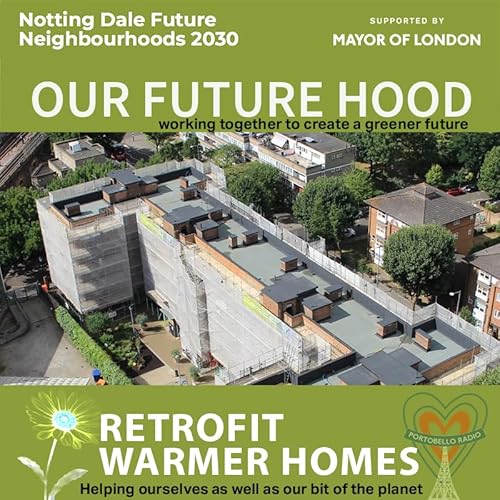
In this episode, we examine how homes in Notting Dale are being retrofitted to be warmer and more energy efficient, helping ourselves as well as our bit of the planet. We brought together Cllr Johnny Thalassites, Lead Member for Environment and Planning at RBKC, James Caspell of Lancaster West Neighbourhood Team, Jill Brown who has recently stepped down as head of the Resident Association at Henry Dickens, and Mushtaq Lasharie CBE, chair of LWRA.
In October 2019 the Royal Borough declared a “Climate emergency” and set a target for the Council’s own operations and buildings to achieve net zero emissions by 2030. This target includes emissions from Council owned social housing estates, schools and operational buildings, fleet activities, street lighting, waste collection and parks maintenance service. Housing accounted for 73% of the Council’s total emissions in 2022, and Notting Dale has 20% of the borough’s social housing.
All three large estates in Notting Dale are over 50 years old: Henry Dickens was built in the early 50s; Lancaster West and Silchester were both constructed at the same time as the Westway, in the early 70s. They all have issues with inadequate insulation and the cost of energy supply. But residents have fought hard to preserve these homes and their communities, so knocking them down and rebuilding is not an option.
We hear how community energy, local jobs, and innovation can shape the next phase of the drive to achieve net zero by 2030. It can be a disruptive process, but local homes are being made warmer and greener through retrofitting


