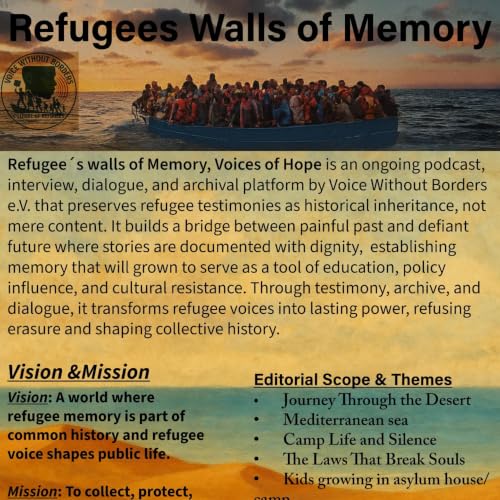
Couverture de Refugees Walls Of Memory

Refugees Walls Of Memory

Refugees Walls Of Memory

De : Destiny Joshua Nduka (D-Ashora)
Écouter gratuitement

3 mois pour 0,99 €/mois

Après 3 mois, 9.95 €/mois. Offre soumise à conditions.

À propos de ce contenu audio

Refugees Walls of Memory, is a living platform that consist of podcast, interview series, dialogue forum, and refugees historical archive built to secure refugee memory and amplify refugee voice. It treats testimony not as content but as inheritance. Stories aren’t headlines here; they are kept with dignity, preserved for learning, policy, and posterity. Where others bury trauma, we lay it as a foundation stone. Where reports flatten lives into numbers, we build oral histories with names, faces, and breath. This platform turns a symbolic room into a bridge and refugees museum.Destiny Joshua Nduka (D-Ashora) Sciences sociales
Les membres Amazon Prime bénéficient automatiquement de 2 livres audio offerts chez Audible.

Vous êtes membre Amazon Prime ?

Bénéficiez automatiquement de 2 livres audio offerts.
Bonne écoute !
    Épisodes
    • Criminalized Without Crime: Detention, Deportation, and System Failure Across Europe”
      Jan 11 2026


      B. Mufalme took time to speak about his experience, often breaking down in tears while narrating his encounters with the Polish and German police. His story reflects fear, confusion, and deep psychological harm.

      In Poland, he was treated like a criminal despite committing no crime. He was arrested, detained, and sent to prison without clear explanation. Instead of receiving protection as an asylum seeker, he was denied basic rights and prosecuted by a system that was meant to safeguard him.

      He was deported back and forth between European countries, including Poland and Germany, under migration enforcement procedures. This repeated transfer left him unstable, frightened, and without any sense of security. Throughout this period, asylum lawyers failed to provide effective legal support, leaving him unprotected and uninformed about his case.

      During these transfers, he was handcuffed and treated as a criminal, despite having no criminal charges. He was imprisoned again in Hof, Germany, where he spent one month in detention before being transferred to the Ankerzentrum in Bamberg.

      His time in the Ankerzentrum marked a severe decline in his health. He reported feeling constant fear and believed he might die there. Medical examinations later confirmed that he was suffering from depression, ulcers, and other stress-related illnesses. These conditions developed as a direct result of prolonged detention, uncertainty, and mistreatment.

      Eventually, he was transferred to Lichtenfels, Germany, but the damage caused by his experiences across multiple systems and countries remained. His case shows how repeated detention, deportation, and lack of legal protection can seriously harm the physical and mental health of asylum seekers.


      Afficher plus Afficher moins
      23 min
    • “Broken by the System: Life in Bamberg’s Ankerzentrum”
      Jan 10 2026

      A. Muzamil is from Ghana. He is a refugee and is currently doing a vocational training as a kitchen chef in Bamberg. Before starting his training, he lived in the Ankerzentrum in Bamberg for more than six months. During this time, he went through serious and disturbing experiences.

      After only a few days in the Ankerzentrum, his behavior and personality changed. He was no longer the same person he used to be. He became withdrawn, anxious, and emotionally affected. The person he was before arrival slowly disappeared as a result of what he experienced inside the center.

      Muzamil reports repeated harassment by security staff, including unnecessary control, intimidation, and disrespectful treatment. He also faced constant pressure related to the Dublin Regulation, which created fear of transfer to another country and made him feel unsafe and unstable.

      In addition, he received negative decisions and official letters without proper explanation or legal support. These letters caused confusion, fear, and emotional distress. During his asylum process, his interview was interrupted, which affected his ability to explain his situation fully and fairly.

      These combined experiences had a strong negative impact on his mental health and sense of identity. Life in the Ankerzentrum did not only delay his future; it changed him as a person. Even after leaving the Ankerzentrum, the effects of this period remain visible in his daily life.


      Afficher plus Afficher moins
      16 min
    • Live Experience in an Asylum House in Germany
      Jan 9 2026

      Voice Without Borders is committed to examining our lived reality inside the Ankerzentrum in Germany, with particular focus on Bamberg. We speak from within the system, not about it from a distance. We analyze how we live, how we are treated, and how the asylum system shapes our daily existence.

      Our focus is on three core areas: our living conditions, the asylum process we are subjected to, and the security practices we face. Inside the Ankerzentrum, overcrowding, isolation, limited access to healthcare, poor communication, and endless waiting define our daily lives. These are not temporary conditions; they become our normal reality.

      The asylum process places us in constant uncertainty. Many of us wait months or years without clear information, adequate legal support, or stability. We live with the daily fear of transfer or deportation, which affects our mental health and strips us of dignity and control over our own lives.

      Security practices are one of our most pressing concerns. We experience excessive control, intimidation, discriminatory treatment, and harassment by private security personnel. Our movement is restricted, our privacy is limited, and respect is often absent. Instead of protection, we are met with surveillance.

      Voice Without Borders documents our experiences through observation and our own testimonies. Our purpose is clear: to make our reality visible, to challenge abuse and neglect, and to demand humane, lawful, and respectful treatment for all of us.


      Afficher plus Afficher moins
      8 min
    Aucun commentaire pour le moment