Couverture de Real Talk: Eosinophilic Diseases

Real Talk: Eosinophilic Diseases

Real Talk: Eosinophilic Diseases

De : American Partnership for Eosinophilic Disorders
Écouter gratuitement

3 mois pour 0,99 €/mois

Après 3 mois, 9.95 €/mois. Offre soumise à conditions.

À propos de ce contenu audio

Eosinophils are a type of white blood cell that play a role in immune responses and help fight off infections. When these cells build up and cause inflammation in the digestive system, tissues, organs, and/or bloodstream, without a known cause, it may be the result of an eosinophil-associated disease. Join the American Partnership for Eosinophilic Disorders (APFED) for a series of conversations with researchers, clinicians, patients, and other community members as we discuss practical strategies for disease management and treatments, research, and other topics of interest.© American Partnership for Eosinophilic Disorders (APFED) Hygiène et vie saine Maladie et pathologies physiques
Les membres Amazon Prime bénéficient automatiquement de 2 livres audio offerts chez Audible.

Vous êtes membre Amazon Prime ?

Bénéficiez automatiquement de 2 livres audio offerts.
Bonne écoute !
    Épisodes
    • Tips for Understanding Your Medical Bills
      Jan 22 2026
      Co-hosts Ryan Piansky, a graduate student and patient advocate living with eosinophilic esophagitis (EoE) and eosinophilic asthma, and Holly Knotowicz, a speech-language pathologist living with EoE who serves on APFED's Health Sciences Advisory Council, interview Beth Morgan, a medical billing advocate and consultant, on navigating your medical bills. Disclaimer: The information provided in this podcast is designed to support, not replace, the relationship between listeners and their healthcare providers. Opinions, information, and recommendations shared in this podcast are not a substitute for medical advice. Decisions related to medical care should be made with your healthcare provider. Opinions and views of guests and co-hosts are their own. Key Takeaways: [:51] Co-host Ryan Piansky introduces this episode, brought to you thanks to the support of Education Partners GSK, Sanofi, Regeneron, and Takeda. Ryan introduces co-host Holly Knotowicz. [1:12] Holly introduces today's topic, Medical Billing, and today's guest, Beth Morgan, a medical billing advocate and consultant. [1:31] Beth says a medical billing consultant is an individual who assists someone with medical bills to make sure that they are accurate and correct, and that they match the medical records, which are notes that the provider makes. [1:48] The medical billing consultant or advocate can make sure the bills are paid correctly and that the charges are within the reasonable prices for the treatment area. [2:19] Beth explains how medical insurance covers healthcare costs. It protects the patients and providers from very high expenses. It can also possibly help with the stress of navigating healthcare systems. [2:36] The goals of medical insurance are to help cover patient costs for treatments, preventive care, and prescriptions. It can also provide resources for telehealth visits or support visits, if needed. [2:48] With a telehealth visit, you, the patient, have to make sure that your insurance plan covers and allows it. Sometimes, the cost of a telehealth visit can be more than if you were to go to the office. [3:27] Beth says most people look at what insurance will cost them per month. They fail to look at their yearly deductible, per person or per family, their prescription costs, or what it will cost to see a specialist. They don't consider what therapies will cost them. [4:08] Beth had a client whose insurance company would only cover in-state providers. If she went out of state, she wouldn't be covered; even an emergency might not be covered. You have to look at the "nitty-gritty" of the policy. [4:32] Beth says the biggest things are the deductible and copay, or co-insurance. Don't just look at the cost. Most people will take out the $10,000 or $5,000 deductible plans, saying it only costs $75 for the entire family. What does it actually cover? [5:00] You don't want sudden surprises when you get to the emergency room. You want to know what your copay will be when you go into an emergency room. [5:11] Holly agrees with Beth and notes that Real Talk listeners have chronic illness. Some have multiple illnesses. When you're selecting insurance plans, those are the things you have to look into. [5:27] Patients with EoE often need endoscopies and other specialized procedures. Holly asks for tips on how someone can know what an endoscopy or other procedure will potentially cost. [5:41] Beth says to ask the doctor what the CPT code is. That's the code that describes the treatment. Then look up that CPT code on the insurance company website. They will show an estimated cost for that treatment, for a rough idea of the cost. [6:10] Keep in mind that it will not tell you what the providers will charge or what the hospital fee will be. [6:21] Holly says she has EoE and MS. She asks a social worker for the CPT code for every procedure so she has a record to double-check when the bill comes. The CPT code is the key. [6:50] Holly is a speech pathologist who does feeding therapy. She says to look at your plan to see if therapy is a copay or if it goes toward your deductible. If it goes toward your deductible, it will be very expensive until you meet that deductible. [7:10] People living with an eosinophilic disorder may find themselves in the ER for a variety of reasons. Holly was there this week with a food impaction. For others, it could be a pain flare or an asthma attack. [7:26] Holly asks how families can be prepared for medical bills related to emergency care. [7:40] Beth replies, You also have on that bill the ER doctor and the ambulance fee, including mileage, which must be accurate or rounded up to the next mile. Track the mileage in your car. [8:43] Who will be transporting you: volunteers from the fire department, a hospital ambulance, or an outside ambulance? Are you going under Basic Life Support or Advanced Life Support? [9:05] Once you get to the ER, have someone else...
      Afficher plus Afficher moins
      22 min
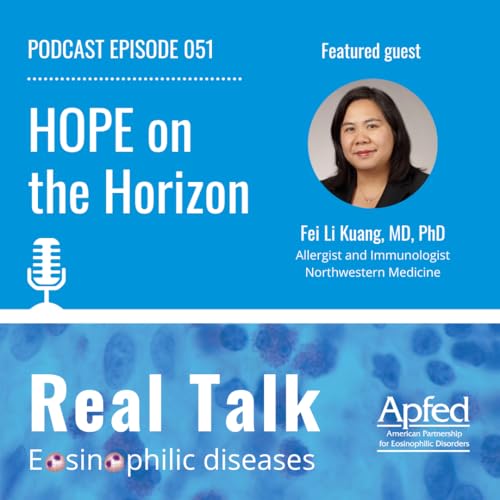
    • HOPE on the Horizon
      Dec 16 2025
      Co-hosts Ryan Piansky, a graduate student and patient advocate living with eosinophilic esophagitis (EoE) and eosinophilic asthma, and Holly Knotowicz, a speech-language pathologist living with EoE who serves on APFED's Health Sciences Advisory Council, interview Fei Li Kuang, MD, PhD, an allergist and immunologist, at Northwestern Medicine, about receiving two APFED HOPE on the Horizon Grants. Disclaimer: The information provided in this podcast is designed to support, not replace, the relationship between listeners and their healthcare providers. Opinions, information, and recommendations shared in this podcast are not a substitute for medical advice. Decisions related to medical care should be made with your healthcare provider. Opinions and views of guests and co-hosts are their own. Key Takeaways: [:50] Co-host Ryan Piansky introduces this episode, brought to you thanks to the support of Education Partners GSK, Sanofi, Regeneron, and Takeda. Ryan introduces co-host Holly Knotowicz. [1:14] Holly introduces today's topic, two APFED HOPE on the Horizon Pilot Grant Projects and today's guest, Fei Li Kuang, MD, PhD, an Assistant Professor in the Division of Allergy and Immunology at Northwestern University Feinberg School of Medicine in Chicago, Illinois. [1:42] Dr. Kuang is a physician-scientist who takes care of patients with eosinophilic disorders and also performs laboratory research on these disorders in her lab, often using patient samples. Holly thanks Dr. Kuang for joining us. [2:05] As a child, Dr. Kuang always wanted to be a scientist. She is so grateful to live out her childhood dream, and it's because of the amazing people who have supported her, most importantly, her parents. [2:29] In graduate school, Dr. Kuang studied B cells. When she went on to do an allergy fellowship, she thought she would study B cells and care for patients with B cell problems. Instead, she fell in love with allergy and eosinophilic disorders. [2:50] Dr. Kuang is here, in part, because of the different mentors she has had, and in large part, because of the patients she has met along the way. [3:20] Dr. Kuang had the opportunity to work with Amy Klion at the NIH in a clinical trial to treat patients with a drug that gets rid of eosinophils. She says it was a dream come true after her training. [4:02] She says she learned so much about eosinophils, their unusual biology, and the mystery behind what they are here for. She got hooked. [4:15] Dr. Kuang thinks the patients you meet in a clinical trial in a special place like NIH occupy a space in your heart that makes you want to keep working on the subject area. [4:34] Patients in a clinical trial have given up a bunch of their time to travel to Bethesda, Maryland. For the trial Dr. Kuang participated in as a Fellow, it was a good year of their time to come out and do it. [4:47] Dr. Kuang felt there were so many interesting questions, from an intellectual point of view, but there was also a real need from patients with chronic conditions. It was a beautiful opportunity to marry scientists with physicians in training. [5:36] Dr. Kuang shares some knowledge about eosinophils. They are white blood cells that are in all of us. They have little pink packages or granules that "jumped out" in the light microscope almost 200 years ago, when we first identified them. [6:00] Dr. Kuang says that animals, dating back to reptiles, and different species of dolphins, all have eosinophils. A veterinary scientist, Dr. Nicole Stacy of the University of Florida, has taken photos of eosinophils from all these different species. [6:21] They've been around for a long time. What are they good for? What we know is that they are associated with disease conditions, such as asthma and others, including leukemia. Those were the classic first studies of eosinophils. [6:42] Now, we have a different mindset about eosinophils from work by the late James Lee at Mayo Clinic, Arizona. [6:58] Dr. Kuang credits Dr. Lee with suggesting that eosinophils not just cause us problems but also help treat parasitic infections, maintain tissue homeostasis, help wound healing, and tissue repair. That's a new area we are beginning to appreciate. [7:41] Dr. Kuang says we need to be open-minded that in some circumstances, eosinophils may be helpful or innocent. Now we have tools to start to understand some of that. We need to collect information from patients being treated with medicines. [8:10] Ryan tells of being diagnosed as a kid. Doctors explained to him that eosinophils fight parasites, but in some people, they get confused and attack the esophagus. That's EoE. That was easy to understand, but he knew that the researchers knew more. [8:53] Ryan is grateful to the patient population around eosinophilic esophagitis, and is proud of APFED's support of patients and caregivers with HOPE Grants. APFED has the HOPE on the Horizon Research Program, entirely funded...
      Afficher plus Afficher moins
      56 min
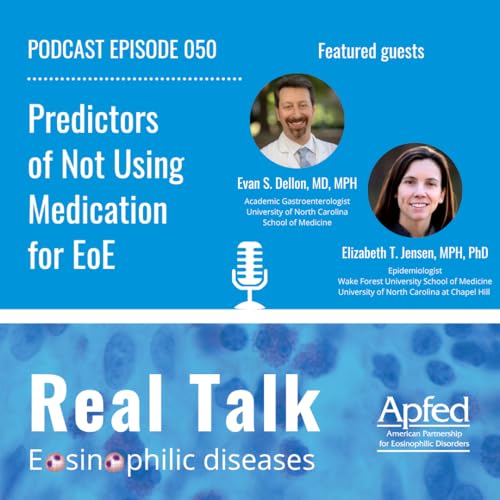
    • Predictors of not using medication for EoE
      Nov 19 2025
      Co-hosts Ryan Piansky, a graduate student and patient advocate living with eosinophilic esophagitis (EoE) and eosinophilic asthma, and Holly Knotowicz, a speech-language pathologist living with EoE who serves on APFED's Health Sciences Advisory Council, interview Evan S. Dellon, MD, and Elizabeth T. Jensen, PhD, about a paper they published on predictors of patients receiving no medication for treatment of eosinophilic esophagitis. Disclaimer: The information provided in this podcast is designed to support, not replace, the relationship between listeners and their healthcare providers. Opinions, information, and recommendations shared in this podcast are not a substitute for medical advice. Decisions related to medical care should be made with your healthcare provider. Opinions and views of guests and co-hosts are their own. Key Takeaways: [:52] Co-host Ryan Piansky introduces the episode, brought to you thanks to the support of Education Partners GSK, Sanofi, Regeneron, and Takeda. Ryan introduces co-host Holly Knotowicz. [1:14] Holly introduces today's topic, predictors of not using medication for EoE, and today's guests, Dr. Evan Dellon and Dr. Elizabeth Jensen. [1:29] Dr. Dellon is an Adjunct Professor of Epidemiology at the University of North Carolina School of Medicine in Chapel Hill. He is also the Director of the UNC Center for Esophageal Diseases and Swallowing. [1:42] Dr. Dellon's main research interest is in the epidemiology, pathogenesis, diagnosis, treatment, and outcomes of eosinophilic esophagitis (EoE) and eosinophilic GI diseases (EGIDs). [1:55] Dr. Jensen is a Professor of Epidemiology with a specific expertise in reproductive, perinatal, and pediatric epidemiology. She has appointments at both Wake Forest University School of Medicine and the University of North Carolina at Chapel Hill. [2:07] Her research primarily focuses on etiologic factors in the development of pediatric immune-mediated chronic diseases, including understanding factors contributing to disparities in health outcomes. [2:19] Both Dr. Dellon and Dr. Jensen also serve on the Steering Committee for EGID Partners Registry. [2:24] Ryan thanks Dr. Dellon and Dr. Jensen for joining the podcast today. [2:29] Dr. Dellon was the first guest on this podcast. It is wonderful to have him back for the 50th episode! Dr. Dellon is one of Ryan's GI specialists. Ryan recently went to North Carolina to get a scope with him. [3:03] Dr. Dellon is an adult gastroenterologist at the University of North Carolina at Chapel Hill. He directs the Center for Esophageal Diseases and Swallowing. Clinically and research-wise, he is focused on EoE and other eosinophilic GI diseases. [3:19] His research interests span the entire field, from epidemiology, diagnosis, biomarkers, risk factors, outcomes, and a lot of work, more recently, on treatments. [3:33] Dr. Jensen has been on the podcast before, on Episode 27. Holly invites Dr. Jensen to tell the listeners more about herself and her work with eosinophilic diseases. [3:46] Dr. Jensen has been working on eosinophilic gastrointestinal diseases for about 15 years. She started some of the early work around understanding possible risk factors for the development of disease. [4:04] She has gone on to support lots of other research projects, including some with Dr. Dellon, where they're looking at gene-environment interactions in relation to developing EoE. [4:15] She is also looking at reproductive factors as they relate to EoE, disparities in diagnosis, and more. It's been an exciting research trajectory, starting with what we knew very little about and building to an increasing understanding of why EoE develops. [5:00] Dr. Dellon explains that EoE stands for eosinophilic esophagitis, a chronic allergic condition of the esophagus. [5:08] You can think of EoE as asthma of the esophagus or eczema of the esophagus, although in general, people don't grow out of EoE, like they might grow out of eczema or asthma. When people have EoE, it is a long-term condition. [5:24] Eosinophils are a type of white blood cell, specializing in allergy responses. Normally, they are not in the esophagus. When we see them there, we worry about an allergic process. When that happens, that's EoE. [5:40] Over time, the inflammation seen in EoE and other allergic cell activity causes swelling and irritation in the esophagus. Early on, this often leads to a range of upper GI symptoms — including poor growth or failure to thrive in young children, abdominal pain, nausea, and symptoms that can mimic reflux. [5:58] In older kids, symptoms are more about trouble swallowing. That's because the swelling that happens initially, over time, may turn into scar tissue. So the esophagus can narrow and cause swallowing symptoms like food impaction. [6:16] Ryan speaks of living with EoE for decades and trying the full range of treatment options: food elimination, PPIs, steroids...
      Afficher plus Afficher moins
      45 min
    Aucun commentaire pour le moment