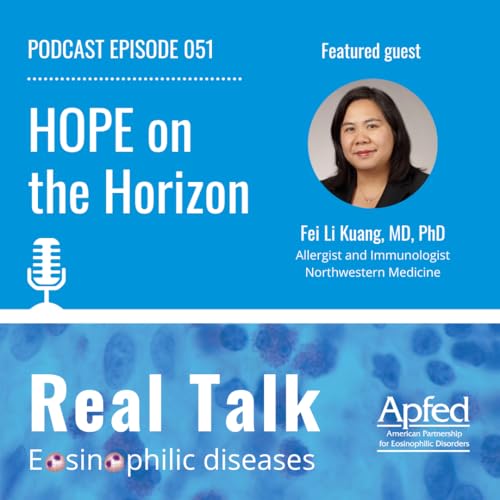
Couverture de HOPE on the Horizon

HOPE on the Horizon

HOPE on the Horizon

Écouter gratuitement

Voir les détails

3 mois pour 0,99 €/mois

Après 3 mois, 9.95 €/mois. Offre soumise à conditions.

À propos de ce contenu audio

Co-hosts Ryan Piansky, a graduate student and patient advocate living with eosinophilic esophagitis (EoE) and eosinophilic asthma, and Holly Knotowicz, a speech-language pathologist living with EoE who serves on APFED's Health Sciences Advisory Council, interview Fei Li Kuang, MD, PhD, an allergist and immunologist, at Northwestern Medicine, about receiving two APFED HOPE on the Horizon Grants. Disclaimer: The information provided in this podcast is designed to support, not replace, the relationship between listeners and their healthcare providers. Opinions, information, and recommendations shared in this podcast are not a substitute for medical advice. Decisions related to medical care should be made with your healthcare provider. Opinions and views of guests and co-hosts are their own. Key Takeaways: [:50] Co-host Ryan Piansky introduces this episode, brought to you thanks to the support of Education Partners GSK, Sanofi, Regeneron, and Takeda. Ryan introduces co-host Holly Knotowicz. [1:14] Holly introduces today's topic, two APFED HOPE on the Horizon Pilot Grant Projects and today's guest, Fei Li Kuang, MD, PhD, an Assistant Professor in the Division of Allergy and Immunology at Northwestern University Feinberg School of Medicine in Chicago, Illinois. [1:42] Dr. Kuang is a physician-scientist who takes care of patients with eosinophilic disorders and also performs laboratory research on these disorders in her lab, often using patient samples. Holly thanks Dr. Kuang for joining us. [2:05] As a child, Dr. Kuang always wanted to be a scientist. She is so grateful to live out her childhood dream, and it's because of the amazing people who have supported her, most importantly, her parents. [2:29] In graduate school, Dr. Kuang studied B cells. When she went on to do an allergy fellowship, she thought she would study B cells and care for patients with B cell problems. Instead, she fell in love with allergy and eosinophilic disorders. [2:50] Dr. Kuang is here, in part, because of the different mentors she has had, and in large part, because of the patients she has met along the way. [3:20] Dr. Kuang had the opportunity to work with Amy Klion at the NIH in a clinical trial to treat patients with a drug that gets rid of eosinophils. She says it was a dream come true after her training. [4:02] She says she learned so much about eosinophils, their unusual biology, and the mystery behind what they are here for. She got hooked. [4:15] Dr. Kuang thinks the patients you meet in a clinical trial in a special place like NIH occupy a space in your heart that makes you want to keep working on the subject area. [4:34] Patients in a clinical trial have given up a bunch of their time to travel to Bethesda, Maryland. For the trial Dr. Kuang participated in as a Fellow, it was a good year of their time to come out and do it. [4:47] Dr. Kuang felt there were so many interesting questions, from an intellectual point of view, but there was also a real need from patients with chronic conditions. It was a beautiful opportunity to marry scientists with physicians in training. [5:36] Dr. Kuang shares some knowledge about eosinophils. They are white blood cells that are in all of us. They have little pink packages or granules that "jumped out" in the light microscope almost 200 years ago, when we first identified them. [6:00] Dr. Kuang says that animals, dating back to reptiles, and different species of dolphins, all have eosinophils. A veterinary scientist, Dr. Nicole Stacy of the University of Florida, has taken photos of eosinophils from all these different species. [6:21] They've been around for a long time. What are they good for? What we know is that they are associated with disease conditions, such as asthma and others, including leukemia. Those were the classic first studies of eosinophils. [6:42] Now, we have a different mindset about eosinophils from work by the late James Lee at Mayo Clinic, Arizona. [6:58] Dr. Kuang credits Dr. Lee with suggesting that eosinophils not just cause us problems but also help treat parasitic infections, maintain tissue homeostasis, help wound healing, and tissue repair. That's a new area we are beginning to appreciate. [7:41] Dr. Kuang says we need to be open-minded that in some circumstances, eosinophils may be helpful or innocent. Now we have tools to start to understand some of that. We need to collect information from patients being treated with medicines. [8:10] Ryan tells of being diagnosed as a kid. Doctors explained to him that eosinophils fight parasites, but in some people, they get confused and attack the esophagus. That's EoE. That was easy to understand, but he knew that the researchers knew more. [8:53] Ryan is grateful to the patient population around eosinophilic esophagitis, and is proud of APFED's support of patients and caregivers with HOPE Grants. APFED has the HOPE on the Horizon Research Program, entirely funded...
Les membres Amazon Prime bénéficient automatiquement de 2 livres audio offerts chez Audible.

Vous êtes membre Amazon Prime ?

Bénéficiez automatiquement de 2 livres audio offerts.
Bonne écoute !
    Aucun commentaire pour le moment
