Épisodes

  • Bob Carr in conversation
    Mar 31 2026

    We are delighted - honoured in fact - to open our 2026 series of conversations with former journalist and State Premier, Bob Carr, speaking about his new memoir, Bring Back Yesterday.

    In October 2023 Bob’s wife of more than fifty years, Helena, suddenly died .

    In this memoir he records his attempt to deal with his grief, switching between the present moment - pacing the night-time streets of Sydney - and reflections on his shared past with Helena, including ruminations on travel, conversations and cultural curiosity.

    Bob Carr was the longest serving Premier of NSW. A committed conservationist, he used his term in power to create literally hundreds of National Parks, preserving vast areas of wilderness. He later held the position of Foreign Minister under Julia Gillard and Kevin Rudd. He is the author of four books, including The Diary of a Foreign Minister.

    Afficher plus Afficher moins
    Moins d'une minute
  • Emily Lighezzolo in conversation
    Mar 31 2026

    Maisie and Charlie meet at a life-drawing session as undergraduates: she’s the model, he’s an artist. Their immediate connection carries them across two decades as they navigate the slippery dynamics of friendship, estrangement and family.

    Emily Lighezzolo’s bold debut interrogates the collision of art and gaze, desire and consent, muse and meaning. This is a love story. At its core: a woman’s body – seen, touched, loved, hated, commodified and reclaimed. Life Drawing is an award-winning and unflinching novel for our times.

    Hypothetically, would you want to live forever but be invisible, or have a short life and be seen? Hypothetically, would you give up wine forever or sex for ten years?Hypothetically, would you show a friend someone else’s nude?

    Emily Lighezzolo has worked in Australian publishing for nearly a decade. Life Drawing won the Glendower Award for an Emerging Queensland Writer at the Queensland Literary Awards and is her first book. She lives in Meanjin/Brisbane.

    Afficher plus Afficher moins
    Moins d'une minute
  • Hugh Mackay in conversation
    Nov 11 2025

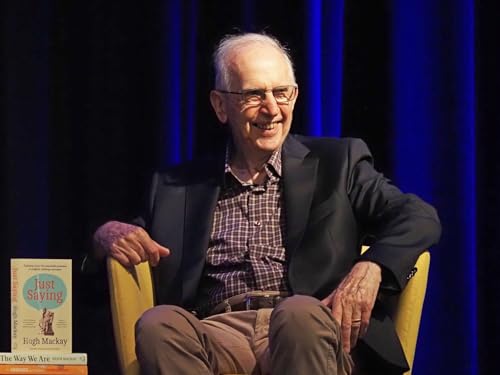
    Hugh Mackay, social psychologist extraordinaire - ‘the man who explains us to ourselves’ has a new book.

    Just Saying is a series of twenty-five essays that take as their starting points statements from writers and thinkers as varied as Susan Sontag and Bertrand Russell, from Samuel Johnson to Gloria Steinem, from Plato to Miles Franklin.

    In these reflections Mackay explores themes ranging from kindness and humility to power and prejudice; from gender equality to ethnic diversity; from coping with change to the damage inflicted on ourselves by revenge, and the great gulf between propriety and virtue.

    Hugh Mackay is the bestselling author of twenty-five books, including The Way We Are and The Kindness Revolution. He had a sixty-year career in social research and was for thirty years a weekly newspaper columnist. In recognition of his pioneering work in social research, he has been awarded honorary doctorates by five Australian universities, as well as being appointed an Officer of the Order of Australia

    This is Hugh’s third visit to Maleny for Outspoken. Hugh, himself, requested to be included in our program, citing the openness and intelligence of the audience. We couldn’t be more delighted to have him return.

    Hugh is in conversation with Steven Lang.

    Afficher plus Afficher moins
    Moins d'une minute
  • Peter Stevens in conversation about Lake Baroon Catchment Care
    Nov 11 2025

    We are, tonight, discussing the new book written by Elaine Green, acclaimed local author of 14 books about community and local history. Unfortunately Elaine is unwell. In her absence Peter Stevens, President of Lake Baroon Catchment Care Group, and myself, will do our best to explain why it was important to have it written.

    Lake Baroon, Caring for Catchment, is a history of both Baroon Pocket, the dam that came to be built there, and of how a community undertook to improve the quality of the water throughout the catchment (along with lots of photos!)

    It shows how a different approach to catchment care - one that involved listening to those who live and farm in the region - delivered remarkable results. It explains how the group grew, over a period of 25 years, from having one person employed for half a day a week, to the single most successful catchment care group in Queensland, with four full-time and two part time staff and a frankly astonishing budget that matches their achievements.

    In a world of environmental woe this is a great story, one that deserves to be celebrated (and recreated in other catchments).

    Afficher plus Afficher moins
    Moins d'une minute
  • Bob Brown in conversation
    Nov 4 2025

    How to begin to introduce Dr Bob Brown? I mean, clearly, you all know exactly who he is and so any introduction is redundant. But, at the same time, the sheer breadth of his achievements over the last six decades are probably not as well known as they should be, so, please, bear with me for a moment.

    After graduating from medicine in 1968, Bob worked in general practice in Canberra, London, Sydney and Perth. He moved to Tasmania in 1972, with his involvement in local environmental politics beginning in 1973, when he became an activist against the damming of Lake Pedder. Although the blockade was not successful, it was this initial clash that led to the formation of the Wilderness Society.

    Six years later he became the President and was responsible for organising the blockade of the dam-works on Tasmania’s Franklin River in 1982. During that blockade, 1500 people were arrested and 600 jailed, including Bob, who spent 19 days in Risdon Prison. On the day of his release from jail, he was elected as the first Green into Tasmania’s Parliament.

    In 1983, the Federal Government decided to intervene and gave the Franklin River heritage protection.

    As a State MP, Bob introduced a wide range of private member’s initiatives. These included his work towards Freedom of Information, Death with Dignity, and Gay Law Reform. In 1987 his bill to ban semi-automatic guns was voted down by both Liberal and Labor members of the House of Assembly, nine years before the Port Arthur massacre. Two years later the same legislation was proposed and passed by the Liberal Party.

    In 1993 he resigned from the Tasmanian Parliament and in 1996 was elected as a Tasmanian Senator to the Federal Parliament where he remained until 2012. In the meantime he was at the centre of the formation of the Australian Greens. After retiring he set up the Bob Brown Foundation, with the specific aim of ‘defending wild places, protecting wildlife, and empowering people to act for nature.’

    Throughout his career Bob has been a tireless campaigner for the environment, in particular for the protection of forests. He’s also written several books, most recently the one we’re going to speak about tonight, Defiance.

    Afficher plus Afficher moins
    Moins d'une minute
  • Heather Rose in conversation
    Oct 13 2025

    It is a few years now since Heather Rose came to Maleny to speak about her memoir Nothing Bad Ever Happens Here. The book revealed that, aside from being a best-selling, internationally-published, award-winning novelist, she had also managed to live a truly remarkable life, pushing the boundaries of the extraordinary in her search for meaning.

    Now she has returned to the novel with A Great Act of Love, a story that begins in 1839 when a young woman ‘of means’, Caroline Douglas, arrives in Hobart, with a young boy in her care. After leasing an old cottage next to an abandoned vineyard, she discovers that, in order to not just survive but flourish in her new life, she will have to navigate an insular colony of exiles and opportunists. But Caroline is carrying a secret of great magnitude and it will take all she is made of to bring it into the light.

    Moving from the champagne vineyards of revolutionary France to London and on to early colonial Australia, A Great Act of Love is a spellbinding novel of legacy, passion and reinvention, inspired by true events. It is an immensely beautiful and heartrending saga of a father and daughter, and the enduring power of familial love.

    Afficher plus Afficher moins
    Moins d'une minute
  • Chris Hammer in conversation
    Oct 7 2025

    These days Chris Hammer is best known for his ‘bush noir’ novels - a category which might even have been created to describe his books. They unravel in far-flung parts of Australia: in the opal fields of Lightning Ridge, out in north-western Victoria, in marginal country. They’re incredibly popular, selling several million to date, all over the world, and two of them have been adapted for television under the title of Scrublands.

    But it wasn’t always thus. Chris started out as a journalist, winning awards for his insights on the machinations in Canberra. By his own account that eventually got too much for him, and he took off, travelling the length of the Murray/Darling from the Paroo to Adelaide, and wrote a book about it, called The River, seeking to depict and understand the complexities of our longest and most important waterway.

    The book was much-lauded, and deservedly so, but its greatest gift might be the sense of the landscape and the people of the bush that has come to imbue his novels. Yes, there’s a crime been committed - and one of his protagonists, Nell Buchanan, or the investigative reporter Martin Scarsden - will have to figure out who done it, but the real hero is always going to be the richness of the place and of the people in which it all happens. There are no stereotypes, just people.

    In his new novel, Legacy, Martin Scarsden is the centre of the action, not because he’s caught the scent of wrong-doing, but because someone is out to kill him. He’s on the run, heading out into the desert, although it seems even there he isn’t safe. He has to simultaneously protect himself, and try to find out who it is that wants him dead.

    Afficher plus Afficher moins
    Moins d'une minute
  • Hugh White in conversation
    Jun 19 2025

    Hugh White argues that, right now, we confront the world's most dangerous crisis in generations, with the old global order facing a direct challenge in three crucial regions: Eastern Europe, the Middle East and East Asia.

    And then there’s Donald Trump, under whose leadership America's retreat from any kind of coherence has been both swift and dramatic.

    For Outspoken Hugh will be discussing his June 2025 Quarterly Essay : Hard New World, Our post-American Future. White examines the dynamics of the US–China rivalry, and the new regional order which is emerging. He explains the big strategic trends driving the war in Ukraine, and why America has already “lost” Asia. He discusses Albanese's record and Labor's future choices in this new world, and where they might lead.

    Hugh White is a former Deputy Secretary for Strategy in the Department of Defence, and was the founding Director of the Australian Strategic Policy Institute. He is now Emeritus Professor of Strategic Studies at the Australian National University in Canberra and is widely regarded as Australia’s pre-eminent commentator on defence matters.

    In his 2022 essay Sleepwalk to War: Australia’s Unthinking Alliance with America, referring to AUKUS, he wrote: 'In the annals of defence policy failure, it is hard to recall anything more absurd than this whole sad mess.'

    Afficher plus Afficher moins
    Moins d'une minute