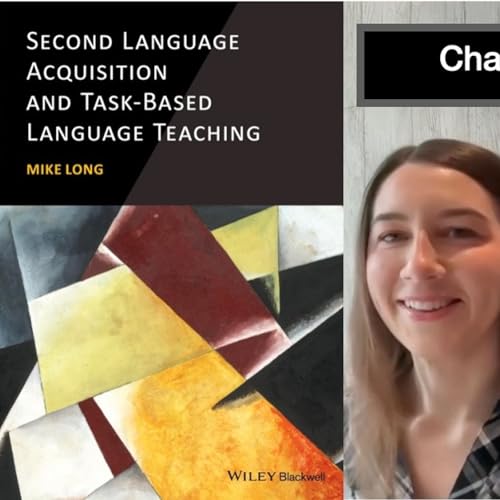
Épisodes

  • Discussing Chapter 5 of Mike Long 2015 Second Language Acquisition and Task-Based Language Teaching
    Apr 10 2026

    This episode on YouTube: https://youtu.be/rWe7gl_sieo

    Brandon and I discuss Chapter 5 of Mike Long's book Second Language Acquisition and Task-Based Language Teaching. This chapter focuses on the rationale for and different approaches to needs analyses in second language instruction.

    Afficher plus Afficher moins
    47 min
  • Ch 4 Mike Long 2015 Second Language Acquisition and Task-Based Language Teaching
    Feb 20 2026
    Brett and I discuss Chapter 4 of Mike Long's 2015 book Second Language Acquisition and Task-Based Language Teaching.00:00 Intro with guest Brett Hall03:08 Chapter overview04:23 'Teaching is a political act'08:23 Can teachers be neutral?12:45 Freedom and Coercion in Education15:45 William Godwin18:19 Adult Learning vs. Child Education18:50 Freedom in education30:32 Exposure vs manipulation34:55 Is learning biologically determined?39:55 Freedom, curiosity and TBLT48:55 Who decides what gets taught, and how?53:47 AI in Language Learning01:03:01 Cooperation vs. Biological Imperatives01:09:02 Adapting Teaching Methods to Student Needs01:14:06 Secondary school vs private language schools01:20:01 Activism in the classroom01:27:30 Towards a conclusion and summaryBrett's podcast can be found at: / @bretthall9080 Episode with Brett reading and discussing the essay 'In Praise of Ignorance': • In praise of ignorance - the podcast. With... The book under discussion can be bought here: https://www.amazon.com/Second-Languag...
    Afficher plus Afficher moins
    1 h et 30 min
  • (1/2) Ch 3 Long 2015 Second Language Acquisition and Task-Based Language Teaching
    Jan 9 2026

    This episode on YouTube: https://youtu.be/MvW0rOxCPHk


    I read and discuss excerpts of Mike Long’s 2015 book Second Language Acquisition and Task-Based Language Teaching. I focus on two key topics:

    1) The status of second-language acquisition (SLA) as a science

    2) The Critical Period Hypothesis


    In the next episode I will talk about implicit and explicit learning.

    References

    DeKeyser, R. M. (2000). THE ROBUSTNESS OF CRITICAL PERIOD EFFECTS IN SECOND LANGUAGE ACQUISITION. Studies in Second Language Acquisition, 22(4): 499–533. doi:10.1017/S0272263100004022

    DeKeyser, R., & Larson-Hall, J. (2005). What does the critical period really mean? In Kroll, J.F., & De Groot, A.M.B. (eds.), Handbook of bilingualism: Psycholinguistic approaches: 88–108. Oxford: Oxford University Press.

    Ioup, G., Boustagui, E., El Tigi, M., & Moselle, M. (1994). Re-Examining the Critical Period Hypothesis: A Case Study of Successful Adult SLA in a Naturalistic Environment. Studies in Second Language Acquisition, 16: 73-98.https://doi.org/10.1017/S0272263100012596

    Laudan, L. (1983). The Demise of the Demarcation Problem. In: Cohen, R.S., Laudan, L. (eds) Physics, Philosophy and Psychoanalysis. Boston Studies in the Philosophy of Science, vol 76. Springer, Dordrecht. https://doi.org/10.1007/978-94-009-7055-7_6

    Long, M.H. (2005a). Problems with supposed counter-evidence to the critical period hypothesis. International Review of Applied Linguistics 43: 287–317.

    Long, M.H. (2013a). Maturational constraints on child and adult SLA. In Granena, G., & Long, M.H. (eds.), Sensitive periods, language aptitude, and ultimate L2 attainment: 3-41. Amsterdam and Philadelphia, PA: John Benjamins.

    Long, M. H. (2015). Second Language Acquisition and Task-Based Language Teaching. Wiley-Blackwell.

    Thornton, Stephen, "Karl Popper", The Stanford Encyclopedia of Philosophy (Winter 2023 Edition), Edward N. Zalta & Uri Nodelman (eds.), URL = https://plato.stanford.edu/archives/win2023/entries/popper/

    Vanhove J. (2013). The critical period hypothesis in second language acquisition: a statistical critique and a reanalysis. PloS one, 8(7), e69172. https://doi.org/10.1371/journal.pone.0069172

    Afficher plus Afficher moins
    43 min
  • Discussing Nunan (1988) Syllabus Design, Chapters 1-3
    Nov 24 2025

    I and my colleague Brandon, a new teacher, discuss chapters 1-3 of David Nunan's 1988 book Syllabus Design.The book can be accessed here.


    Key concepts discussed in this video include:

    - product-oriented and process-oriented syllabuses

    - the grammatical syllabus

    - the functional

    -notional syllabus

    - analytic versus synthetic syllabuses

    Afficher plus Afficher moins
    36 min
  • (2/2) Ch 3 Long 2015 Second Language Acquisition and Task-Based Language Teaching
    Jan 13 2026

    In this episode I finish the discussion of Long 2015 Chapter 3 by talking about implicit and explicit learning. In this episode we hear about empirical studies into implicit/explicit learning, the Interaction Hypothesis, and two key conditions for SLA: sensitivity to input and saliency of the target items.

    This episode on YouTube: https://www.youtube.com/watch?v=niqjAm2D7SI

    First episode (1/2): https://youtu.be/MvW0rOxCPHk

    ReferencesGass, S. M., & Mackey, A. (2007). Input, interaction, and output in second language acquisition. In B. Vanpatten, & J. Williams (Eds.), Theories in second language acquisition (pp. 175-200). London: LEA.Long, M. H. (2015). Second Language Acquisition and Task-Based Language Teaching. Wiley-Blackwell.

    Afficher plus Afficher moins
    42 min
  • Discussing Allwright (2005) "From Teaching Points to Learning Opportunities & Beyond"
    Apr 9 2026

    Watch this episode on YouTube: https://youtu.be/n1zP_Js0gS0

    Arthur and I discuss the concept of aims in language lessons through a discussion of this paper:

    Allwright, D. (2005). From Teaching Points to Learning Opportunities and Beyond. TESOL Quarterly, 39, 9-31.

    It can be accessed here (page 9): https://www.researchgate.net/profile/Bryan-Smith-20/publication/227762726_The_Relationship_Between_Negotiated_Interaction_Learner_Uptake_and_Lexical_Acquisition_in_Task-Based_Computer-Mediated_Communication/links/5490463c0cf214269f266472/The-Relationship-Between-Negotiated-Interaction-Learner-Uptake-and-Lexical-Acquisition-in-Task-Based-Computer-Mediated-Communication.pdf#page=9

    If you enjoyed this episode, consider subscribing!

    Afficher plus Afficher moins
    1 h et 14 min
  • Do we need aims? Discussing Allwright 2005 "From Teaching Points to Learning Opportunities & Beyond"
    Nov 4 2025

    Arthur and I discuss the concept of aims in EFL lessons through a discussion of this paper:


    Allwright, D. (2005). From Teaching Points to Learning Opportunities and Beyond. TESOL Quarterly, 39, 9-31.


    It can be accessed here (page 9):

    https://www.researchgate.net/profile/Bryan-Smith-20/publication/227762726_The_Relationship_Between_Negotiated_Interaction_Learner_Uptake_and_Lexical_Acquisition_in_Task-Based_Computer-Mediated_Communication/links/5490463c0cf214269f266472/The-Relationship-Between-Negotiated-Interaction-Learner-Uptake-and-Lexical-Acquisition-in-Task-Based-Computer-Mediated-Communication.pdf#page=9If you enjoyed this episode, consider subscribing!

    Afficher plus Afficher moins
    1 h et 14 min
  • Discussing Chapters 1-2 of Long (2015) Second Language Acquisition and Task-Based Language Teaching
    Dec 20 2025

    Arthur and I discuss chapters 1-2 of Mike Long (2015) Second Language Acquisition and Task-Based Language Teaching.Quotations read out during the podcast, with added context:§1.1, page 3: 'Most of us are familiar with traditional student populations: captive school children required to “pass” a foreign language (often for no obvious reason), college students satisfying a language requirement or working toward a BA in literature, young adults headed overseas for university courses, as missionaries or to serve as volunteers in the Peace Corps and similar organizations, and adults needing a L2 for vocational training or occupational purposes in the business world, aid organizations, the military, federal and state government, or the diplomatic and intelligence services. Typically, these students are literate, well educated, relatively affluent, learning a major world language, and, the school children aside, doing so voluntarily.'§1.2, page 7: '[W]hat is gained by blurring the original meaning of (in this case) ‘task-based’ until it denotes something quite different, and indeed, opposed to the original meaning of the term? In fact, it is not hard to see what is gained and by whom. Synthetic approaches, especially grammatical syllabuses, are palatable to commercial publishers and various politically powerful LT institutions because they are what underlie at least 90% of existing, commercially highly successful textbooks sold around the world.'§1.3, page 8: 'As with any theory, the embryonic cognitive-interactionist theory goes beyond the data in hand, so may eventually turn out to be wrong, wholly or in part, thereby under- mining the validity of parts of TBLT. That is the nature of theories, which by definition go beyond the facts in an attempt to fill in the gaps in our knowledge and, more importantly, seek to explain the facts we think have been established.'§1.3.2: 'The principles [of TBLT] are ones to which most language teachers and students subscribe in their everyday lives – principles that need not be forgotten in the classroom. They include educating the whole person, learning by doing, rationalism, free association, learner-centeredness, egalitarian teacher–student relationships, and participatory democracy. Interestingly, the implications of these philosophical principles and those of TBLT’s psycholinguistic underpinnings converge in most cases.'§1.3.6, page 13: 'There is some evidence, after all, that a certain degree of tension, or classroom anxiety, can have a positive effect on learning (Scovel 1978), probably because it activatesa process known to be critical for language learning: attention.'Other references: Taking Children Seriously: https://takingchildrenseriously.com/Sponge ELT's discussions of Long which talk about how to apply it to children:Sponge Chats - Perspectives on TBLT teacher education with Lara Bryfonski • Sponge Chats - Perspectives on TBLT teache... Sponge Chats - Perspectives on TBLT with Martin East • Sponge Chats - Perspectives on TBLT with M...

    Afficher plus Afficher moins
    55 min