Épisodes

  • Why Your Best Leadership Work Is Still Ahead | Doug Conant | 747
    Oct 29 2026
    Most CEOs treat leadership development as something to delegate. Doug Conant taught the classes himself, and kept doing it while recovering from a near-fatal car accident. In this companion episode to The Thought Leadership Handbook, Bill Sherman sits down with the former President and CEO of Campbell Soup Company, founder of ConantLeadership, and NYT bestselling author of TouchPoints. Together they explore a thought leadership journey that didn't start at retirement. It ran quietly alongside a 50-year career. Doug's view of leadership is simple: put people first. If you invest in your talent, your talent invests in the agenda. That belief carried him from a political science classroom through Nabisco and Campbell's. Along the way, 52 people who once worked for him went on to become CEOs themselves. The conversation also goes to harder places. Doug talks about being fired ten years into his career, and how an outplacement counselor pushed a self-described introvert to stop being who everyone wanted him to be. He describes his first day as Campbell's CEO, alone in a wood-paneled office, realizing he depended entirely on people in a thousand rooms he would never enter. Bill and Doug also dig into a question every thought leader eventually faces. With hundreds of leadership books out there, what can you uniquely add? Doug's answer is the "been there, done that" perspective of someone who had to show up every Monday and deliver. Bill offers a framework for how ideas move: awareness, acceptance, and activation. Doug adds a humbling truth: most people get it wrong the first time, and that's part of the process. Doug also shares why he's more energized than ever. Inspired by a nudge from Alan Mulally and by Stephen Covey's idea of living life in crescendo, he's launching the Higher Ground Leadership Success System, a new framework built from five decades of practice. This episode suits anyone building a second act around their expertise. It's also for anyone wondering how to make their ideas travel when they aren't in the room, or who suspects their best work hasn't happened yet. Three Key Takeaways: • Understanding is important, but insufficient. An idea only creates value when people can apply it on Monday morning. Thought leaders need to design for activation, not just awareness. • Your distinct contribution comes from lived experience. In a crowded field like leadership, Doug stands out by speaking as an operator who carried real responsibility week after week. That perspective is hard to replicate. • Thought leadership is a continuous apprenticeship. Doug calls himself an apprentice even after 50 years. Ideas keep evolving after a book is published, and the best thinkers keep refining how they explain what they see. Doug Conant's story doesn't end with this episode. His journey from Fortune 500 CEO to leadership thought leader is one of the case studies in The Thought Leadership Handbook: How the Experts Elevate Their Big Ideas—And How You Can Too. Drawing on more than 700 conversations from this podcast, authors Bill Sherman, Peter Winick, and Naren Aryal map the patterns behind journeys like Doug's. The book covers how to find what you uniquely add, how to choose the right business model, and how to move ideas from awareness to action. If this conversation got you thinking about your own next season, the Handbook gives you frameworks and tools to plan it. Visit thoughtleadershiphandbook.com for a free excerpt and to discover your thought leadership avatar. Order your copy today from Amazon, Barnes & Noble, Bookshop, or Amplify Publishing Group.
    Afficher plus Afficher moins
    30 min
  • Innovation Ecosystems: Why Systems Thinking Beats Siloed Problem-Solving | Ilene Fischer | 746
    Oct 25 2026
    Seventy percent of organizational change efforts fail. Ilene Fischer has spent 35 years working out why. Her answer has less to do with strategy than with whether people feel safe enough to say what they actually think. Few people have had a front-row seat like hers. She started as a chemical engineer and moved into quality management. Then she spent a decade with Peter Senge's Innovation Associates and eight years at the Tom Peters Company. Her new book, Innovation Ecosystems: A Dynamic Blueprint for Organizational Success and Engagement, combines systems thinking with a bias for action. The idea first took shape when she watched fearless, collaborative teams at NASA Langley Research Center. In this conversation, Peter Winick pushes on the "why now." Ilene's case is that the structures that worked in 1990 can't keep up with today's speed and complexity: silos, linear problem-solving, fixing one thing at a time. She points to nine disruptive forces reshaping business. One is a Gen Z workforce that demands purpose. Another is a talent shortage that is really a shortage of people with deep expertise in two unrelated fields. Then it gets practical. At a healthcare insurer, cross-functional teams with no formal leader went after a $15 million gain in operating margin. At a pharmaceutical company, a 25-person team of PhDs and MDs met once a year and took 12 years to develop a drug. Moving to a core team of eight that worked in weekly cycles cut that time. Peter also raises the positioning question every thought leader faces: is this change management, culture or innovation? Ilene says it's all three, because changing how people work changes the culture. That leads to a sharp exchange on why "change management" has become a damaged brand, and why every client claims to be "ready to rock and roll." Her organizational readiness assessment, taken by at least 50 people inside a company, is built to separate perception from reality. For thought leaders there's another layer. Peter does an "archaeological dig" into how Ilene's ideas build on Senge and Peters while still standing as her own distinctive IP. Ilene is clear about her ambition: this isn't a book, it's a movement. If you lead teams, advise executives or build ideas meant to change how organizations work, this episode is worth your 20 minutes. Three Key Takeaways: • Change fails when people don't feel heard. Resistance is the biggest obstacle to any change effort, and it usually comes from people who don't feel safe to speak up. Deep listening at the start turns resisters into your strongest supporters. • Silos can't keep up with today's complexity. Linear, one-problem-at-a-time thinking worked in a slower era. Today, cross-functional teams that include customers and vendors and work in weekly cycles move faster and drop fewer balls. • Culture determines whether innovation happens. In a culture of fear, people stop experimenting and stop using their talents. Change how people work and you change the culture, but check honestly whether the organization is ready before you start. Ilene Fischer's story shows that a great idea is only the beginning. She spent years absorbing the thinking of Peter Senge and Tom Peters before shaping it into a framework that's distinctly her own. If you're working to turn your own expertise into IP that stands out, The Thought Leadership Handbook by Peter Winick and his co-authors Bill Sherman and Naren Aryal shows how to shape it, package it and scale it in a crowded market. Learn more at thoughtleadershiphandbook.com, and order your copy today from Amazon, Barnes & Noble, Bookshop or Amplify.
    Afficher plus Afficher moins
    20 min
  • Neurodivergent Talent Doesn't End at the Hiring Door | Caroline Maguire | 745
    Oct 18 2026
    Companies are hiring neurodivergent talent to build their algorithms, power their hedge funds, and design their AI. Then they lose those people, and nobody can explain why. In this episode, Peter Winick sits down with Caroline Maguire, social-emotional learning expert and author of Why Will No One Play With Me? and the new Friendship Skills for Neurodivergent Adults (Hachette). Caroline has spent more than two decades on a problem that, as she puts it, "people really didn't talk about": the social gaps that make it harder for neurodivergent people to connect, communicate, and belong. The conversation starts with timing. When Caroline wrote her first book, publishers wouldn't offer a big deal for anything with diagnostic labels in it. By her second book, diagnosis rates had surged, and she pitched that shift as a market opportunity. Peter uses this to make a broader point for thought leaders: build on ideas that are evergreen, then connect them to whatever wave is coming. You can't control the wave, but you can watch for it. From there, the focus moves to the workplace. Most organizations, Caroline argues, think the work ends once someone is hired. It doesn't. Instructions like "show me everything you've got" or "be a team player" mean very little to someone who doesn't easily read social cues. Managers have to boost the signal and be explicit. That change, she points out, makes them better managers for everyone. The business case is direct. Gallup data still shows that what people want most at work is a friend. There's a loneliness epidemic in offices, and people who don't feel integrated leave. Sometimes they leave for less money. Most companies only call someone like Caroline after the damage is done, which Peter compares to buying a burglar alarm after the house has been robbed. Caroline also explains how she takes her work to market. She uses a book to attract media attention, works her network hard to reach decision-makers, and gets in the door by training senior leaders and line managers. If you lead teams, build talent strategy, or are trying to carve out a niche of your own, this episode gives you a clear way to think about the market and the people in it. Three Key Takeaways: • Hiring is the starting line, not the finish line. Organizations recruit neurodivergent talent for how they think, but without training managers to communicate explicitly, those hires struggle to integrate and often leave. • Belonging is a retention strategy. Employees who don't feel connected at work are more likely to leave, even for less money, so workplace friendship and social skills are business issues, not "soft" extras. • Find the problem nobody's talking about, then own it. Caroline built her niche by spotting a well-documented problem the field ignored, earning the credentials to back it up, and timing her book for when the market was ready. Caroline Maguire's path is a working example of how thought leadership gets built. She spotted a problem nobody was talking about, earned the credentials to own it, and timed a big book to the moment the market was ready. Then she used that book to bring in media, open doors with decision-makers, and turn her expertise into paid engagements. That path from idea to impact is what The Thought Leadership Handbook: How the Experts Elevate Their Big Ideas—and How You Can Too lays out, step by step. Peter Winick wrote it with Bill Sherman and Naren Aryal, drawing on more than 700 conversations from this podcast. Inside, you'll find the patterns behind successful thought leadership journeys and five avatars to help you identify your own path. You'll also get practical frameworks and tools for making your ideas visible, trusted, and scalable. Learn more at thoughtleadershiphandbook.com, and order your copy today from Amazon, Barnes & Noble, Bookshop.org, or Amplify Publishing.
    Afficher plus Afficher moins
    19 min
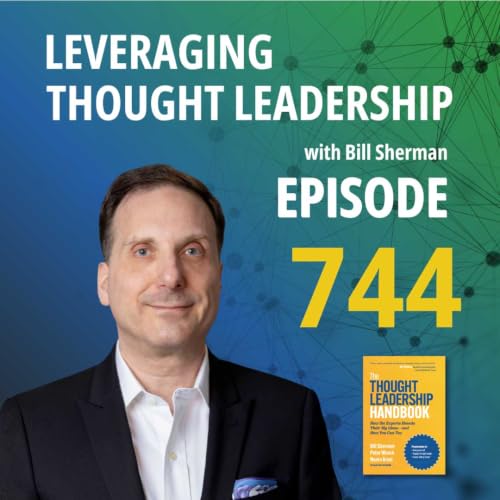
  • The Trusted Advisor: How a Wisdom Book Became Business Language | Charlie Green| 744
    Oct 15 2026
    Publishers turned it down. They said there was no data and no market for a "wisdom book." Twenty-five years and roughly 700,000 copies later, The Trusted Advisor is still on consultants' shelves, and "trusted advisor" has become so common that many people use the phrase without knowing where it came from. In this episode, Bill Sherman talks with Charlie Green, co-author of The Trusted Advisor, founder of Trusted Advisor Associates and former New York cab driver, about where one of the most durable ideas in professional services came from. The story starts with luck. Two business school friends were trading consulting stories over coffee when a chance meeting with David Maister fixed their publishing problem in one phone call. One flaw in an older model, which Charlie had to fix, became the trust equation, the part of the book that stuck with readers. From there the conversation moves to bigger questions every thought leader faces. Should you protect your intellectual property, or treat ideas as part of a shared commons? Charlie is blunt: "Don't be too full of yourself." He argues that the idea itself is a bit overrated and that the real advantage is in how you express and package it. Charlie, a former philosophy major, also explains why defining your terms precisely helped turn a loose concept into something people could use. Bill and Charlie also look at "little-t truth," the practical, imperfect wisdom that helps people handle hard conversations and build relationships. They talk about the duty to share it, and the humility to accept that your audience doesn't owe you its attention. They explain why repeating yourself is necessary rather than redundant. Charlie shares how he gives the same talk hundreds of times and still finds it fresh. The conversation ends warmly. Charlie talks about the signs that his ideas have landed, including a phone call showing the book had been passed down to a second generation. Bill closes with a personal thank-you that shows just how far an idea can travel. If you've ever wondered whether your ideas will outlast you, or whether you're saying them enough, this episode is for you. Three Key Takeaways: • Expression beats ownership. Very few ideas are truly unique. What sets a thought leader apart is how clearly, memorably and usefully they communicate an idea, not whether they've trademarked it. •Define your terms, then repeat them. "Trusted advisor" was already a common phrase. Giving it a precise meaning, and repeating that meaning consistently, is what made it a shared language others could pick up. •Repetition is not redundancy. Just because you've written or posted something doesn't mean your audience has read it, let alone absorbed it. Like a stage actor's thousandth performance, each delivery is new for the people in front of you. Charlie Green's story of how The Trusted Advisor went from rejected "wisdom book" to everyday business language is the kind of journey Bill Sherman, Peter Winick and Naren Aryal map out in their new book, The Thought Leadership Handbook: How the Experts Elevate Their Big Ideas—and How You Can Too. Charlie draws on Bill's "little-t truth" from the book in this episode. The book also covers the episode's other big lessons: define your terms precisely, keep repeating your ideas, and accept that ideas don't speak for themselves. It draws on more than 700 conversations from this podcast and gives you the frameworks, case studies and tools to move your own ideas from insight to impact. Learn more and get a free chapter at thoughtleadershiphandbook.com, and order your copy today at Amazon, Barnes & Noble, Bookshop or Amplify Publishing.
    Afficher plus Afficher moins
    34 min
  • Why Focus Is a Team Problem, Not a Personal One | Shawn Vanderhoven | 743
    Oct 11 2026
    A leader stands up in the middle of a 200-person workshop, slams his hand on the table, and says out loud what everyone in the room is feeling: I can't do great work here anymore. That moment helped start Pause: How to Lead Brilliant Work in a Busy World, and it's where this conversation gets interesting. Shawn Vanderhoven leads the executive development practice at the Wiseman Group and collaborated on the second edition of Multipliers. His argument is simple and uncomfortable. The productivity crisis in knowledge work isn't mainly personal. It's social. When the medium is speed, speed becomes the message. Teams learn that responding fast signals value, and deep, cognitively demanding work gets crowded out. Peter pushes on the practical problem. One person can't opt out of team norms without paying a career price, so the smallest unit of change is the team. Shawn agrees. That's why his research looked at two sets of behaviors: what leaders do to create space and clarity, and how contributors "pause up" to make the case to their bosses. The book covers 12 tested practices, and teams are meant to pick a few rather than all of them. One of them, "house rules," produced large gains in what Shawn calls traction time: time spent on the top priority. The conversation also addresses AI directly. Shawn argues that for most people, AI's productivity benefit is marginal, and the real risk is producing a lot of mediocre work very fast. He also has a line that reframes burnout: it often comes less from doing too much than from having too little impact. For thought leaders, the business side is just as useful. Shawn explains how Pause was built as a product line, not only a book. It includes a free team quiz and distraction inventory, partner-led workshops from 15 minutes to a full day, coaching materials, keynotes, and an AI tool called Jam that runs a fast, low-friction team 360 and coaches leaders on one distracting behavior at a time. There's also a story here about building your own IP inside someone else's firm. Shawn expected to leave the Wiseman Group to pursue this research. Liz Wiseman's answer was, "Of course you can do this here. I'll coach you." If your team is busy but not moving the work that matters, this episode is worth your time. Three Key Takeaways: • Productivity is a social problem, not a personal one. Individuals can tweak their habits, but team norms set the pace. Lasting change means building a team "bubble" that puts clarity and space ahead of constant connectivity. • Small, tested behaviors beat big resolutions. Pause offers 12 research-backed practices, and teams pick only the few they need most. Practices like "house rules" produced measurable gains in time spent on top priorities. • Great IP needs a product line, not just a book. Pause scales through a free quiz, a distraction inventory, partner-led workshops, coaching tools, keynotes, and an AI assistant. Each gives buyers a different way to engage with the ideas. Shawn Vanderhoven didn't stop at writing Pause. He turned his research into a free team quiz, partner-led workshops, coaching tools, keynotes, and an AI assistant, so buyers have several ways to put his ideas to work. The Thought Leadership Handbook by Peter Winick, Bill Sherman, and Naren Aryal explains the thinking behind moves like these: how to test an idea, choose the formats that fit your buyers, and build a lasting business around what you know. If this episode got you thinking about what your ideas could become beyond the page, the Handbook is a practical next step. Learn more at thoughtleadershiphandbook.com, and get your copy from Amazon, Barnes & Noble, Bookshop, or Amplify Publishing.
    Afficher plus Afficher moins
    20 min
  • How to Scale Executive Coaching Across an Entire Organization | Billy Hoogterp | 742
    Oct 1 2026

    Ask professionals at the world's biggest companies whether they have a plan for their own learning and growth, and Bill Hoogterp says the answer is almost never yes. He built LifeHikes around that gap, and in this episode he shows how a happy accident turned into a scalable model.

    Bill's career reads like a series of rivers rather than a roadmap: a decade of living cashless and keyless, nonprofits that mobilized over a million student volunteers, an internet company that grew into Raptive, and, 12 years ago, a pivot into training and coaching. Peter presses him for the through line, and the answer says a lot about how ideas take shape.

    The pivotal moment came at a public speaking session with a room full of Hollywood agents. Bill's coaches had started offering ten free minutes of executive coaching during breaks. When one agent asked for an honest read on himself in front of the group, a line formed. Peter calls it the free sample model, the same play bakeries and Costco have run for years.

    Those short conversations surfaced a bigger problem. Learning is highly structured until school ends, and then people are on their own, with no system for mapping what to learn, what the business needs, and where they want to go. As Prudential's Charlie Lowrey put it, it's the 401(k) before the 401(k). LifeHikes is Bill's answer: a model any company can customize, shaped by regular conversations with a couple hundred learning leaders. He is also moving his shares into a foundation, which is now working with the Mastercard Foundation on workforce skills for young people in Africa.

    Then the conversation gets personal. Bill has coached celebrities and CEOs, and he is direct about what he sees behind the titles: plenty of people who look like they're crushing it are running on empty. Beyond a certain income, he argues, fulfillment comes from growth, challenge, meaning, and adventure, and how society keeps score shapes what we chase. He even asks Peter to guess how much potential most people leave on the table.

    If you build ideas for a living, or lead people who do, this one is worth your time. It's a candid look at how a small experiment becomes a model, and what a model is ultimately for.

    Three Key Takeaways:
    • Give people a taste and demand follows. Ten free minutes of executive coaching at the end of a training session revealed a hunger most people didn't know they had. The sample became the on-ramp to a much larger business.

    • Growth is a missing system, not a missing desire. Once school ends, nobody maps out what you should learn or where you're headed. A customizable, 401(k)-style model gives companies a way to fill that gap for everyone, not just the top tier.

    • How you keep score shapes what you chase. Past a certain income, happiness comes from growth, challenge, meaning, and adventure, not the next raise. Change the scoring, as the three-point line changed basketball, and you change the game.

    This conversation is basically the book in miniature. Bill's LifeHikes story — free coaching samples turning into a scalable model, one insight at a time — is exactly the pattern Peter, Bill Sherman, and Naren Aryal mapped out after 700+ podcast conversations with thought leaders. If you want the frameworks behind what you just heard, not just the anecdote, pick up The Thought Leadership Handbook, co-authored by Peter Winick, Bill Sherman, and Naren Aryal. It's available now at Amazon, Barnes & Noble, Amplify and Bookshop.org.

    Afficher plus Afficher moins
    19 min
  • How to Stand Out When AI Makes Content a Commodity | Jack Myers | 741
    Sep 27 2026
    What if the one thing you've spent your career building, your expertise, is about to become the least valuable thing you own? In this episode of Leveraging Thought Leadership, Peter Winick sits down with Jack Myers, a media ecologist, futurist, and author of Your Third Brain: Powering a Future of Unimagined Possibilities. Jack launched The Myers Report as a fax newsletter in 1984, founded MediaVillage, and has spent decades watching each new medium reshape the people who use it. The two have known each other for more than ten years. Peter's focus is how to scale, leverage, and monetize ideas; Jack's is the humanity behind them. Jack's argument starts with a simple observation: distribution and content creation are now commodities. When anyone can publish anywhere and AI can replicate knowledge on demand, information stops being the product. Citing his NYU mentor Neil Postman, he calls information a form of garbage and predicts that expertise alone will carry almost no commercial value within a few years. What AI can't replace, he says, is lived experience, ethical judgment, empathy, intuition, and trust. Peter pushes back with the other side of that coin. Today's AI is the worst it will ever be, but there's a flip side: laziness and AI slop that quietly burn through the trust a brand has spent years building. His litmus test is simple. If a semi-intelligent reader can tell, you've failed. Jack's answer centers on discernment and on the consistent, original, deeply human work that makes an audience show up in the first place. The conversation also covers why Jack wrote another book in a market flooded with them, what he means by the "third brain," techno-intelligence, and techno-intuition, and why he calls this moment a potential spiritual awakening without meaning anything religious. Jack also shares the advice he gave a young Newhouse graduate that very morning: build a career on relationships, not a resume. For authors, speakers, consultants, and executives wondering where their ideas hold value as AI gets faster, this episode is worth the time. Three Key Takeaways: • Information and expertise are being commoditized. With distribution and content creation available to everyone, and AI able to replicate knowledge on demand, expertise alone no longer differentiates you. Jack expects its commercial value to shrink fast. • Judgment, discernment, and trust are the new premium. AI can't replicate lived experience, ethical judgment, empathy, or intuition. The thought leaders who break through will lead with who they are, not only what they know. • Relationships beat reach. Originality, consistency, and genuine human connection build the trust that keeps an audience coming back. Follower counts and content volume can't deliver that, and AI can't do it consistently. Jack Myers makes the case that expertise alone is no longer enough, and that the leaders who stand out will be the ones who know how to turn their ideas into visible, trusted impact. That is the problem Peter Winick set out to solve with co-authors Bill Sherman and Naren Aryal in The Thought Leadership Handbook: How the Experts Elevate Their Big Ideas, and How You Can Too. The book draws on more than 700 conversations from this podcast, distilling the patterns behind how ideas get built, scaled, and monetized into frameworks you can apply to your own work. Learn more at thoughtleadershiphandbook.com, then order your copy today from Amazon, Barnes & Noble, Bookshop, or Amplify Publishing.
    Afficher plus Afficher moins
    21 min
  • Building Trust Between Humans and AI in R&D| Jayshree Seth| 740
    Sep 20 2026
    What does it take for a corporate scientist with zero direct reports to land on a list dominated by business school professors and bestselling authors? That's the question Jayshree Seth had to answer for herself when she was named to the Thinkers50 Radar in 2025 — and her answer became a framework. In her third appearance on the show, Jayshree Seth, 3M's Chief Science Advocate and now-published trilogy author, returns to catch listeners up on a remarkable stretch: a Thinkers50 keynote, a panel alongside Amy Edmondson, an HBR collaboration on trust and AI, and the release of her third book, The Heart of Science: Engineering Blueprint. The conversation moves through several of Jayshree's signature acronym-driven frameworks. There's METRICS-OPTICS-RUBRICS-ENERGETICS, born from reflecting on how she — an engineer with no traditional management credentials — ended up on a list built for management thinkers. There's the "three Cs" that block innovation: copy-pasting, catchphrositis, and cherry-picking, delivered as her Thinkers50 keynote. And there's VIABLE, her personal-branding framework built around voice and visibility, image and impact, backstory and behaviors, and experience and exposure. Beyond the frameworks, this is a conversation about the mechanics of building a reputation from inside a technical role. Jayshree traces the specific chain of relationships — a mention in David Epstein's book Range, an introduction to Rita McGrath, an eventual collaboration with Amy Edmondson on psychological safety and "intelligent failure" applied to human-AI trust — that turned an internal 3M scientist into an external voice cited in Harvard Business Review and Fast Company. Bill and Jayshree also dig into what it means to write a book for three different audiences at once — emerging thought leaders, established experts, and Hall of Fame-level veterans — and why friction in that process is often a sign you're doing it right. The episode closes with a reflection on responsibility: once you have an audience, thought leadership isn't a hobby, it's a discipline that has to coexist with a full-time job. If you've ever wondered whether your expertise "counts" as thought leadership because it didn't come with a traditional credential, this one's for you. Three Key Takeaways: • Being different can be your competitive advantage, not a liability. Jayshree's METRICS-OPTICS-RUBRICS-ENERGETICS framework argues that outsiders to a field — like an engineer among management thinkers — don't need to conform to existing rubrics. Changing the measurement, the framing, and the energy you bring can alter who gets to lead a conversation. • Reaching out to "inaccessible" experts is a discipline, not a gamble. Jayshree's collaborations with Amy Edmondson, Rita McGrath, and others didn't start with credentials — they started with cold outreach after reading an article or hearing a podcast. The lesson: most thought leaders are more accessible than they appear, and it's okay if they say no. • A personal brand for thought leadership rests on delivery, not image. Her VIABLE framework (voice/visibility, image/impact, backstory/behaviors, experience/exposure) puts the emphasis on tangible results and consistent values over aesthetics — visibility only amplifies a brand that already has substance behind it. This episode isn't just an interview — it's a live example of the ideas in Bill's brand-new book, The Thought Leadership Handbook, co-written with Peter Winick and Naren Aryal. Jayshree's journey — from in-house corporate scientist to Thinkers50 Radar honoree — is practically a case study for the book's core idea: that thought leadership follows identifiable patterns, not luck. In fact, the book itself draws on more than 700 conversations from this very podcast, and organizes those stories into five thought leadership "avatars" — Jayshree's path as an In-House Expert turned public voice fits right into that framework. If her VIABLE branding model resonated with you, the Handbook goes deeper into exactly how experts like her make that leap from personal effort to public influence. Pick up The Thought Leadership Handbook: How the Experts Elevate Their Big Ideas — And How You Can Too, by Bill Sherman, Peter Winick, and Naren Aryal, wherever books are sold — including Amazon, Barnes & Noble, and Amplify Publishing Group's website.
    Afficher plus Afficher moins
    40 min