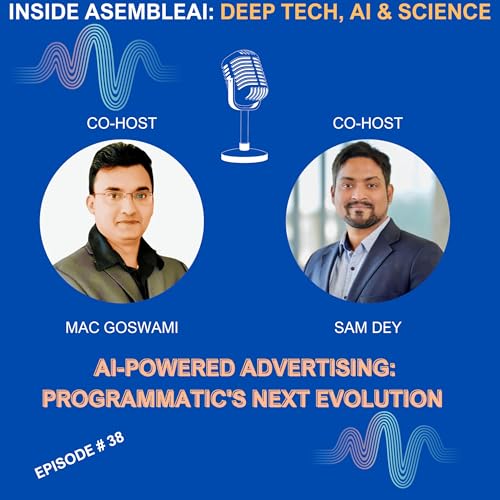
Couverture de Inside AsembleAI: DeepTech, AI & Science

Inside AsembleAI: DeepTech, AI & Science

Inside AsembleAI: DeepTech, AI & Science

De : Mac & Sam
Écouter gratuitement

À propos de ce contenu audio

AsembleAI brings you thought-provoking conversations at the nexus of artificial intelligence, innovation, and leadership. In each episode, hosts Mac and Sam, veterans in data and tech world, sit down with AI researchers, fast‑scaling founders, Fortune 500 executives, and pioneering technologists to reveal how AI is reshaping business strategy, sparking breakthrough product development, and guiding executive decisions. Tune in for actionable insights, compelling case studies, and forward‑looking perspectives on the promises and pitfalls of AI‑driven innovation.Mac & Sam 2025 Science
Épisodes
  • EP 40: AI Analytics: From Hindsight to Foresight
    Feb 25 2026

    AI analytics represents a fundamental shift from analyzing what happened to predicting what will happen. Traditional marketing analytics was retrospective-dashboards showing last month's performance, reports explaining why campaigns succeeded or failed. AI analytics is prospective-predictive models forecasting customer behavior, propensity scores indicating conversion likelihood, churn risk signals identifying at-risk customers before they leave.

    The shift in marketing team composition is significant. Traditional teams were heavy on creative and campaign managers. AI-driven marketing teams need data scientists, analytics engineers, and marketing technologists who understand both strategy and technical implementation. The skillset evolves from "what message resonates" toward "what patterns in customer data predict behavior we can influence."

    Critical pitfalls include overfitting models on historical data, optimizing for proxies rather than actual business outcomes, and creating feedback loops where AI recommendations reinforce existing biases rather than discovering new opportunities. Privacy regulations like GDPR and CCPA create constraints on what data you can collect and how you can use it for profiling.

    The ROI is compelling. McKinsey research shows businesses using advanced analytics growing 10-15% faster than competitors, with 20-40% improvement in marketing efficiency through better targeting and resource allocation.

    Afficher plus Afficher moins
    16 min
  • EP 39: AI Chatbots: 95% of Interactions by 2025
    Feb 25 2026

    Servian Global Solutions projects that 95% of customer interactions will be AI-powered by 2025. We're in 2026 now-that's not a future prediction anymore, it's the present reality. The chatbot market is growing by $11.45 billion through 2026, fueled by major advances in natural language processing and machine learning making chatbots intuitive, context-aware, and capable of handling genuinely complex conversations.

    Modern AI chatbots differ dramatically from frustrating automated systems of years ago. These systems now understand context, handle follow-up questions, detect sentiment, and maintain conversation flow naturally. They're not doing keyword matching scripts anymore—they're using transformer models similar to ChatGPT, trained specifically for customer service scenarios with reinforcement learning for real-time contextual awareness.

    However, limitations exist. Chatbots struggle with truly novel situations they haven't been trained on, can't make judgment calls requiring human empathy, and occasionally hallucinate confidently incorrect information—which is why accuracy checking and clear escalation paths matter. Some customers simply prefer human interaction regardless of AI capability, which businesses must respect.

    Cost savings are substantial but shouldn't be the only driver. NIB Health Insurance saved $22 million through AI-driven digital assistance, reducing customer service costs by 60%. The strategic value extends beyond cost reduction: 24/7 availability supports customers globally, instant response times improve satisfaction, and consistent answer quality eliminates variance in agent knowledge.

    Afficher plus Afficher moins
    14 min
  • EP 38: AI-Powered Advertising: Programmatic’s Next Evolution
    Feb 25 2026

    Traditional ad buying involved manual targeting, static audiences, and fixed bids. AI advertising uses machine learning to optimize targeting, bidding, and creative selection in real time across millions of data points. Performance Max and Meta Advantage+ campaigns represent this evolution - algorithms handling what used to require entire teams of media buyers.

    Smart bidding algorithms adjust bids based on conversion likelihood, time of day, device type, user behavior history, competitor activity, and dozens more variables simultaneously. This dynamic approach consistently outperforms manual bid management, especially for campaigns with large audiences and multiple ad variations. However, human strategy and oversight remain necessary—marketers must set clear goals, supply quality creative assets, and analyze performance to ensure AI automation aligns with business objectives.

    Critical risks include over-optimization—AI might optimize for metrics that don't actually align with business goals. Optimizing for clicks gets clicks but might not deliver quality traffic. Optimizing for conversions without considering lifetime value might acquire expensive customers who churn quickly. The human role is defining success properly so AI optimizes toward meaningful outcomes.

    Looking at 2026, programmatic advertising moves toward full automation. For small businesses without media buying expertise, this democratizes access to sophisticated advertising. For agencies and specialists, it forces evolution toward strategic consulting rather than tactical execution.

    Afficher plus Afficher moins
    13 min
Aucun commentaire pour le moment