Épisodes

  • 973 - Giving Advice in English - Have You Ever Thought About It?
    Jan 22 2026
    Do you ever feel a little uncomfortable giving advice in English? Maybe you want to help someone - but you don’t want to sound pushy, bossy, or rude. So you’re not sure what to say. The good news is, native speakers rarely give advice in a very direct way. Instead of saying things like, “You should do this,” we usually soften our advice and make it sound more friendly and conversational.

    So today, let’s look at some very common, very natural ways native speakers give advice in everyday English.


    Happy English Podcast – Speak English Naturally I’m Michael from Happy English, and I help people speak English more naturally, confidently, and clearly.

    🎥 Watch video versions of the Happy English Podcast on YouTube:
    https://www.youtube.com/@HappyEnglishNY/podcasts

    📘 Build your vocabulary with my free Vocabulary Workshop:
    https://learn.myhappyenglish.com/vocabulary-workshop-signup

    🌐 Learn more about my English lessons and courses:
    https://www.myhappyenglish.com
    Afficher plus Afficher moins
    9 min
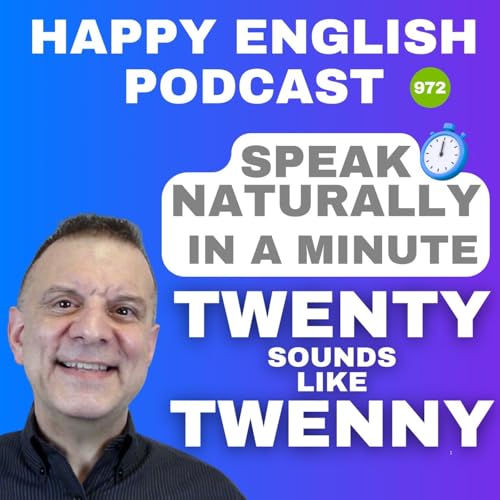
  • 972 - Why Americans Don’t Say the T in Winter
    Jan 20 2026
    Hey there! It’s Michael here - and welcome back to Speak Naturally in a Minute from Happy English. I’m here every week with a quick one-point lesson to help you improve your pronunciation, rhythm, and intonation. And if you want to watch this lesson, just look for Happy English Podcast on YouTube.

    Today, let’s talk about something fun in American English: Why “winter” and “winner” often sound exactly the same.

    This happens because of a sound change called the N-flap. When N + T comes between two vowel sounds, the T often disappears or becomes a soft flap - something like a quick D sound.
    • winter sounds like winner
    • twenty sounds like twenny
    • plenty sounds like plenny

    For example:
    • “I don’t like winter weather.” sounds like “I don’t like winner weather.”
    • “We invited twenty people.” sounds like “We invited twenny people.”

    This isn’t slang - it’s just the natural rhythm of American English.

    Hey, thanks for listening! And remember to follow and subscribe so you won’t miss the next Happy English Podcast and next week’s Speak Naturally in a Minute. Until next time, keep learning and keep it cool.


    Happy English Podcast – Speak English Naturally I’m Michael from Happy English, and I help people speak English more naturally, confidently, and clearly.

    🎥 Watch video versions of the Happy English Podcast on YouTube:
    https://www.youtube.com/@HappyEnglishNY/podcasts

    📘 Build your vocabulary with my free Vocabulary Workshop:
    https://learn.myhappyenglish.com/vocabulary-workshop-signup

    🌐 Learn more about my English lessons and courses:
    https://www.myhappyenglish.com
    Afficher plus Afficher moins
    2 min
  • 971 - Talking About Plans and Intentions in English - Want To, Plan To, Be Going To, Hope To, and Intend To
    Jan 18 2026
    Do you ever notice that when you talk about your plans in English, you use the same phrase again and again?
    Maybe you say things like: “I’m gonna do this.” “I’m gonna go there.” “I’m gonna improve my English.” Those sentences are totally fine. No problem at all.

    But native speakers don’t only use “be going to” when they talk about future plans. We also use phrases like want to, plan to, hope to, and even intend to - and each one sounds a little different. So today, let’s look at five very common ways to talk about plans and intentions in English, and how native speakers really use them in everyday conversation.

    Watch video versions of the Happy English Podcast on YouTube: https://www.youtube.com/@HappyEnglishNY/podcasts
    Build Vocabulary With My Free Vocabulary Workshop: https://learn.myhappyenglish.com/vocabulary-workshop-signup
    Afficher plus Afficher moins
    8 min
  • 970 - It Turns Out - English Tips in a Minute | Happy English
    Jan 18 2026
    Hey there! It’s Michael here — and welcome back to English Tips in a Minute from Happy English. I’m here every week with a short, simple tip to help you speak English more naturally and confidently. And if you want to watch this lesson, just look for Happy English Podcast on YouTube.

    Today, let’s look at a really useful conversational phrase — “it turns out (that).”
    We use it turns out to mean actually or in fact, especially when the result is surprising or different from what we expected.
    • Like, I left the house in a hurry, and it turns out I forgot my wallet.
    • Or when talking about relationships: They dated for a while, but it turns out they weren’t compatible.
    • We also use this phrase when we discover new information: I did some research, and it turns out my grandfather was a taxi driver for a while.

    So remember, when something ends up being different than you expected, try using “it turns out…” It’s a very natural way to tell that kind of story in English.

    Lemme know in the comments how it goes, and remember to follow or subscribe so you don’t miss the next Happy English Podcast and next week’s English Tips in a Minute. Hey, thanks for listening — and until next time, keep learning and keep it cool.

    Watch video versions of the Happy English Podcast on YouTube: https://www.youtube.com/@HappyEnglishNY/podcasts

    Build Vocabulary With My Free Vocabulary Workshop: https://learn.myhappyenglish.com/vocabulary-workshop-signup
    Afficher plus Afficher moins
    2 min
  • 969 - Map Out - Phrasal Verbs in a Minute | Happy English
    Jan 17 2026
    I’m here every week with a quick one-point lesson to help you learn a new phrasal verb and sound more natural when you speak. By the way, if you want to see the video version of this lesson, just look for Happy English Podcast on YouTube.

    Today’s phrasal verb is map out. When you map out something, it means you plan it carefully, step by step - just like drawing a map.
    • Like, a lot of people map out their goals for the new year - health, work, hobbies, all of it.
    • My friend Olivia mapped out her budget for 2026 so she can save more.
    • And I just mapped out my podcast schedule for the next few months… busy but exciting!

    And here’s a pronunciation tip. The P of Map links with out. Ma-pout

    So how about you? Have you mapped out anything for the new year? Let me know in the comments, and remember to follow or subscribe so you don’t miss the next Happy English Podcast and next week’s Phrasal Verbs in a Minute. Hey, thanks for listening - and until next time, keep learning and keep it cool.

    Watch video versions of the Happy English Podcast on YouTube: https://www.youtube.com/@HappyEnglishNY/podcasts
    Build Vocabulary With My Free Vocabulary Workshop: https://learn.myhappyenglish.com/vocabulary-workshop-signup
    Afficher plus Afficher moins
    2 min
  • 968 - Talking About Obligation in English - Have To, Must, Need To, and Be Supposed To
    Jan 13 2026
    Do you ever feel like English has too many ways to say the same thing? Maybe you’ve wondered why English has have to, must, need to, and be supposed to, when they all seem to mean something like “I should do this.” Like, “I have to work late.” “I must finish this.” “I need to call her.” “I’m supposed to send the email.”

    Today, we’ll look at four very common ways to talk about obligation, rules, and expectations - and you’ll hear how each one sounds a little different, even though they’re all connected to “things we should do.”

    Watch video versions of the Happy English Podcast on YouTube: https://www.youtube.com/@HappyEnglishNY/podcasts
    Build Vocabulary With My Free Vocabulary Workshop: https://learn.myhappyenglish.com/vocabulary-workshop-signup
    Afficher plus Afficher moins
    9 min
  • 967 - OR Sounds like ER - Speak Naturally in a Minute
    Jan 12 2026
    Hey there! It’s Michael here - and welcome back to Speak Naturally in a Minute from Happy English. I’m here every week with a quick one-point lesson to help you improve your pronunciation, rhythm, and intonation. And if you want to watch this lesson, just look for Happy English Podcast on YouTube.

    One of the biggest pronunciation secrets in American English is how we reduce the sound “or.”
    In everyday conversation, “or” often becomes a quick, relaxed “er.”
    • Do you want tea er coffee
    • Should we meet today er tomorrow?
    • Is your answer, yes er no?

    This small reduction keeps the rhythm smooth and relaxed.

    Hey, thanks for listening! And remember to follow and subscribe so you won’t miss the next Happy English Podcast and next week’s Speak Naturally in a Minute. Until next time, keep learning and keep it cool.

    Watch video versions of the Happy English Podcast on YouTube: https://www.youtube.com/@HappyEnglishNY/podcasts
    Build Vocabulary With My Free Vocabulary Workshop: https://learn.myhappyenglish.com/vocabulary-workshop-signup
    Afficher plus Afficher moins
    1 min
  • 966 - When It Comes To - English Tips in a Minute | Happy English
    Jan 10 2026
    Hey there! It’s Michael here - and welcome back to English Tips in a Minute from Happy English. I’m here every Saturday with a short, simple tip to help you speak English more naturally and confidently. And if you want to watch this lesson, just look for Happy English Podcast on YouTube.

    Today, let’s look at a very useful conversational phrase - “when it comes to…”
    We use when it comes to followed by a sentence, to mean regarding or about. When it comes to
    is a great way to introduce a topic or give your opinion.
    • Like, “When it comes to cooking, my sister is amazing.”
    • Or “When it comes to playing sports, well, it’s not my cup of tea.”
    • And you know what, when it comes to learning English, I’m glad you found me here!

    It’s simple, natural, and you’ll hear it all the time - at work, in casual conversations, evenin TV shows and movies. So remember, the next time you want to give your opinion about a topic, try using “when it comes to…” It’s one of the most natural ways to start that sentence.

    Lemme know in the comments how it goes, and remember to follow or subscribe so you don’t miss the next Happy English Podcast and next Saturday’s English Tips in a Minute. Hey, thanks for listening - and until next time, keep learning and keep it cool.

    Watch video versions of the Happy English Podcast on YouTube: https://www.youtube.com/@HappyEnglishNY/podcasts
    Build Vocabulary With My Free Vocabulary Workshop: https://learn.myhappyenglish.com/vocabulary-workshop-signup
    Afficher plus Afficher moins
    2 min