Couverture de GORE AND GRIME PODCAST 80's Reviews

GORE AND GRIME PODCAST 80's Reviews

GORE AND GRIME PODCAST 80's Reviews

De : Gruesome Hertzogg Presents
Écouter gratuitement

GORE AND GRIME PODCAST 80's reviewsGruesome Hertzogg Presents Art
Épisodes
  • Child’s Play (1988)
    May 12 2026

    Released on November 9, 1988, Child’s Play introduced the world to Chucky, a Good Guys doll possessed by the soul of serial killer Charles Lee Ray. Directed by Tom Holland (who also directed Fright Night), the film is a standout of the late-80s slasher era for its clever blend of supernatural horror and dark humor.

    Key Production Facts

    • Practical Effects Mastery: Before the era of CGI, Chucky was brought to life using a complex mix of animatronics, puppetry, and actors in suits (most notably Ed Gale). The production utilized different sized dolls—some larger than life—to create the illusion of movement.

    • The Voice: Brad Dourif provided the iconic voice of Chucky. His performance was so integral that he recorded his lines ahead of time so the crew could sync the doll's animatronic mouth to his delivery.

    • Original Concept: The initial script by Don Mancini, titled Blood Buddy, was more of a psychological "whodunit" where it wasn't clear if the doll was alive or if the young Andy was committing the murders.

    Legacy and Style

    The film is celebrated for its gritty urban atmosphere (set in a wintry Chicago) and its transition from a suspenseful thriller into a full-blown "splatter" climax. Unlike later sequels that leaned heavily into camp and meta-comedy, the 1988 original played the premise with a surprising amount of tension and straight-faced horror.


    Afficher plus Afficher moins
    6 min
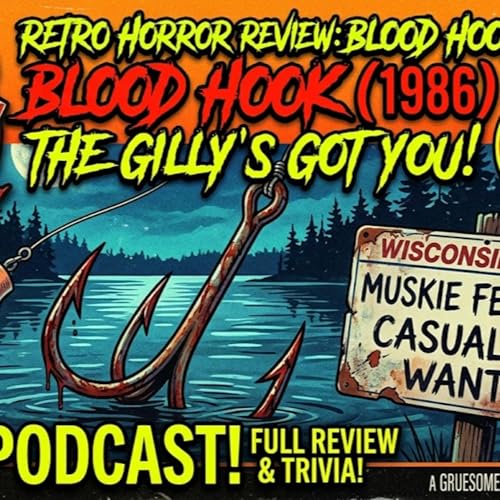
  • Blood Hook (1986)
    May 12 2026

    Blood Hook (1986)

    Directed by James Mallon, Blood Hook is a unique entry in the 1980s slasher wave, blending rural horror with a quirky, Midwest dark-humor aesthetic. It remains a notable title for fans of "splatter" and practical effects mastery from that era.

    The story follows Peter van Giese, who returns to a lakeside community in Wisconsin for a local fishing festival years after his grandfather vanished under mysterious circumstances. Soon, Peter's friends and other festival participants begin to disappear. They are being targeted by a colossal, razor-sharp fishing hook wielded by a deranged killer who "casts" for human prey.

    • Practical Effects: True to the "1986 horror" trend, the film features creative and gruesome practical "splatter" mastery, specifically revolving around fishing-related kills.

    • Midwest Setting: The film was shot on location in Wisconsin, giving it a distinct atmosphere compared to the coastal or suburban slashers common at the time.

    • Creative Team: Director James Mallon later became well-known for his extensive work as a producer on Mystery Science Theater 3000.

    Plot OverviewProduction Highlights

    Afficher plus Afficher moins
    6 min
  • Psycho III (1986)
    May 12 2026

    Psycho III (1986)

    Directed by and starring Anthony Perkins, Psycho III is often cited as a standout entry in the franchise for its stylish direction and Perkins' deeply nuanced return to Norman Bates. It leans further into the "slasher" aesthetic of the mid-80s while maintaining the psychological gothic atmosphere of the original.

    Set shortly after the events of Psycho II, Norman Bates is back running the Bates Motel. His fragile stability is threatened when two people enter his life: Maureen Coyle, a disgraced nun who bears a striking resemblance to Marion Crane, and Duane Duke, a sleazy musician looking for work. As Norman struggles with his "Mother" persona, a local reporter begins snooping into the disappearance of Emma Spool, leading to a new cycle of violence.

    • Direction: This marked Anthony Perkins' directorial debut. He brought a "German Expressionist" flair to the film, using bold colors and unconventional camera angles.

    • Practical Effects: The film is well-regarded for its creative kill sequences and impressive practical makeup effects, moving away from the more restrained approach of the earlier films.

    • Music: Deviating from the traditional Bernard Herrmann strings, the score by Carter Burwell (in one of his earliest roles) features an eerie, electronic-infused sound that fits the 80s era perfectly.

    Plot OverviewProduction Highlights

    Afficher plus Afficher moins
    6 min
adbl_web_anon_alc_button_suppression_t1
Aucun commentaire pour le moment