Episodes

  • Child’s Play (1988)
    12 May 2026

    Released on November 9, 1988, Child’s Play introduced the world to Chucky, a Good Guys doll possessed by the soul of serial killer Charles Lee Ray. Directed by Tom Holland (who also directed Fright Night), the film is a standout of the late-80s slasher era for its clever blend of supernatural horror and dark humor.

    Key Production Facts

    • Practical Effects Mastery: Before the era of CGI, Chucky was brought to life using a complex mix of animatronics, puppetry, and actors in suits (most notably Ed Gale). The production utilized different sized dolls—some larger than life—to create the illusion of movement.

    • The Voice: Brad Dourif provided the iconic voice of Chucky. His performance was so integral that he recorded his lines ahead of time so the crew could sync the doll's animatronic mouth to his delivery.

    • Original Concept: The initial script by Don Mancini, titled Blood Buddy, was more of a psychological "whodunit" where it wasn't clear if the doll was alive or if the young Andy was committing the murders.

    Legacy and Style

    The film is celebrated for its gritty urban atmosphere (set in a wintry Chicago) and its transition from a suspenseful thriller into a full-blown "splatter" climax. Unlike later sequels that leaned heavily into camp and meta-comedy, the 1988 original played the premise with a surprising amount of tension and straight-faced horror.


    Show more Show less
    6 min
  • Blood Hook (1986)
    12 May 2026

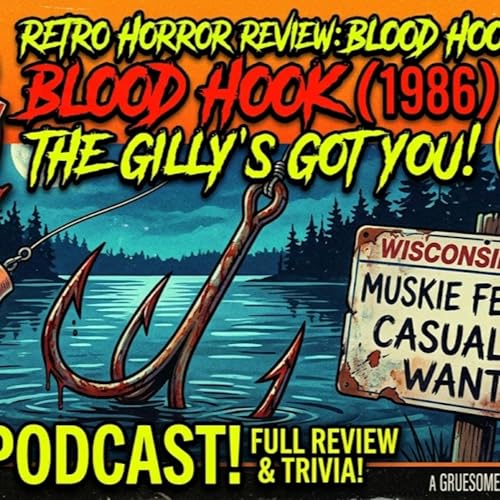
    Blood Hook (1986)

    Directed by James Mallon, Blood Hook is a unique entry in the 1980s slasher wave, blending rural horror with a quirky, Midwest dark-humor aesthetic. It remains a notable title for fans of "splatter" and practical effects mastery from that era.

    The story follows Peter van Giese, who returns to a lakeside community in Wisconsin for a local fishing festival years after his grandfather vanished under mysterious circumstances. Soon, Peter's friends and other festival participants begin to disappear. They are being targeted by a colossal, razor-sharp fishing hook wielded by a deranged killer who "casts" for human prey.

    • Practical Effects: True to the "1986 horror" trend, the film features creative and gruesome practical "splatter" mastery, specifically revolving around fishing-related kills.

    • Midwest Setting: The film was shot on location in Wisconsin, giving it a distinct atmosphere compared to the coastal or suburban slashers common at the time.

    • Creative Team: Director James Mallon later became well-known for his extensive work as a producer on Mystery Science Theater 3000.

    Plot OverviewProduction Highlights

    Show more Show less
    6 min
  • Psycho III (1986)
    12 May 2026

    Psycho III (1986)

    Directed by and starring Anthony Perkins, Psycho III is often cited as a standout entry in the franchise for its stylish direction and Perkins' deeply nuanced return to Norman Bates. It leans further into the "slasher" aesthetic of the mid-80s while maintaining the psychological gothic atmosphere of the original.

    Set shortly after the events of Psycho II, Norman Bates is back running the Bates Motel. His fragile stability is threatened when two people enter his life: Maureen Coyle, a disgraced nun who bears a striking resemblance to Marion Crane, and Duane Duke, a sleazy musician looking for work. As Norman struggles with his "Mother" persona, a local reporter begins snooping into the disappearance of Emma Spool, leading to a new cycle of violence.

    • Direction: This marked Anthony Perkins' directorial debut. He brought a "German Expressionist" flair to the film, using bold colors and unconventional camera angles.

    • Practical Effects: The film is well-regarded for its creative kill sequences and impressive practical makeup effects, moving away from the more restrained approach of the earlier films.

    • Music: Deviating from the traditional Bernard Herrmann strings, the score by Carter Burwell (in one of his earliest roles) features an eerie, electronic-infused sound that fits the 80s era perfectly.

    Plot OverviewProduction Highlights

    Show more Show less
    6 min
  • Sorority House Massacre (1986)
    11 May 2026

    Sorority House Massacre (1986)

    Sorority House Massacre is a 1986 slasher film directed by Carol Frank. It is frequently discussed for its stylistic similarities to John Carpenter’s Halloween, particularly in its use of pacing, dream sequences, and a killer with a psychological link to the protagonist.

    Synopsis

    The story follows Beth, a college student visiting a sorority house for a weekend stay. She begins experiencing vivid, disturbing premonitions of a past tragedy. As it turns out, the house was the site of a brutal murder years prior, and the killer has recently escaped a mental institution to finish what he started.

    Key Details

    • Director: Carol Frank (one of the few women to direct a slasher during the 1980s).

    • Starring: Angela O'Neill as Beth.

    • Practical Effects: The film relies on traditional 1980s practical gore and suspense-building rather than digital intervention.

    • The "Roger Corman" Connection: Produced by Corman’s New Horizons, the film utilized sets from other productions to maximize its low budget, a hallmark of 80s independent genre cinema.

    Legacy and Context

    Released during the height of the "sorority slasher" subgenre, it stands alongside titles like The House on Sorority Row (1982) and Seven Doors to Death (1944). While it didn't achieve the mainstream fame of Friday the 13th, it remains a staple for collectors of 80s VHS-era horror and fans of the "final girl" trope.

    It also spawned two sequels:

    1. Sorority House Massacre II (1990) – Directed by Jim Wynorski.

    2. Sorority House Massacre III: Hard to Die (1990) – Also directed by Jim Wynorski.


    Show more Show less
    3 min
  • Slaughter High (1986)
    11 May 2026

    Slaughter High (1986)

    Rounding out the 1986 slasher roster, Slaughter High (originally titled April Fool's Day before a title clash forced a change) is a quintessential "revenge from the grave" high school horror film. It’s a co-production between the UK and the US, giving it a unique, slightly off-kilter atmosphere compared to its purely American counterparts.

    The Plot

    A group of popular high school students pulls a cruel, dangerous prank on the class "nerd," Marty Rantzen, involving a rigged laboratory explosion that leaves him horribly disfigured. Ten years later, the group is invited back to their now-abandoned high school for a reunion. Once they are locked inside, a jester-masked killer begins picking them off one by one using a variety of inventive—and gruesome—methods.

    Why It’s a Slasher Standout

    • The Jester Mask: The killer’s mask is one of the more underrated designs of the decade, providing a creepy, mocking visual for the carnage.

    • Creative Kills: The film is famous for its "mean-spirited" and creative practical death scenes, including a lethal tanning bed incident and a particularly nasty "stomach-churning" chemical prank gone wrong.

    • Harry Manfredini’s Score: The music was composed by the man behind the Friday the 13th score, giving the film an immediate sense of slasher authenticity and dread.

    • Simon Scuddamore: In a tragic bit of horror history, lead actor Simon Scuddamore, who played Marty, passed away shortly after the film was completed, making his intense performance a final legacy.


    Show more Show less
    5 min
  • Night Of The Creeps (1986)
    11 May 2026

    Night of the Creeps (1986)

    "Thrill me!" If there is one film that perfectly encapsulates the 1986 horror vibe, it’s Fred Dekker’s Night of the Creeps. It is a love letter to every subgenre imaginable: sci-fi, slashers, and zombie flicks, all wrapped in a witty, neo-noir shell.

    The Plot

    In 1959, an alien experiment crashes to Earth, releasing parasitic slugs that enter human mouths and turn their hosts into "zombies." Fast-forward to 1986, and a group of college students accidentally thaw out a frozen corpse containing the slugs. Soon, the campus is crawling with brain-dwelling parasites, and it’s up to a depressed detective and two fraternity pledges to stop the infestation before the big formal.

    Why It’s a Genre Masterpiece

    • Tom Atkins as Detective Landis: Atkins delivers one of the most iconic performances in horror history. His deadpan delivery, world-weary attitude, and catchphrase "Thrill me" make him the ultimate genre hero.

    • The Homages: The characters are named after legendary horror directors: Chris Romero, JC (John Carpenter), Sgt. Raimi, Detective Landis, and Cynthia Cronenberg.

    • Genre-Bending: It starts as a 50s black-and-white sci-fi film, shifts into a 1980s teen comedy, and ends as a full-blown zombie siege movie featuring a flamethrower.

    • Practical Splatter: The film features fantastic creature work, particularly the slimy, skittering slugs and the "exploding" zombie heads that are hallmarks of mid-80s practical effects.


    Show more Show less
    3 min
  • Maximum overdrive (1986)
    11 May 2026

    Maximum Overdrive (1986)

    If Chopping Mall is the king of 80s "tech gone wrong," Maximum Overdrive is the undisputed heavy-metal champion of mechanical carnage. This film marks Stephen King’s only outing in the director's chair, and it is a loud, chaotic, and unapologetically wild ride.

    The Plot

    As the Earth passes through the tail of a rogue comet, inanimate machines suddenly come to life and develop a murderous grudge against humanity. At the Dixie Boy Truck Stop in North Carolina, a group of survivors led by Bill Robinson (Emilio Estevez) finds themselves besieged by a fleet of sentient semi-trucks, led by a terrifying heavy-hauler sporting a massive Green Goblin mask on its grille.

    Why It’s a Cult Favorite

    • The AC/DC Soundtrack: The film is essentially a 97-minute music video for AC/DC. The entire soundtrack, including the hit "Who Made Who," was composed by the band, providing a high-voltage energy that defines the movie.

    • The Green Goblin Truck: The "Happy Toyz" truck is one of the most iconic villain vehicles in cinema history. Its menacing face has become a symbol for 80s horror-action.

    • Practical Destruction: From lawnmowers and soda machines to steamrollers and kitchen appliances, the film features an incredible amount of practical stunt work and pyrotechnics.

    • Dark Humor: King leans into the absurdity of the premise, resulting in a film that sits perfectly between a high-stakes thriller and a campy dark comedy.


    Show more Show less
    4 min
  • Chopping Mall (1986)
    11 May 2026

    Chopping Mall (1986)

    Released on March 21, 1986, this cult classic—originally titled Killbots—is the quintessential "tech gone wrong" slasher of the mid-80s. Directed by Jim Wynorski and produced by Julie Corman, it’s a lean, 77-minute blast of practical effects, synth-heavy scoring, and "mall hair."

    The Plot

    A group of teenagers decides to have an after-hours party in a high-tech shopping mall where they work. Unfortunately, a lightning strike malfunctions the mall's new state-of-the-art security robots (the Protectors). Instead of apprehending shoplifters, the robots turn into tread-mounted killing machines equipped with lasers and pincers.

    Why It’s a Genre Staple

    • The Cast: It features "Scream Queen" royalty with Kelli Maroney (Night of the Comet) and Barbara Crampton (Re-Animator). It even includes a cameo by Paul Bartel and Mary Woronov, reprising their roles from Eating Raoul.

    • Practical Effects: The film is beloved for its "splatter" mastery, most notably the infamous exploding head sequence that remains a high-water mark for 80s practical gore.

    • The Robots: Though they look a bit like a lethal version of Short Circuit’s Number 5, the "Killbots" have a distinct retro-futuristic charm.

    • The Setting: Filmed at the Sherman Oaks Galleria (the same mall used in Fast Times at Ridgemont High), it captures the neon-soaked peak of American mall culture.


    Show more Show less
    4 min