Épisodes

  • Risk, Models, and Financial Decision‑Making with Petter Kolm, PhD and Gordon Ritter, PhD
    Jun 11 2026

    Petter Kolm, PhD and Gordon Ritter, PhD, join Lotta Moberg, PhD, for a conversation on quantitative models, risk, and financial decision‑making. The discussion examines how models are constructed and evaluated, the assumptions that underpin them, and the trade‑offs involved when applying theory to real‑world financial problems. Kolm and Ritter share perspectives on model risk, uncertainty, and the role of judgment alongside data, offering insights relevant to both researchers and practitioners working at the intersection of finance and analytics.

    Afficher plus Afficher moins
    42 min
  • Infrastructure Debt with Clements, Ricciardelli, Beckman and Le Bret
    May 21 2026

    Philip Clements, CFA, Alfonso Ricciardelli, CFA, Matthieu LeBret and Simon Beckman join Will Goodhart (CFA Institute Research Foundation Board of Trustees), to discuss their recent brief on infrastructure debt and its growing role in institutional portfolios. The conversation explores how infrastructure debt has evolved from a niche allocation into a core component of alternative credit, shaped by the energy transition, government funding needs, and limits on bank balance sheets. The guests examine risk characteristics across the asset class, including construction risk, technology change, political uncertainty, and interest‑rate regimes, as well as how infrastructure debt fits alongside equity, private credit, and real assets. The discussion also covers renewable energy, data centers, and why infrastructure is increasingly central to long‑term investment strategy.

    Afficher plus Afficher moins
    48 min
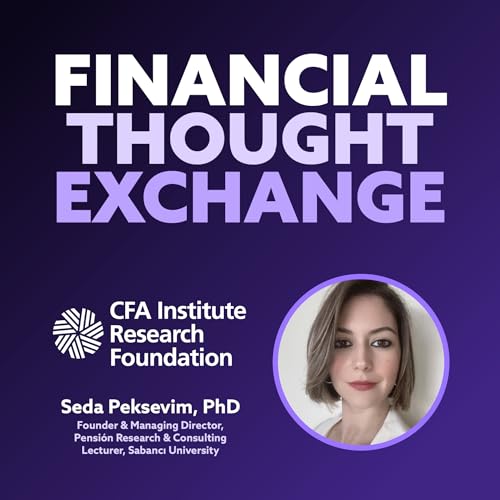
  • Designing Pension Systems for Emerging Markets with Seda Peksevim, PhD
    Apr 30 2026

    Laurence B. Siegel hosts a conversation with Seda Peksevim, PhD, Founder & Managing Director of Pensión Research & Consulting and Lecturer at Sabancı University, on how pension systems must be designed differently in emerging market economies.

    Dr. Peksevim explains why retirement outcomes are shaped by three interconnected challenges: behavioral biases that limit saving, unstable and risky labor income, and heightened financial market volatility. She discusses the critical role of automatic enrollment, default options, and lifecycle fund design—and why importing pension models from developed markets without adjustment can produce poor results.

    The discussion also explores multipillar pension systems, behavioral and technological tools to improve participation, micro‑pension innovations, and the complexities of both accumulation and decumulation under uncertainty. The central takeaway: effective pension systems must be context‑specific, behaviorally informed, and aligned with local economic realities.

    Afficher plus Afficher moins
    36 min
  • Hedge Funds Explained: Risk, Returns & Due Diligence with Stephen J. Brown, PhD
    Apr 2 2026

    In this episode of the Financial Thought Exchange, Lotta Moberg, CFA, PhD, speaks with Stephen J. Brown, PhD, Emeritus Professor of Finance at Monash University in Australia and at the Stern School of Business at New York University, and winner of the CFA Institute Research Foundation 2025 James R. Vertin Research Award.

    Brown discusses the origins of hedge funds, their role as liquidity providers, and why their performance often disappoints relative to public markets. He explains how hedge fund risk differs from traditional market risk, the limits of diversification, and why rigorous due diligence is essential. The conversation also explores his research on sensation‑seeking behavior among hedge fund managers and its implications for risk‑adjusted returns.

    Related research by Stephen J. Brown:

    • Why Hedge Funds

    https://www.tandfonline.com/doi/full/10.2469/faj.v72.n6.6

    • Sensation Seeking and Hedge Funds

    https://www.jstor.org/stable/26656034

    Afficher plus Afficher moins
    40 min
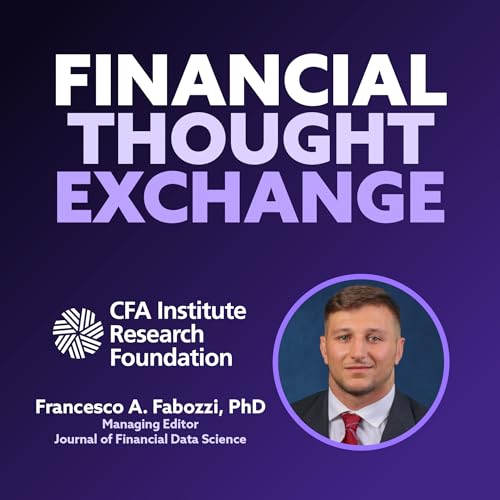
  • How LLMs Transform Investment Workflows: Fine-Tuning, RAG & Agents with Francesco Fabozzi
    Mar 12 2026

    In Part 2, Francesco Fabozzi, PhD—Managing Editor of the Journal of Financial Data Science—joins host Lotta Moberg, CFA, PhD, to explore how modern NLP and large language models are reshaping investment management. Building on the technical foundations from Part 1, this episode turns to real-world applications: when to fine‑tune models versus rely on prompt engineering, how retrieval‑augmented generation (RAG) keeps models current with fast‑changing financial information, and why agentic systems are emerging as powerful tools for research automation. Fabozzi explains practical use cases ranging from sentiment‑driven return prediction to efficient knowledge‑distillation workflows, research assistants that read earnings reports, and coding agents that help back‑test investment ideas. The discussion closes with a look at where innovation is headed, including the potential of "general price transformers" for market forecasting.

    This episode is essential for anyone applying AI within investment processes.

    Afficher plus Afficher moins
    43 min
  • How NLP Evolved: From Word Counts to Transformers with Francesco Fabozzi, PhD
    Mar 5 2026

    Francesco Fabozzi, PhD, Managing Editor of the Journal of Financial Data Science, joins Lotta Moberg, CFA, PhD to unpack how natural language processing matured into the powerful tool it is today. The discussion traces early finance‑focused techniques—dictionary counts, sentiment word lists, and sparse document‑term matrices, along with their limits around context and negation. Fabozzi then explains how neural networks introduced embeddings and contextual meaning, paving the way for recurrent models and eventually transformer architectures. He breaks down how self‑attention, encoder–decoder designs, and decoder‑only LLMs transformed language understanding and made large‑scale modeling feasible.

    This episode lays the groundwork for understanding how modern NLP models interpret financial text. Look for Part 2, where the conversation turns to practical applications in investment management.

    Afficher plus Afficher moins
    31 min
  • Future Quantum Finance Applications & Risks with Oswaldo Zapata, PhD
    Feb 10 2026

    In the concluding episode, Lotta Moberg, CFA, PhD and Oswaldo Zapata, PhD look toward the future of quantum computing in finance. They discuss potential high‑value applications such as optimization, option pricing, machine learning, and large‑scale simulations. Zapata also highlights the cyber‑security implications of quantum technologies, including the threat of breaking RSA encryption and the urgency of adopting quantum‑safe protocols. The conversation covers industry readiness, from hedge fund research to major institutions investing in quantum capabilities, as well as the emerging need for "quantum‑quants." This episode provides a forward‑looking view of how quantum computing may reshape financial services, risk management, and professional skill sets in the decade ahead.

    To read Oswaldo Zapata, PhD's chapter in AI in Asset Management, follow this link: https://rpc.cfainstitute.org/research/foundation/2025/chapter-9-quantum-computing-for-finance

    Afficher plus Afficher moins
    29 min
  • Quantum Computing Challenges in Finance with Oswaldo Zapata, PhD
    Feb 3 2026

    Part 2 explores the technical hurdles shaping quantum computing's readiness for financial applications. Oswaldo Zapata, PhD and host Lotta Moberg, CFA, PhD discuss qubit quality, error rates, and why today's devices remain in the "noisy intermediate‑scale quantum" (NISQ) era. The episode breaks down hybrid classical‑quantum approaches, quantum‑inspired algorithms, and the complex process of encoding classical data into quantum states. Zapata explains why portfolio optimization is a promising—but still aspirational—area for quantum speedups, and how current hardware limitations constrain real‑world deployment. This conversation offers an honest assessment of where the technology stands today and what breakthroughs are still needed before quantum tools can meaningfully impact finance.

    To read Oswaldo Zapata, PhD's chapter in AI in Asset Management, follow this link: https://rpc.cfainstitute.org/research/foundation/2025/chapter-9-quantum-computing-for-finance

    Afficher plus Afficher moins
    29 min