Épisodes

  • Neuro-affirming Self Acceptance with Dr Emma Bede
    Jan 20 2026

    Am delighted to be sharing this interview with the fantabulous Dr Emma Bede. We met online when we were both presenting at Online Events’ Living and Working with Neurodivergence Conference last year and she is SUCH a joy.

    SIGN UP FOR THE FREE NEWSLETTER AND GET MORE INFORMATION HERE

    Here are some of my favourite quotes from our conversation:

    “These are the structures I need to have in place. I think as someone with ADHD, I think if I think of that as like, ‘Come on, you’ve got to do this every day for the rest of your life,’ I just get angry.” ~ Dr Emma Bede

    “I’m not very good at forming habits. Things don’t become autopilot except for the really unhelpful things. I played Candy Crush once and I’m going to play it every day for the rest of my life. But for the helpful things, I’m never on autopilot, you know, I always need the reminders, the prompts, the visual cues, the apps, the habit trackers. But I’ve been gradually adding more and more things.” ~ Dr Emma Bede

    “I can’t do all of those things every day, but they go in waves and I’m getting better over time at noticing, oh, I’ve skipped a few days of this actually. And I quite kind of miss it and I want to come back to it. I want to feel how I feel when I do that thing and that might mean that I give up on something else a little bit.” ~ Dr Emma Bede

    “I’m saying to other people, ‘Well, that’s OK. That’s how your body works. That’s how your brain works. Let’s find a way to go with that. Let’s find a way to go with the rhythm of that.’ And then to walk out of the room and swear at myself for doing the exact same thing? You can only sustain that for so long.” ~ Dr Emma Bede

    “If you’re holding a screwdriver in your hand and everyone else is holding a spanner, you can sit there for years trying to use it as a spanner and it’s not going to work. But then you go, ‘Do you know what? This is a screwdriver. I cannot do the things that those people can do with their spanners, but screwdrivers can do amazing stuff. I’m going to go do some of those things!’” ~ Dr Emma Bede

    JOURNAL PROMPTS

    As you watch or listen to our interview, ask yourself:

    · Who can you be that honest with in your life? Advocating for your sensory needs while also loving and accepting them?· How can you be kinder to yourself when you meltdown? What will help you repair? Remember, the reparation allows deeper healing and connection than if you were to somehow magically become the perfect parent/partner/therapist etc.

    Let me know in the comments or by email – eve@selfcarecoaching.net

    le grá (with love),

    Eve

    CHAPTERS

    0:00–1:54 Self-care without punishment: the paradox of acceptance and change

    1:54–5:13 Welcome and introductions: Dr Emma Bede

    5:13–13:02 Ideal vs actual self-care: ACT, gentleness, and finding a rhythm that works with ADHD/autism

    13:02–20:06 Self-acceptance, perfectionism, and “acceptance permits change” (including the screwdriver metaphor and RSD moment)

    20:06–28:21 Support systems and boundaries: co-regulation, humour, cats and spotting capacity before meltdown

    28:21–33:06 Healing your Younger Self: reassurance, being more of you, and not being a “tribute band”

    33:06–35:35 Where to find Emma, book mention and closing notes

    LINKS

    Emma Bede’s website:

    https://www.willowpsychology.co.uk/

    https://thefeelbettereverydaypodcast

    for all episodes and more information

    https://selfcarecoaching.net

    for free resources (including Míle Buíochas Mondays), more...

    Afficher plus Afficher moins
    36 min
  • More Joy, Less Angst: Trauma-Informed Yoga for AuDHD
    Jan 13 2026

    GET YOUR FREE POLYVAGAL-INFORMED JOURNAL PROMPTS HERE

    If it hadn’t been for the immediate pain relief from the endometriosis, I’d have run a gazillion miles in the opposite direction from yoga, breathwork and meditation. Back in 2001, I didn’t understand about the impact my trauma history had on my capacity to feel safe around other humans, let alone my differently wired brain and extra sensitive nervous system.

    I’d adore elements (was getting up for 6.30am classes in London at one point) but be full of angst – which I blamed myself for – around many other seemingly inevitable parts of every class (e.g. other people’s feet waaaay too close to my face when I struggled with even my own feet being so close).

    In this episode, I share some of my yoga glimmers as well as triggers and ideas – using the Feel. Love. Heal. framework – to help you give yourself the chance to experience calm and ease as you build strength, resilience, flexibility, focus, stamina, balance and reconnect with the peace and joy that are your birthright.

    JOURNAL PROMPTS

    As you watch or listen to this episode, ask yourself:

    What do I hate about yoga, meditation and breathwork?

    Might there be ways around it?

    To get the benefits without wanting to run a gazillion miles in the opposite direction?

    What do I LOVE about them? In the moment? For minutes, hours and even days afterwards?

    What will you do differently (with your self-talk and communicating your needs and wants to others) as a result of watching or listening to this episode?

    Let me know in the comments or by email – eve@selfcarecoaching.net

    And if you’re feeling sad reading this because you can’t think of anything that supportive, let it be a cue to encourage you to be open to more of it in 2026 and beyond.

    LINKS

    Moving into 2026 with Roxy Romaniuk: https://youtu.be/3fZVHL_4wzk

    Community as Self Care (with Elizabeth Potts): https://youtu.be/ukjngIR6U_w

    Book bonus videos: https://selfcarecoaching.net/book/

    Míle Buíochas Mondays: https://feelbettereveryday.kit.com/f7f730d651

    Trauma-informed and neuro-affirming yoga, breathwork and meditation: https://selfcarecoaching.net/services/yoga-and-meditation/

    Endometriosis:

    https://selfcarecoaching.net/?s=endometriosis

    CHAPTERS

    0:00–4:12 Introduction and recognising the benefits of yoga, breathwork, and meditation

    4:12–8:43 Trauma-informed and neuro-affirming approaches and adapting practice to your needs

    8:43–11:34 Sensory considerations, self-advocacy and embracing self-love

    11:34–15:34 Community, co-regulation and giving yourself permission to experiment

    15:34–20:16 Resources, support and moving further into 2026

    FULL TRANSCRIPT

    Do you like the idea of yoga, breathwork, meditation, but think that with your trauma history, hypervigilance, AuDHD (that’s autism and ADHD) brain, you simply can’t?

    This episode will share some of the things that I use with clients and students, as well as the things that have helped yoga, breathwork and meditation really become a way which I come home to myself, rather than a way in which it often felt quite torturous.

    Welcome to Episode 93 of the Feel Better Every Day Podcast. I’m your host and producer, Eve Menezes Cunningham. I’m an author,...

    Afficher plus Afficher moins
    20 min
  • Moving into 2026 with Roxy Romaniuk
    Jan 6 2026

    Happy New Year! And welcome to Season 3 of the Feel Better Every Day Podcast!

    As we move into 2026, am delighted to share my (Eve Menezes Cunningham, author, podcast host, columnist, trauma-informed and neuro-affirming therapist, Self care coach and senior accredited supervisor – https://selfcarecoaching.net has more information) interview with yoga teacher, Roxy Romaniuk.

    I adore her yoga classes and really loved our conversation and her honesty about moving through difficult feelings, emotions and situations by paying attention and moving them through her body with movement and journalling.

    I know yoga students and groups have often called me serene (and that I so often feel anything but!) AND while I don’t know how Roxy feels on the inside while she’s teaching, I do know that she wouldn’t embody such serenity as a yoga teacher if she wasn’t doing all this inner work.

    Nothing’s good or bad. Everything is simply information. But we all need support (compassion for ourselves as we face challenges, the courage to ask for help and support and community around us to offer it when we can’t ask).

    JOURNAL PROMPTS

    As you watch or listen to our interview, ask yourself: How might you make more space to process, reflect and work with ALL the feelings in 2026? How and where might you access support and that essential feeling of being held we all need in order to co-regulate and thrive? Maybe there’s a yoga class local to you where you feel able to exhale deeply and let go? Maybe a great friend or loved one you don’t have to mask around? A therapist or coach? Some other kind of relationship?

    Let me know in the comments or by email – eve@selfcarecoaching.net

    And if you’re feeling sad reading this because you can’t think of anything that supportive, let it be a cue to encourage you to be open to more of it in 2026 and beyond.

    THE SOLE TO SOUL CIRCLE IS EVOLVING

    Whereas before, the deeper dive exclusive content would go out on Wednesdays, this will now be an additional bonus for my Míle Buíochas Mondays newsletter subscribers (as well as the regular polyvagal-informed journal prompts and some of the things I’m most grateful for and delighted to share with you). If you’re not already a subscriber, you can sign up for free at https://feelbettereveryday.kit.com/f7f730d651

    And I’ll share more about the evolving Sole to Soul Circle soon.

    Happy New Year!

    Le grá (with love),

    Eve

    LINKS

    @yogawithroxy

    theyogaroot.org – check out their upcoming open weekend with free classes

    CHAPTERS

    (0:03) Difficulty expressing “negative” emotions

    (2:07) Introducing guest Roxolana Romaniuk

    (3:47) Ideal vs actual self-care through my Feel. Love. Heal. framework

    (6:00) Small daily rituals and intuitive movement

    (8:13) Expressing anger and difficult emotions safely

    (12:21) Community, belonging, and collective care

    FULL TRANSCRIPT

    Do you struggle to express yourself when you’re feeling really sad or angry or hurt or any of the so-called negative emotions?

    Today’s guest is an absolute delight and while she’s one of my favourite yoga teachers, I especially love what she shares about her own self-care in terms of giving space, making space for messy movement and expression.

    I hope you love listening to her as much as I enjoyed talking to her and I’d also love to hear from you in terms of maybe the emotion you struggle most to process and what you’re going to do differently, what you’re going to try as a result of today’s episode.

    Welcome to episode 92 of the Feel Better Every Day Podcast and I look forward to hearing from you.

    I’m your host and producer Eve Menezes Cunningham. I’m an author, columnist, trauma therapist, self-care coach and senior accredited supervisor specialising in ADHD and

    Afficher plus Afficher moins
    21 min
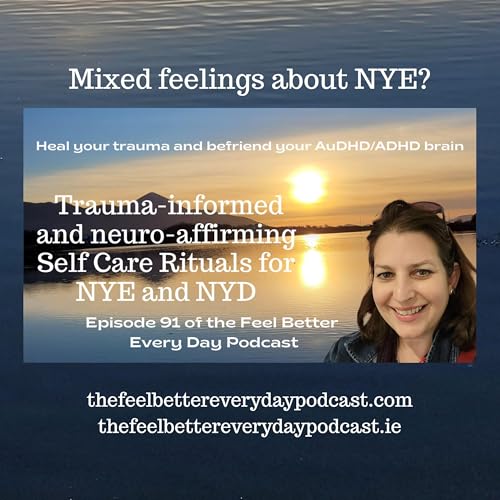
  • Trauma-informed and Neuro-affirming Self Care Rituals for NYE and NYD
    Dec 30 2025

    Happy New Year!

    Do you love New Year’s Eve? Do you hate New Year’s Eve? Do you feel indifferent to New Year’s Eve?

    However you feel, I hope you have a wonderful New Year! Watch or listen to episode 91 of the Feel Better Every Day Podcast wherever you get your podcasts for some of the self-care rituals and practices that I do every year or most years.

    I hope they’ll help you work with your own ADHD brain, AuDHD brain, and also to continue to heal from any trauma. Use this time of year, where there is so much external pressure in terms of how you might be thinking you should be celebrating or what you should be doing to go for it with all that appeals and ignore all the rest!

    [Link to selfcarecoaching.net/blog for show notes, full transcript and more]

    le grá (with love),

    Eve

    LINKS

    Sign up for Míle Buíochas Mondays (Polyvagal-informed and more every Monday) here

    Westport Lunar Circles

    Your vibe for 2025: Episode 38 of The Feel Better Every Day Podcast

    Choose your transpersonal quality for the year ahead

    Happy New Year and bring what was good about the break into your year ahead

    Make the most of the seasonal energies

    CHAPTERS

    0:00 – Mixed feelings about New Year’s Eve?

    2:28 – Checking in with what actually appeals

    4:53 – New Year intentions and PDA-friendly resolutions

    6:01 – Lessons, blessings and reflecting on the year

    8:18 – Choosing a guiding word or theme for the year ahead

    10:26 – Clearing space and symbolic release rituals

    12:02 – Self-acceptance instead of self-improvement

    13:39 – Community, connection and designing New Year’s Day

    16:12 – Creative visioning and sensory mood-setting

    FULL TRANSCRIPT

    Do you love New Year’s Eve? Do you hate New Year’s Eve? Do you feel indifferent to New Year’s Eve?

    However you feel, I hope you have a wonderful New Year and in this episode, episode 91 of the Feel Better Every Day Podcast, I’m going to be sharing some of the self-care rituals and practices that I do every year or most years in order to help you work with your own ADHD brain, AuDHD brain, and also to continue to heal from any trauma and just to really use this time of year where there is so much external pressure in terms of how you might be thinking you should be celebrating or what you should be doing and they’re very tentative invitations in terms of if anything appeals, go for it and ignore all the rest.

    I’m your host and producer, Eve Menezes Cunningham. I’m an author, columnist, trauma therapist, self-care coach and senior accredited supervisor specialising in ADHD and ADHD friendly trauma-informed, neuro-affirming, transpersonal and somatic approaches.

    I help people heal through self-care practices that honour your body and your brain and your nervous system as well as your Self, that highest, wisest, truest,...

    Afficher plus Afficher moins
    20 min
  • Practice Resting in the Rest of 2025
    Dec 23 2025

    With ADHD, with AuDHD, with trauma, our nervous systems can really struggle with rest. It can feel unsafe to rest.

    Why do I share how hard I find rest this while extoling the virtues of rest? Because it’s STILL an advanced practice for me. The whole point of this podcast is to show the gap, sometimes gulf, between what we – as self-care and Self care professionals – want to be doing and are actually doing. Especially with trauma histories and the hypervigilance that comes with having needed to survive. And AuDHD and ADHD where endless cycles of burnout eventually teach us how to honour our sensitive nervous systems.

    It doesn’t have to take you the decades it’s taken me!

    Everyone (and I’ve interviewed neuroscientists, other therapists, somatic therapists, energy workers and coaches, nutritional therapists, choreographers, artists and more) knows what would help us. We just need to give ourselves permission to make the necessary changes. For me, that’s constantly taking more and more off my plate and becoming more strategic (and actually getting MORE done while feeling better about it all!) by paying closer attention to my own nervous system and energies.

    I hope that you’ll gift yourself some extra breathing space over the holidays. Begin to ponder ways in which you can build in sustainable changes for a more restful, easier, more peaceful and joyful 2026.

    I’ve shared loads of resources to support you (and myself!) over the decades and you can access some here (including some research on rest) as well as listening to Tracy Otsuka (am imagining that the 43% of ADHDers with excellent mental health are better at prioritising rest. I know my mental health has improved along with my capacity for more rest), Caroline Shole Arewu and others share some of their tools to support prioritising rest.

    Enjoy the episode and let me know what you’re going to do to rest more today, this week, this month and in the New Year!

    le grá (with love),

    Eve

    CHAPTERS

    0:00 – Why rest feels so difficult

    2:55 – AuDHD, ADHD, trauma and nervous system safety

    4:02 – Different ways of resting

    5:27 – Productivity, pressure and burnout

    8:25 – Rest, holidays and emotional release

    11:37 – When rest feels unsafe to the nervous system

    13:59 – Learning to love a sensitive nervous system

    16:24 – Collective care, boundaries and co-regulation

    FULL TRANSCRIPT

    Do you struggle to take time to rest, to give yourself a break, to take things off your plate? It can be especially challenging with trauma histories, with AuDHD (autism and ADHD) with ADHD.

    It’s especially important to pay attention to your nervous system and make sure that you are getting enough rest, because we’re mammals, just like my little role model here, Meadbh.

    Cats don’t feel guilty about all the snoozes, all the rest, it enables them to play harder, to climb, to do other things, but we humans, we are in a world which doesn’t encourage rest. It encourages us to think we need all sorts of things we don’t necessarily need.

    Welcome to Episode 90 of the Feel Better Every Day Podcast.

    I’ve talked and written about rest a lot and there’ll be links...

    Afficher plus Afficher moins
    26 min
  • Yule Love These Self Care Rituals
    Dec 16 2025

    A Polyvagal-informed approach to the seasonal energies for trauma, AuDHD and ADHD

    Feeling the weight of the darkest days? In this episode of the Feel Better Every Day Podcast,

    I’m sharing gentle, nervous system-friendly rituals to help you honour the seasonal energies of Yule (Winter Solstice) while healing your trauma and befriending your AuDHD or ADHD brain.

    Discover how to:

    ✨ Use a Yule log tradition for releasing and renewal

    ✨ Navigate seasonal overwhelm with polyvagal-informed practices

    ✨ Honour both the darkness and the returning light

    ✨ Set intentions that actually feel good for your nervous system

    ✨ Create community connection on your own terms

    Whether you’re struggling with the season or finding joy in it, this episode welcomes all your feelings and offers practical ways to thrive through winter’s longest night.

    🔗 Free resources and show notes

    📖 Get the book: 365 Ways to Feel Better: Self-care Ideas for Embodied Wellbeing

    💌 Join the Sole to Soul Circle for deeper dives, exclusive content and instant access to the whole archive

    🎙️ New episodes every Tuesday – listen on Spotify, Apple or wherever you get your podcasts

    #WinterSolstice #Yule #TraumaHealing #AuDHD #ADHD #PolyvagalTheory #NervousSystemHealing #SelfCare #NeurodivergentSupport

    Wishing you the coolest of Yules! 🕯️

    LINKS

    Listen to Purr! Hiss! Freeze! Episode 48 of the Feel Better Every Day Podcast wherever you get your podcasts. Watch and read full transcript here

    Find out more about how embodied journalling can help you here

    CHAPTERS

    (0:00) Honouring the darkness and welcoming renewal

    (0:57) Trusting your nervous system and honouring your needs

    (2:05) Introducing Episode 89

    (3:38) Yule log ritual

    (5:38) Embodied journalling and self-acceptance

    (7:03) Collective care and community intentions

    (8:39) Free newsletter and polyvagal-informed gratitude practice

    (10:31) Book, coaching and other resources

    (11:04) Closing message and thanks

    FULL TRANSCRIPT

    How do you feel about the dark nights and long [I meant SHORTER 😊] days? You may be loving it, you may be feeling a bit hopeless, and this week we’re looking at ways in which you can celebrate your winter solstice here in the Northern Hemisphere by honouring the darkness, the cold, potentially the hopelessness, and also remembering the renewal, the hope, the deep roots growing underground even when it feels like there’s nothing happening on the surface.

    Trusting your nervous system, giving yourself permission to go to events that feel good for you and avoid potential sensory overload or make up for it by having quiet days after, just really honouring how you feel, whether it’s through trauma, through ADHD, through autism, honouring what you need.

    With it being the longest night in terms of darkness in this part of the world, it can feel a bit hopeless. If it feels good for you, I encourage you to connect with that, dipping the...

    Afficher plus Afficher moins
    13 min
  • Hyper Empathy? Silent Nights Might Help
    Dec 9 2025

    Do you feel overwhelmed not just by your own intense feelings but by everyone else’s too? This episode will help you honour and appreciate your sensitive nervous system.

    I (Eve Menezes Cunningham, author, columnist, trauma therapist, senior accredited supervisor, coach, trauma survivor and AuDHDer) share practical strategies for managing hyper empathy which is common with ADHD, autism, AuDHD and trauma histories.

    I encourage you to create protected silence in your life, from daily meditation to weekly 12-hour mini retreats, explaining why this isn’t indulgent but can be especially helpful for sensitive nervous systems.

    Using my Feel. Love. Heal. framework, I guide you through:

    • Creating buffer time and space for yourself (Feel)
    • Accepting your sensitivity as a superpower (Love)
    • Building community support for your needs (Heal)

    Perfect for trauma survivors, AuDHDers, autistic people and ADHDers (and those who identify highly sensitive people or empaths) and anyone who finds themselves absorbing everyone else’s emotions and energy.

    Le grá (with love),

    Eve

    Resources mentioned:

    • Tracy Otsuka (ADHD for Smart Ass Women) and Episode 86 for our interview
    • Alice Tew & Carly Radford episode
    • The Sole to Soul Circle
    • 365 Ways to Feel Better book

    Topics: hyper empathy, ADHD, autism, AuDHD, trauma recovery, sensitivity, boundaries, nervous system regulation, self-care

    Chapters

    (0:00) Overwhelmed by everyone else’s feelings

    (1:00) Honouring your extra-sensitive nervous system

    (2:30) When boundaries collapse under sensory overload

    (3:05) The Feel. Love. Heal. framework and creating space for silence

    (4:39) When life gets “too peopley”

    (8:17) Sensitivity as a superpower (when you protect it)

    (10:33) Healing through community and collective care

    (12:20) Imagining your future self with stronger boundaries

    Links

    Tracy Otsuka: Episode 86

    Too Sensitive? Too Much? Says Who? Episode 78 with Alice Tew and Carly Radford

    Shadow Work with Black Cats and Sharks: Episode 71


    Be More Cat: Episode 70


    Love your inner Smelly Cat this Bealtaine and beyond Episode 56


    Cattitude: Purr! Hiss! Freeze! Episode 48


    Sole to Soul Circle membership (just €8/month):

    https://selfcarecoaching.net/sole-to-soul-circle/


    Book: 365 Ways to Feel Better

    https://selfcarecoaching.net/book/


    FULL TRANSCRIPT

    Do you ever feel overwhelmed not just by your own intense feelings but seemingly everyone else’s feelings?

    This episode, Episode 88 of the Feel Better Every Day Podcast, is for you. You can access show notes and everything else via thefeelbettereverydaypodcast.com You can subscribe wherever you want to subscribe and you

    Afficher plus Afficher moins
    17 min
  • Movement as Medicine with Gwen Williams: Episode 87 of the Feel Better Every Day Podcast
    Dec 2 2025

    Get your free weekly journal prompts and more here

    Watch here or listen here or wherever you get your podcasts

    Dance movement psychotherapist Gwen Williams joins me (trauma therapist, AuDHDer, senior accredited supervisor, coach, author and columnist etc, Eve) to discuss how she combines yoga therapy, dance, art, and psychotherapy to help people reconnect with their bodies and heal.

    Gwen shares her journey from yoga therapy training (while pregnant!) to completing her MA in dance movement psychotherapy, plus her exhibition “Reclaiming the Wild Body.” She offers practical insights on movement practices for ADHD and neurodivergent brains, explaining why gentle, slow practices work best when your mind moves at a million miles an hour.

    Perfect for anyone interested in somatic healing, trauma recovery, creative therapy, or finding movement practices that actually work for neurodivergent nervous systems.

    Find Gwen: Website: gwen-williams.com Instagram: @movement_art_therapy

    Topics covered: ADHD, dance movement psychotherapy, yoga therapy, somatic practices, neurodiversity, creative healing, embodiment

    le grá (with love),

    Eve

    Chapters

    (0:00) Introduction to Gwen Williams

    (0:53) Reconnecting after yoga therapy training 14 years ago

    (2:09) Gwen’s evolving body-based and creative work

    (3:57) Reclaiming the Wild Body exhibition

    (5:12) Neurodiversity, ADHD and creative practice

    (7:14) Where to find Gwen online

    (7:48) Exploring Eve’s Feel. Love. Heal. framework

    (9:22) Gwen’s essential Feel self-care

    (11:05) Ideal and essential Love Self care

    (14:49) Designing life around slower somatic practice

    (16:22) Heal collective care: community, dance and co-regulation

    (18:03) Reclaiming the Wild Body workshops

    (19:20) Earth body, social body and transpersonal body

    (21:02) Vegan chat and episode planning

    (22:57) Where to find Gwen (recap)

    (23:23) Closing credits and resources

    FULL TRANSCRIPT

    Welcome to episode 87 of the Feel Better Every Day Podcast. Today’s guest is the delightful Gwen Williams. We trained together as yoga therapists for mental health and it was so lovely to catch up with her for this episode and reconnect.

    She’s since become a psychotherapist and she is combining art and her psychotherapy and yoga and movement and just all around delightfulness. If you’re in Bristol check her out and online obviously also you can gain a lot from her amazing presence in the world. I hope you enjoy the episode and let me know how you get on.

    Welcome Gwen, thank you so much for joining me. Thank you for having me Eve, it’s really nice to be here. It’s so funny because I met you like we used to sit together a lot in the yoga therapy training we did with the Minded Institute and you were pregnant at the time and you like I couldn’t believe that I was struggling because it was a lot.

    It was amazing but it was a lot and there you were and now finding out how old your son your first son is it’s like wow like you say it’s a huge mark of time but yeah it’s gorgeous seeing what you’ve been doing with the work and how it’s evolved for you and it looks so beautiful in the video. Do you want to say a little bit more about how it has evolved for you, where people can find...

    Afficher plus Afficher moins
    25 min