Couverture de Feedstuffs in Focus

Feedstuffs in Focus

Feedstuffs in Focus

De : Feedstuffs
Écouter gratuitement

À propos de ce contenu audio

Feedstuffs in Focus is a weekly look at the hot issues in the livestock, poultry, grain and feed industries. Join us as we talk with industry influencers, experts and leaders about trends and more. Feedstuffs in Focus is produced by the team at Feedstuffs.

© 2026 Feedstuffs in Focus

Economie Marketing et ventes Politique et gouvernement
Les membres Amazon Prime bénéficient automatiquement de 2 livres audio offerts chez Audible.

Vous êtes membre Amazon Prime ?

Bénéficiez automatiquement de 2 livres audio offerts.
Bonne écoute !
    Épisodes
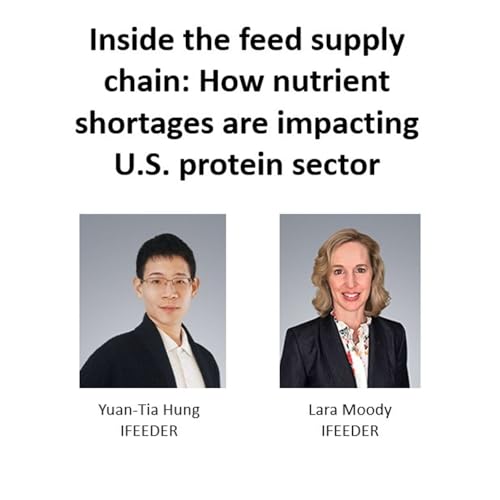
    • Inside the feed supply chain: How nutrient shortages are impacting U.S. protein sector
      Feb 18 2026

      The proper nutrients can make a big difference but what happens when they aren't available or are priced out of the diet formulation? We sit down with IFEEDER’s Lara Moody and Dr. Yuan-Tia Hung to unpack new species-level reports that reveal how disruptions in feed-grade vitamins and amino acids ripple through broilers, layers, turkeys, and swine operations. The conversation connects precise on-farm impacts—like average daily gain cut in half when lysine runs short and broiler meat yield slipping by double digits—to the bigger picture of U.S. food security and supply chain resilience.

      We dig into what the data say: where lysine, methionine, threonine, and tryptophan matter most by species and phase; how vitamin A, B-complex, D, and E shape animal health and carcass yield; and why reformulating with corn, soybean meal, DDGS, or fish meal is only a partial fix. You’ll hear how higher crude protein can strain gut health and barns, why costs can spike more than 50% when replacing methionine in poultry diets, and where ingredient-based vitamin replacement simply hits a wall. Then we zoom out to trade realities: imports of vitamins rising from roughly 68% to 76%, a widening price discount from China encouraging least-cost rations, and vitamin A capacity utilization hovering around 40–50%, all pointing to fragility in a system that looks cheap—until it is not.

      We talk through practical resilience moves for producers and nutrition teams, from mapping critical nutrients and testing reformulation scenarios to diversifying suppliers and considering targeted inventories. On the policy side, we explore why tariffs likely miss the mark for vitamins, and how credible data equips stakeholders to pursue smarter levers that encourage diversified capacity and faster approvals for alternative sources. Want the details? The full 200-plus-page report, a 12-page summary, and species sub-reports are available at ifeeder.org.

      If this conversation helps you plan better, subscribe, share with your team, and leave a review. Your feedback guides future deep dives and keeps these industry-critical insights flowing.

      Afficher plus Afficher moins
      16 min
    • Akralos to deliver advanced feed and nutrition solutions
      Feb 6 2026

      Akralos Animal Nutrition, a new North American animal feed and nutrition company, officially launched Feb. 1. Formed through a joint venture between global agriculture leaders ADM and Alltech, Akralos combines Alltech’s U.S.-based Hubbard Feeds and Canada-based Masterfeeds businesses with ADM’s U.S. feed operations.

      Operating an extensive network of more than 40 feed mills across North America and supported by more than 1,400 team members, Akralos delivers reliable, high-quality feeds, minerals and supplements through its trusted brands, backed by advanced nutrition expertise, leading-edge science and personalized service.

      We talk with Alltech President and CEO Dr. Mark Lyons to learn more about the longstanding relationship between the two companies, the unified organization's mission and what's ahead.

      Afficher plus Afficher moins
      16 min
    • Trust through science: Common Swine Industry Audit
      Jan 28 2026

      Proof builds trust, and trust keeps the supply chain moving. We take you inside the Common Swine Industry Audit (CSIA) to show how one science-based, third-party verification practices helps producers and packers demonstrate animal welfare and pre-harvest pork safety with clarity and credibility. With guests Brooke Kitting, CSIA task force co-chair and senior veterinarian at Seaboard Foods, and Stephanie Wetter, Director of Animal Welfare at the National Pork Board, we explore why a single recognized audit reduces duplicative demands while protecting freedom to operate for farms of every size.

      We break down the 2026 CSIA updates that matter most. The audit now reflects the Five Domains model, shifting from a narrow focus on avoiding negatives to recognizing positive welfare states that contribute to a good life for pigs. You’ll hear how the animal benchmarking section evolves, why sampling is being expanded to detect low-frequency issues with greater confidence, and how clear transport space and handling criteria close critical gaps between barn and plant. These changes align with PQA Plus and TQA, creating a teach–implement–verify loop that matches what caretakers do every day and what customers expect to see documented.

      Beyond passing a checklist, the goal is a reliable feedback loop that drives continuous improvement and builds stronger trust with processors, retailers, and global customers. Ready to see how a single, science-backed practices can raise the bar for welfare, safety, and transparency across U.S. pork? Follow the show, share this episode with your team, and leave a quick review to tell us what change you’re most excited about.

      Afficher plus Afficher moins
      16 min
    Aucun commentaire pour le moment