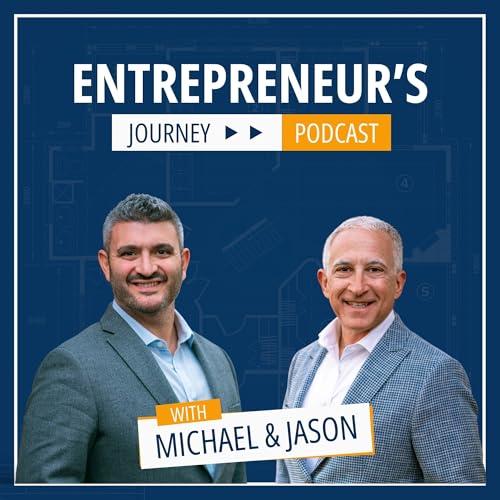
Couverture de Entrepreneur's Journey

Entrepreneur's Journey

Entrepreneur's Journey

De : HFM Investment Advisors LLC
Écouter gratuitement

À propos de ce contenu audio

Welcome to the Entrepreneur's Journey where Michael Pallozzi leads discussions with successful entrepreneurs to learn about their journey of starting, building, and eventually selling their business or transitioning it to the next generation. The goal is to allow you to learn from their knowledge, experience, and wisdom, as you pursue that in your own business. Michael Pallozzi is the President of HFM Investment Advisors, LLC and brings over 30 years of experience working with business owners to organize and manage their business and personal financial plans to help them define and realize their personal version of success in their lives and businesses.Copyright 2026 HFM Investment Advisors, LLC Direction Economie Management Management et direction Réussite personnelle
Épisodes
  • From $26M to $12M—and BACK: Hard Lessons from a Private Equity Rollercoaster
    Apr 30 2026

    What does it really take to scale a trades business into a national leader—and what happens when it all starts to unravel?

    In this episode of The Entrepreneur’s Journey, Michael Pallozzi sits down with Kory Mitchell, former CEO of a leading environmental services company and current founder of Iconic Founders. Kory shares his full journey—from growing a family business into the #1 abatement company in the U.S., to navigating a dramatic post-sale downturn, and ultimately rebuilding the company under intense pressure.

    This conversation goes beyond the highlight reel. Kory opens up about painful lessons, leadership challenges, private equity realities, and what founders must understand before selling their business.

    If you're building, scaling, or thinking about exiting your company—this episode is packed with hard-earned wisdom you won’t want to miss.

    Tune into this episode to also learn:

    ● Why chasing the wrong type of growth can quickly destroy profitability.

    ● How a single leadership decision cut EBITDA in half in under a year.

    ● Why sticking to your core business is critical when scaling.

    ● How to think about selling your business—and when not to.

    What we discussed

    ● [00:00:40] Introduction to Kory Mitchell and his journey from family business to industry leader.

    ● [00:02:30] Growing up in an asbestos abatement business and early exposure to entrepreneurship.

    ● [00:04:30] Scaling through new service lines and expanding into new markets.

    ● [00:06:30] Using acquisitions to rapidly grow revenue and geographic footprint.

    ● [00:08:00] Selling the business to private equity and transitioning leadership.

    ● [00:09:30] The impact of bringing in an outside CEO and shifting strategy.

    ● [00:10:45] How chasing large industrial projects led to massive losses.

    ● [00:12:20] Taking back control and leading a full company turnaround.

    ● [00:14:00] Lessons learned from rebuilding EBITDA from $12M back to $26M.

    ● [00:16:00] The emotional and operational challenges of scaling a large organization.

    ● [00:18:00] When it makes sense to sell—and when it doesn’t.

    ● [00:19:30] Building a business that creates optionality for founders.

    ● [00:21:00] Launching Iconic Founders and helping trades owners scale and exit.

    ● [00:23:00] What business owners need to know before selling to private equity.

    3 Things To Remember
    1. Growth is only valuable if it aligns with what your business actually does well—otherwise, it can quickly erode profits.
    2. Selling your business creates opportunity, but it also introduces new risks and challenges that require careful planning.
    3. The ultimate goal is optionality—building a business that gives you the freedom to sell, scale, or step back on your terms.

    Useful Links

    Connect with Michael Pallozzi: pallozzi@hfmadvisors.com | LinkedIn

    Connect with Jason Gabrieli: jgabrieli@hfmadvisors.com | LinkedIn

    Editing and post-production work for this episode was provided by The Podcast Consultant (https://thepodcastconsultant.com)

    Like what you’ve heard…

    Subscribe to our BuiltWealth™ Newsletter HERE

    Afficher plus Afficher moins
    40 min
  • Rung 1 to Rung 2: Turning Your Business Income Into Personal Wealth
    Apr 9 2026

    In this episode of The Entrepreneur’s Journey, Jason Gabrieli and Michael Pallozzi break down the first two stages of the Built Wealth Ladder—Rung 1 and Rung 2. Designed specifically for trades and home service business owners, this framework helps simplify the transition from running a business to building real, lasting personal wealth.

    They explore what it means to operate at Rung 1, where everything is reinvested into the business and survival is the primary goal. Then, they explain how to progress to Rung 2—where profitability begins to create opportunities for wealth-building outside the business.

    Along the way, they discuss common financial blind spots, the importance of true profit, and how to start making intentional decisions with your money to support both your lifestyle and long-term goals.

    Tune into this episode to also learn:

    ● Why reaching “Rung 1” is a major accomplishment for any business owner.

    ● How to properly define and create true profit in your business.

    ● Why most trades business owners struggle with personal financial planning.

    ● How to start building wealth outside of your business at Rung 2.

    What we discussed

    ● [00:01:33] What Rung 1 looks like and why most business owners start here focused on survival and reinvestment.

    ● [00:02:20] Why simply generating income doesn’t mean your business is profitable.

    ● [00:03:30] The common financial blind spots for trades and home service business owners.

    ● [00:05:10] How the Profit First methodology helps business owners create real profit.

    ● [00:06:07] The role of advisors and consultants in helping business owners grow beyond Rung 1.

    ● [00:09:59] What signals that you’re ready to move from Rung 1 to Rung 2.

    ● [00:10:30] How much profit you should aim for before starting to build wealth outside the business.

    ● [00:12:11] Where to allocate profits first, including lifestyle, taxes, and investments.

    ● [00:14:17] Why retirement plans like 401(k)s are a powerful starting point for wealth-building.

    ● [00:16:46] The risks of overcomplicating wealth by investing in multiple businesses or real estate.

    ● [00:20:07] Why education and intentional decision-making are critical at Rung 2.

    3 Things To Remember
    1. Building a profitable business is just the first step—real wealth begins when you intentionally take money out of the business and put it to work elsewhere.
    2. Understanding what true profit is and consistently setting it aside creates the foundation for long-term financial success.
    3. Simple, intentional investment strategies often outperform more complex approaches that demand additional time, energy, and risk.

    Useful Links

    Connect with Michael Pallozzi: pallozzi@hfmadvisors.com | LinkedIn

    Connect with Jason Gabrieli: jgabrieli@hfmadvisors.com | LinkedIn

    Editing and post-production work for this episode was provided by The Podcast Consultant (https://thepodcastconsultant.com)

    Like what you’ve heard…

    Subscribe to our BuiltWealth™ Newsletter HERE

    Afficher plus Afficher moins
    25 min
  • Buying a Business and Building a Team: How Brian Tustin Is Raising the Standard in the Moving Industry
    Mar 26 2026

    Welcome back to the Entrepreneur’s Journey. In this episode, Michael Pallozzi sits down with Brian Tustin, owner of First Rate Movers, to discuss his path from the hospitality industry to purchasing and growing a moving company. Brian shares how his experience managing restaurants, retail spaces, and co-working environments prepared him for entrepreneurship, even though he ultimately stepped into a completely different industry.

    Brian explains how he discovered the opportunity to buy a business through BizBuySell, the lessons he learned during the first year of ownership, and how focusing on people and culture helped him build trust with his team. The conversation also explores hiring the right employees, building systems that allow a company to grow, and why reputation and transparency are critical in an industry where trust matters. Brian also reflects on the importance of vulnerability in leadership and how being open about challenges can strengthen relationships within a team and community.

    Tune into this episode to also learn:

    ● Why buying an existing business can be a powerful entry point into entrepreneurship.

    ● How focusing on character and personality helps build stronger teams.

    ● Why systems and processes are essential for growth and freedom as a business owner.

    ● How vulnerability and transparency can strengthen leadership and team trust.


    What we discussed

    [00:01:13] Brian’s background in hospitality and how his early career shaped his approach to leadership and service.

    [00:04:44] Discovering the opportunity to buy a moving company through BizBuySell and deciding to take the leap into ownership.

    [00:07:57] How Brian built trust with existing employees during the transition to new ownership.

    [00:10:56] Why moving companies rely heavily on word-of-mouth and repeat customers more than many people realize.

    [00:13:48] The challenges within the moving industry and why transparency is critical to building a strong reputation.

    [00:15:45] How Brian hires and develops great team members by focusing on character before skills.

    [00:19:39] The importance of building systems and processes that allow business owners to delegate and grow.

    [00:23:11] Why vulnerability and openness can strengthen leadership and relationships within a business.


    3 Things To Remember

    1. Buying an existing business can provide a faster path into entrepreneurship while allowing you to build on an established foundation.

    2. Hiring the right people based on character, attitude, and culture fit can make a significant difference in the success of a service-based business.

    3. Strong systems, processes, and open communication allow businesses to grow while creating healthier teams and stronger leadership.


    Useful Links

    Connect with Michael Pallozzi: https://www.linkedin.com/in/michaelpallozzihfm/

    First Rate Movers: https://firstratede.com/


    Like what you’ve heard…

    Subscribe to our BuiltWealth™ Newsletter HERE


    Editing and post-production work for this episode was provided by The Podcast Consultant (⁠https://thepodcastconsultant.com⁠)


    Afficher plus Afficher moins
    28 min
Aucun commentaire pour le moment