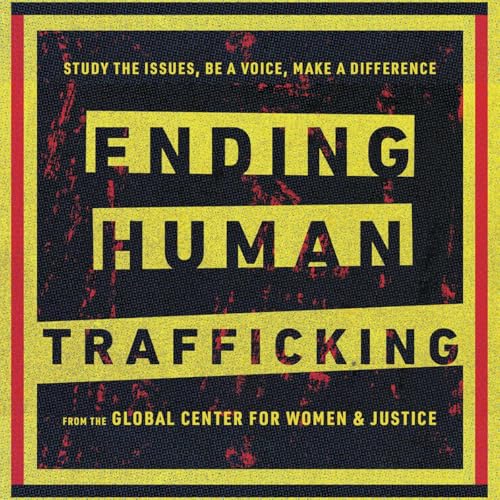
Couverture de Ending Human Trafficking

Ending Human Trafficking

Ending Human Trafficking

De : Dr. Sandra Morgan
Écouter gratuitement

À propos de ce contenu audio

The Global Center for Women and Justice launched the Ending Human Trafficking podcast in April 2011 and it has passed the 160 podcast milestone as of January 2018. Our mantra is Study the Issues. Be a voice. Make a difference. We believe that if you do not study first, you may say or do the wrong thing. The National Family and Youth Services Clearinghouse promoted EHT as “a good way to get up to speed on human trafficking”. Our audience includes students, community leaders, and even government leaders. EHT listeners come from all corners of the world, which accomplishes our mission of building a global community that works together to end human exploitation.Ending Human Trafficking Christianisme Economie Management Management et direction Ministère et évangélisme Spiritualité
Les membres Amazon Prime bénéficient automatiquement de 2 livres audio offerts chez Audible.

Vous êtes membre Amazon Prime ?

Bénéficiez automatiquement de 2 livres audio offerts.
Bonne écoute !
    Épisodes
    • 364: Are Our Systems Adapting as Fast as Traffickers Are?
      Feb 2 2026

      Dr. Kari Johnstone joins Dr. Sandie Morgan as they discuss how traffickers adapt fast, moving money, victims, and exploitation through digital systems most of us interact with every day, examining whether our institutions are adapting fast enough to protect victims without them risking everything to testify.


      Dr. Kari Johnstone


      Dr. Kari Johnstone is the OSCE Special Representative and Co-ordinator for Combating Trafficking in Human Beings, representing the Organization for Security and Co-operation in Europe at the political level on human trafficking issues and coordinating anti-trafficking efforts across the OSCE region. Before joining the OSCE, Dr. Johnstone spent nearly a decade (2014-2023) as Senior Official, Acting Director, and Principal Deputy Director of the U.S. Department of State's Office to Monitor and Combat Trafficking in Persons (J/TIP), where she advised senior leadership on global trafficking policy and programming and oversaw the annual Trafficking in Persons Report. Her extensive U.S. government service also includes senior roles in the Bureau of Democracy, Human Rights, and Labor. Dr. Johnstone holds a B.A. from the University of Michigan and a Ph.D. in Political Science from the University of California, Berkeley.


      Key Points


      • The OSCE survey revealed a 17-fold increase in forced criminality cases over five years across the 57 member states, making it the fastest growing form of human trafficking globally.
      • Forced scamming, which originated in Southeast Asia, is now being exported to other regions as criminals adopt this lucrative business model that exploits victims with brutal tactics to defraud others.
      • Technology and artificial intelligence present both challenges and opportunities in combating trafficking, allowing law enforcement to process data more quickly to find victims and perpetrators while also being misused by traffickers for recruitment and exploitation.
      • Financial intelligence and following the money can supplement or even replace victim testimony in prosecutions, reducing the burden on survivors and providing effective pathways to convict traffickers.
      • The non-punishment principle remains woefully inadequate in practice worldwide, with victims often arrested, prosecuted, and convicted for crimes directly related to their trafficking experience, creating lifelong consequences that prevent access to housing, employment, and stability.
      • The United States leads globally on criminal record relief for trafficking survivors, with 48-49 states having vacature or expungement laws and new federal legislation (Trafficking Survivor Relief Act) awaiting presidential signature, though much work remains worldwide.
      • Victim assistance must be unlinked from the criminal justice process, allowing survivors to receive care and services first before deciding whether to cooperate with law enforcement, which actually increases the likelihood they will come forward and participate.
      • The demographics of trafficking victims are shifting beyond stereotypes, with forced scamming targeting educated individuals with IT and language skills, while forced criminality increasingly exploits younger children, including those under age 10, for drug-related crimes and violence.


      Resources


      • Organization for Security and Co-operation in Europe (OSCE)
      • OSCE Office of the Special Representative and Co-ordinator for Combating Trafficking in Human Beings
      • Protocol to Prevent, Suppress and Punish Trafficking in Persons (UN Palermo Protocol)
      • UN Global Plan of Action to Combat Trafficking in Persons
      • U.S. State Department Office to Monitor and Combat Trafficking in Persons
      • Trafficking in Persons Report
      • Trafficking Survivors Relief Act
      • Ending Human Trafficking Podcast


      Transcript


      Transcript will be here when available.

      Afficher plus Afficher moins
      32 min
    • 363: The Hidden Link Between Romance Scams and Forced Labor
      Jan 19 2026

      Matthew Friedman joins Dr. Sandie Morgan as they explore how pig butchering scams work, why they're so effective, and how they're tied to forced labor and human trafficking, while explaining what prevention can look like from personal red flags to safeguards in financial systems.


      Matthew Friedman


      Matthew Friedman is the Founder and CEO of The Mekong Club, a pioneering organization that mobilizes the private sector to fight modern slavery across Asia. A globally recognized expert on human trafficking, Friedman has spent over three decades working at the intersection of business, government, and humanitarian action to combat exploitation and promote ethical leadership. Before founding The Mekong Club, Friedman served as Regional Project Manager for the United Nations International Project on Human Trafficking (UNIAP/UNDP), overseeing a six-country initiative spanning China, Cambodia, Laos, Myanmar, Vietnam, and Thailand. He also served as Deputy Director for the USAID Office of Public Health (Asia Region), managing a $100 million annual portfolio. Friedman holds a Master's degree in Health Education from New York University and is a renowned keynote speaker who has delivered more than 900 presentations in 20 countries, inspiring individuals and organizations to take a stand in the fight against modern slavery.


      Key Points


      • Pig butchering scams are sophisticated romance scams where criminals build trust over weeks before convincing victims to invest life savings in fake cryptocurrency schemes, with the metaphor referring to "fattening the pig before the slaughter."
      • An estimated 300,000 to 400,000 young professionals have been trafficked into scam centers across Southeast Asia, where they are forced under extreme violence and coercion to run online scams targeting victims in wealthy nations.
      • The Prince Group sanctions marked one of the most significant global crackdowns on forced-labor scam centers, with the UK freezing real estate assets and the US freezing $15 billion in cryptocurrency, signaling increased international cooperation.
      • Financial institutions can help prevent pig butchering by monitoring unusual withdrawal patterns, such as when customers who haven't touched their accounts for 30 years suddenly liquidate everything, and by contacting clients before large transfers are completed.
      • Victims in scam centers face brutal violence including being tasered, beaten, and in some cases tortured to death with videos sold as "hardcore" content, creating a level of violence unprecedented in modern slavery according to Friedman's 35 years of experience.
      • Only 0.2% of the 50 million people in modern slavery receive assistance globally, not because counter-trafficking organizations don't care, but because the $236 billion generated by criminals vastly outweighs the $400 million available to fight it.
      • Public education and awareness are critical for prevention, as people in North America remain largely unaware of pig butchering scams while Asian communities have become more informed through widespread media coverage and victim testimonies.
      • The Mekong Club has developed multilingual e-learning tools including a three-and-a-half-minute video to help raise awareness about both human trafficking into scam centers and the scams themselves, emphasizing that prevention must be widespread.

      Resources


      • The Mekong Club
      • The Mekong Club - Tools & Resources
      • Valid8 Financial
      • Ending Human Trafficking Podcast - Episode 269
      • Matthew Friedman on LinkedIn
      • Contact Matthew Friedman
      • Ending Human Trafficking Website


      Afficher plus Afficher moins
      38 min
    • 362 – Before Teens Hide Online, Youth Pastors Must Build Trust
      Jan 5 2026
      Brenton Fessler joins Dr. Sandie Morgan as they explore why teenagers aren't hiding their digital lives because they're rebellious—they're hiding because they don't feel safe talking, and what trusted adults do next can change everything.Brenton FesslerBrenton Fessler is the Lead Pastor of Refuge OC Church in Orange County, California, where he provides vision and leadership for a growing faith community with a strong emphasis on family, discipleship, and community responsibility. With a background in youth ministry and ministry education, Brenton brings deep experience working with adolescents, parents, and church leaders navigating the complexities of formation, trust, and safety in a digital age. In addition to his pastoral leadership, Brenton has taught ministry-related courses and mentored emerging youth pastors, equipping them to build relationally healthy, developmentally appropriate, and ethically grounded ministry environments. As a parent of teenagers himself, he offers a practical, lived perspective on the challenges families face around technology, online identity formation, and risk exposure. Brenton's work reflects a prevention-first, relational approach rooted in grace, accountability, and collaboration between parents, churches, and broader community systems.Key PointsYouth pastors hold a unique position of trust with teenagers, making them critical partners in digital safety conversations, as students often confide in them before approaching parents about risky online behavior.The scaffolding metaphor illustrates healthy digital boundaries—parents and church leaders provide temporary support structures that can be removed as young people demonstrate increasing responsibility, rather than permanent fences.When a 14-year-old discloses risky online behavior, youth pastors should offer to walk alongside them in conversations with parents rather than protecting confidentiality at all costs, because these young people need adult guidance to navigate complex situations safely.Youth ministry should focus on spiritual formation and relationship building rather than behavior modification, creating environments where students feel safe to make mistakes and receive grace while learning to live righteously.Churches need to update child protection policies to include digital and virtual environments with the same rigor as physical spaces, including background checks that examine volunteers' online presence and social media activity.Youth pastors serve as cultural missionaries within church staffs, helping senior pastors understand emerging technologies, social media platforms, and the realities of youth culture that shape the next generation's spiritual development.The "talk tech every day" initiative from Ensure Justice emphasizes that digital safety conversations must be ongoing and integrated into daily family life, not reactive responses to scary news articles.Building cross-generational trust requires two-way mentoring where students teach adults about technology while adults provide wisdom and boundaries, creating healthy churches where both generations learn from each other.ResourcesInfluence Magazine Winter 2025 IssueEpisode 354: Love Bombs and Long Cons: Understanding Pig Butchering ScamsEnsure Justice ConferenceRoyal Family Kids CampRefuge OC ChurchTranscript[00:00:00] Brenton Fessler: The youth pastor decided that the best way forward was to actually call her up on stage and have her publicly announce her pregnancy so he could shame her as if behavior modification was gonna be the true path to her healing.[00:00:15] But[00:00:15] Delaney: Teenagers aren't hiding their digital lives because they're rebellious. They're hiding because they don't feel safe talking. What trusted adults do next can change everything. In this episode, you'll hear why talk tech every day matters. How to set guardrails without shame and what to do when a teen says, I can't tell my parents.[00:00:35] Hi, I'm Delaney. I'm a student here at Vanguard University and I help produce this show. Today, Sandie Talks with Dr. Brenton Fessler. He's the lead pastor of Refuge OC in Orange County with years of youth ministry experience and mentoring youth leaders focused on digital safety and trust building with teens.[00:00:54] Now here's their conversation.[00:00:57][00:01:03] Sandie Morgan: Reverend Dr. Brenton Fessler, welcome to the Ending Human Trafficking Podcast.[00:01:10] Brenton Fessler: Thank you, Sandie. It is so good to be with you and I'm delighted. I hope I can add to the conversation, but I'm really honored to be here.[00:01:18] Sandie Morgan: This isn't the way I usually do this, Brenton. But you read the article that they published in Influence Magazine under the youth pastor column, and the concern is digital safety for our kids.[00:01:35] So when you read that, did you have a question? Wow. If I could talk to Dr. Sandie Morgan. This is what I'd ask her.[00:01:45] Brenton Fessler: Ooh, that's a good point....
      Afficher plus Afficher moins
      35 min
    Aucun commentaire pour le moment