Couverture de Echoes of Heresy

Echoes of Heresy

Echoes of Heresy

De : Andy Altschuler
Écouter gratuitement

Offres de saison | 0,99 € par mois pendant les 3 premiers mois

5,99 €/mois par la suite. Des conditions s’appliquent. Annulation mensuelle possible.
À propos de ce contenu audio

Echoes of Heresy – a podcast about spiritual dissent, divergent beliefs and doctrinal conflict across time and tradition.

In each episode the host, Andy Altschuler, looks into the stories of heterodox thinkers, movements or systems from various places, epochs and traditions. He also explores doctrinally problematic, controversial or insufficiently defined theological concepts and ritual practices within the mainstream religious frameworks.

From visionary cosmologies and mystical dissidents to folk saints, philosophical provocateurs, and long-buried sects, each episode dives into a story of a particular movement or sect, theological concept or trend, heterodox thinker or strain of thinkers, with references to primary and secondary sources, highlighting curious facts and crucial details.

It’s not strictly academic, but grounded in scholarship. Not esoteric, not sensationalist, not pushing any ideology — just curious, evidence-based exploration of the ways belief resists boundaries, shapes and shakes the world's spiritual traditions.

Listener feedback is always welcome.

Email: echoesofheresy@gmail.com

Echoes of Heresy
Spiritualité
Épisodes
  • Folk Saints of Latin America
    Mar 5 2026

    The final episode of the first season. A glimpse into a phenomenon of Latin American Folk Saints.

    Folk saint veneration is far from being a uniquely Latin American thing, but in Latin America, this phenomenon feels especially vivid – more public that elsewhere, more embodied, and woven deeply into everyday life.

    Rooted in a long history of Catholic tradition, Indigenous cosmology, Afro-Caribbean spiritual practices, and mestizo cultural memory, the popular religiosity of the region creates fertile ground for unofficial saints. In fact, the Church often finds itself playing catch-up – cautiously acknowledging some folk cults, while condemning others as superstition or even heresy.

    Folk saints often emerge in spaces where institutional religion seems distant: borderlands, rural villages, prisons, inner cities. They fill gaps the Church can’t or won’t reach.

    Still, the line between folk devotion and Church orthodoxy is not always a battleground. In fact, more often than not, it’s a negotiation...

    Afficher plus Afficher moins
    36 min
  • The Gospel of Leo Tolstoy
    Feb 16 2026

    One of the greatest literary figures in Russian history — and, perhaps, the most recognizable Russian author in the world...

    Tolstoy was celebrated during his lifetime. He was a cultural monument in his own time — read not only by the Russian intelligentsia, but by factory workers, schoolteachers, revolutionaries, and monarchists alike.

    Unlike so many Russian thinkers and artists, he was never imprisoned, never exiled, never formally repressed by the state. His writings generally were not banned – neither by the Tsarist regime, nor by the Soviets who followed. In fact, both systems found ways to celebrate him.

    In the Soviet Union, he was often presented as a proto-socialist critic, a moral voice who condemned inequality and imperial hypocrisy. In the West, he was embraced as a literary genius, a prophet of nonviolence, a spiritual humanist. Across cultures and ideologies, Tolstoy has remained, in many ways, untouchable.

    Yet there is another side to Tolstoy. A side that is far more controversial, and far less publicized.

    A man who delved into theology with relentless passion. Who challenged the foundations of Orthodox dogma. Who called the Church a distortion of Christ’s teachings. Who rejected the sacraments, denied the resurrection, and saw the cross not as a symbol of salvation, but as an emblem of cruelty.

    What led Tolstoy, the literary saint of Russia, to this final spiritual rebellion? And why did the Church respond not with debate, but with excommunication?

    Afficher plus Afficher moins
    40 min
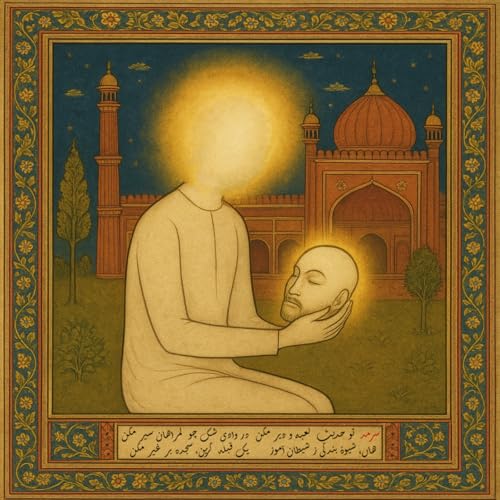
  • Sarmad - The Naked Saint of Mughal India
    Jan 7 2026

    A poet for whom the boundaries between creeds were illusionary. A mystic for whom non-dualism and apophatic vision weren’t just poetic metaphors — they were his lived reality.

    All his life represents a bridge between the Abrahamic and Dharmic worlds.

    Who was Sarmad Kashani? What was his formation in Iran? And what was his role in Mughal India? What is his legacy - spiritual, literary, social?

    For those today who are suspicious of religious certainty and drawn to spiritual experimentation, he remains a startling, beautiful, and uncompromising presence.

    Afficher plus Afficher moins
    52 min
adbl_web_anon_alc_button_suppression_t1
Aucun commentaire pour le moment