Couverture de EP Edge Journal Watch

EP Edge Journal Watch

EP Edge Journal Watch

De : Niraj Sharma MD FACC FHRS
Écouter gratuitement

À propos de ce contenu audio

Welcome to EP Edge Journal Watch — where cardiac electrophysiology meets evidence, precision, and perspective. Hosted by Dr. Niraj Sharma, this bi-weekly podcast distills high-impact cardiovascular and EP research into clear, clinically meaningful insights. Each episode goes beyond headlines and abstracts to uncover what new studies actually mean for patient care, decision-making, and the future of electrophysiology. What EP Edge Journal Watch stands for: Evidence-based practice Precision electrophysiology A forward-thinking, edge-driven approach to how we interpret and apply data in real-world clinical settings. Whether you’re an electrophysiologist, cardiologist, researcher, trainee, or allied health professional, EP Edge Journal Watch brings you the signal — not the noise. Expect sharp summaries, thoughtful commentary, and practical takeaways designed for the busy clinician who wants to stay ahead of the curve© 2026 Niraj Sharma MD FACC FHRS Hygiène et vie saine Maladie et pathologies physiques Science
Les membres Amazon Prime bénéficient automatiquement de 2 livres audio offerts chez Audible.

Vous êtes membre Amazon Prime ?

Bénéficiez automatiquement de 2 livres audio offerts.
Bonne écoute !
    Épisodes
    • EP Edge™ Journal Watch: February 2026 Issue 12: AF Ablation “Success” Reframed: ADVENT-LTO 4-Year PFA Durability, 20-Year PVI Outcomes, Monitoring Rules, CIED Risks & PICM
      Feb 23 2026

      In this episode of EP Edge™ Journal Watch (Issue 12, February 2026), Dr. Niraj Sharma breaks down a deceptively simple question in atrial fibrillation (AF) ablation: what does “success” actually mean—at 1 year, 4 years, and 20 years? We start with ADVENT-LTO, the long-term extension of the randomized ADVENT trial, examining 4-year outcomes of pulse field ablation (PFA) vs thermal ablation—and why redo ablation and hospital-based interventions may matter more than a single headline p-value.

      Next, we zoom way out with a 20-year pulmonary vein isolation (PVI) cohort, showing how AF behaves like a progressive atrial cardiomyopathy over decades—and why very late recurrences may occur even when PV isolation remains durable.

      Then we tackle the “quiet drivers” of trial results: monitoring intensity, the 30-second recurrence rule, blanking periods, and AF burden—the design choices that can make technologies look better (or worse) without changing biology.

      Finally, two practical, real-world segments: ablation in patients with pacemakers/ICDs (MAUDE signal patterns, including resets and generator issues) and pacing-induced cardiomyopathy (PICM) in the leadless era (leadless vs transvenous RV pacing). Full written issue (with references) is on Substack: epedge.substack.com and on LinkedIn Newsletter EP Edge Journal Watch

      Afficher plus Afficher moins
      25 min
    • EP Edge™ Journal Watch (Special Edition): Feb 2026 HRS/EHRA Pulsed Field Ablation (PFA) Scientific Statement — Vote Counts, Safety Signals, and Real-World Workflow
      Feb 19 2026

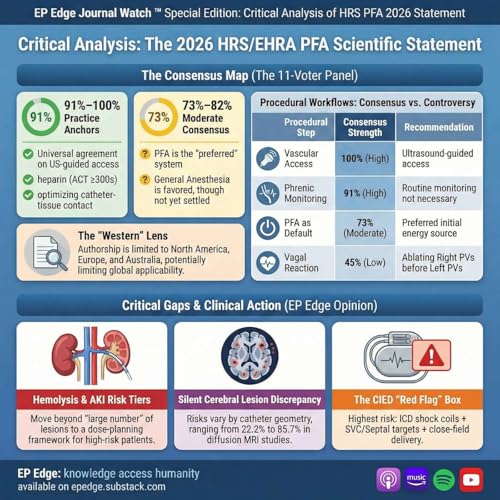
      In this EP Edge™ Journal Watch Special Edition, we unpack the newly released 2026 HRS/EHRA Scientific Statement on Pulsed Field Ablation (PFA) and translate “consensus language” into practical, lab-ready decision-making. This isn’t a surface summary—it’s a critical appraisal of how the statement was built (including the 11-voter model), where the field is truly aligned, and where recommendations may outpace either the evidence base or global clinical reality.

      final pfa statement

      You’ll hear a Consensus Map that separates high-agreement anchors (e.g., access, anticoagulation, sheath discipline) from moderate-consensus workflow preferences (e.g., anesthesia models, ICE use, waiting periods), and the genuinely controversial areas. Then we go deep on what matters most to operators and patients: platform-aware safety and post-market signal management, hemolysis/AKI mitigation tied to lesion burden, phrenic/airway realities, esophageal considerations when lesion sets expand, CIED interaction risk, and why “PFA is a system, not a single technology” should change how you read every recommendation.

      final pfa statement

      Show notes: All graphics and full references are available on epedge.substack.com and on LinkedIn in the EP Edge™ Journal Watch newsletter (Issue 12 Special Edition).
      Questions/suggestions: email: epedgecast@gmail.com

      Afficher plus Afficher moins
      17 min
    • EP Edge Journal Watch Issue 11 February 2026: Varipulse Safety Signal, ElectroPulse PFA, Farapoint CTI Ablation, Leadless Pacemaker Infection & EP Occupational Hazards
      Feb 16 2026

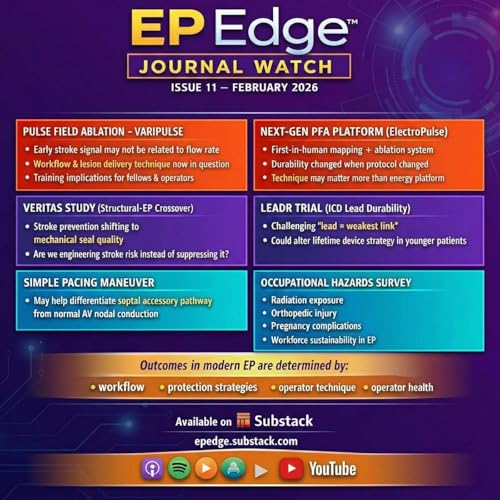
      In this episode of EP Edge Journal Watch, we review several developments that directly impact modern electrophysiology practice — from pulsed field ablation safety to operator health. We begin with the real-world Varipulse experience, where early neurovascular events dropped dramatically after workflow modification and reduction of lesion stacking, highlighting that PFA success depends as much on procedural execution as on device design. We then discuss the first-in-human ElectroPulse mapping-ablation platform and what its early durability signals suggest about integrated catheter systems and standardized ablation protocols.

      We next turn to right-sided ablation safety. The episode examines cavotricuspid isthmus pulsed field ablation, the mechanism of coronary vasospasm, and the high-dose nitroglycerin protection strategy used in studies. We also review emerging intracoronary imaging findings suggesting possible delayed coronary arterial remodeling after PFA. Device and structural therapy updates follow, including Amulet 360 left atrial appendage occlusion sealing performance and long-term outcomes of a small-diameter ICD lead platform designed to improve lead durability.

      Finally, we discuss practical EP laboratory implications: a simplified pacing maneuver to distinguish AV nodal from septal accessory pathway conduction, the first reported infection involving an atrial leadless pacemaker, and new data on occupational hazards in electrophysiology — including radiation exposure, cataracts, orthopedic injury, and pregnancy-related workforce considerations. The central message is clear: electrophysiology outcomes increasingly depend on workflow discipline, protection strategies, and operator sustainability.

      Full references, figures, and detailed graphics are available in the LinkedIn Newsletter: EP Edge Journal Watch — Issue 11 (February 2026) and on Substack at epedge.substack.com.
      Questions or feedback: epedgecast@gmail.com.

      Afficher plus Afficher moins
      13 min
    Aucun commentaire pour le moment