Épisodes

  • Staying, Making, Connecting: The 2025 creative playbook
    Jan 2 2026

    In this podcast you will learn how media artists stay with uncertainty, make deliberate choices with technology, and build work through collaboration—with people, place, ecology, and time.

    This is a 2025 compilation episode, bringing together the advice I ask for at the end of every conversation on Creating New Spaces. Across the year, artists returned to a few shared concerns: how to keep going when meaning arrives slowly, how to test and refine work without being led by the tools, and how installation practice is shaped by teams, trust, and the systems around us.

    Listen to this podcast to learn about:

    • How to stay with the work when it’s unclear, slow, or shifting
    • How to make with machines through testing, revision, and refinement
    • How media work becomes shared — through collaboration, community, and ecology
    • Guests featured

      Johan F Karlsson, Ariana Gerstein, Monteith Mccollum, Matt Warren, Rita Eperjesi, Georgie Friedman, Matthew Ragan, Troy Merritt, Darryl Rogers, Alex Moss, Maggie Jeffries, and Keith Armstrong

      Chapters

      (00:00:00) Intro: staying, making, connecting

      (00:00:52) Staying with the work: pace, patience, resilience (Johan, Ariana, Matt, Rita)

      (00:05:51) Making with machines: testing, tools, refinement (Georgie Friedman, Matthew, Troy)

      (00:09:34) Making with others: teams, shared practice, impact (Darryl Rogers, Alex and Maggie, Keith)

      (00:14:17) Closing

      Links from the podcast

      Guests

      • Johan F Karlsson— website
      • Ariana Gerstein — website
      • Matt Warren— website
      • Rita Eperjesi — website
      • Georgie Friedman — website
      • Matthew Ragan — website
      • Troy Merritt / Soma Lumia — website
      • Darryl Rogers — website
      • Alex Moss — website
      • Maggie Jeffries — website
      • Keith Armstrong — website
      • Projects and organisations mentioned

        • The Weather at Midnight
        • Moonah Arts Centre
        • Dissolution
        • Lacuna
    Afficher plus Afficher moins
    15 min
  • Creating a shared practice with Alex Moss & Maggie Jeffries
    Oct 24 2025

    In this podcast you will learn how artists Alex Moss and Maggie May Jeffries developed a shared creative process that bridges traditional painting and interactive media.

    In this interview, Alex Moss and Maggie Jeffries discuss the creative process behind The Weather at midnight. The exhibition combines painting, projection, and real-time interaction to create a shifting environment of light and movement. Through subtle digital overlays and live painting, static canvases become dynamic, evolving works that change with audience presence. The exhibition was presented at Moonah Arts Centre.

    Alex Moss is a Lutruwita/Tasmanian-based media artist whose work transforms spaces through projected light, sound design, and interactive elements. Maggie May Jeffries is a painter from Lutruwita/Tasmania whose practice explores memory, environment, and sensory experience through layered, detailed compositions.

    Listen to this podcast to learn about:

    • The role of experimentation, trust, and structure in cross-disciplinary collaboration, and how shared workshops shaped Alex and Maggie’s evolving process.
    • How data, audience presence, and live performance intertwined during the exhibition.
    • What “slow noticing” reveals about time, attention, and the perception of creative work.

    Chapters

    (00:00:00) Introduction to artist collaboration

    (00:01:18) Meet Maggie and Alex

    (00:01:52) The weather at midnight project

    (00:04:17) Audience experience and interaction

    (00:05:51) Inspiration and process

    (00:09:11) Live painting and performance

    (00:18:06) Workshops and collaboration

    (00:23:26) Future directions and advice

    (00:25:13) Conclusion and farewell

    About Alex Moss

    Alex Moss is a media artist based in Lutruwita/Tasmania and a member of Second Echo Ensemble. With over ten years of experience, his work spans projection, sound design, and interactive installation, transforming spaces through light and sensory engagement. He has created work for the University of Tasmania, Hobart City Council, the Tasmanian Museum and Art Gallery, and the Huon Valley Mid-Winter Festival. Alex received the 2023 Best Sound Design Professional Theatre Award for Outside Boy with Second Echo Ensemble.

    About Maggie Jeffries

    Maggie May Jeffries is a painter based in Lutruwita/Tasmania and a member of Second Echo Ensemble. Her practice explores memory, place, and the natural environment through layered paintings that merge observation with imagination. She graduated with First Class Honours in Fine Art and Psychology from the University of Tasmania in 2022. Represented by Despard Gallery, she received the NEXT Award in 2018 and was a finalist in the 2024 Women’s Art Prize Tasmania.

    Links from this podcast with Alex Moss and Maggie Jeffries

    • Visit Moonah Arts Centre
    • Explore Moonah Arts Centre’s exhibition page for The weather at midnight
    • Visit Alex Moss’ website
    • Follow Alex Moss on Instagram
    • Learn more about Maggie May Jeffries at Despard Gallery
    • Follow Maggie May Jeffries on Instagram
    Afficher plus Afficher moins
    26 min
  • Cultivating curiosity in creative coding with Matthew Ragan
    Sep 26 2025

    In this podcast you will learn why curiosity matters more than technical skill.

    In this interview, Matthew Ragan explores coding as a practice of sculpting and rehearsal, showing how collaboration with technology leads to more fluid and sustainable creative outcomes.Matthew Ragan is a California-based creative technologist, educator, and co-founder of SudoMagic. He has an MFA in interdisciplinary digital media and performance. His TouchDesigner tutorials are used by creatives worldwide.

    Listen to this podcast to learn about:

    • Why curiosity and patience matter more than technical skill in creative coding
    • What Matthew Ragan’s circus training revealed about working with technology as a collaborator rather than an obstacle.
    • Why “slow coding” offers a sustainable counterbalance to the culture of instant results.

    Chapters

    (00:00:00) Introduction and host's acknowledgment

    (00:00:48) Guest introduction: Matthew Ragan

    (00:01:15) The importance of curiosity in creative coding

    (00:02:31) Exploring noise algorithms and sculpting

    (00:05:08) Lessons from circus performance to coding

    (00:07:17) Balancing creative and commercial projects

    (00:09:15) Matthew's journey into coding

    (00:22:03) Choosing the right tools and languages

    (00:24:03) Advice for newcomers and final thoughts

    (00:30:55) Conclusion and call to action


    About Matthew Ragan

    Matthew Ragan is a California-based creative technologist, educator, and artist whose work bridges performance and technology. With a background in acting, dance, and circus arts, he brings embodied lessons of rehearsal and collaboration into his creative coding practice. He has shaped a generation of artists through his widely used TouchDesigner tutorials, and professionally he has led large-scale projects at Obscura Digital and the Madison Square Garden Company, including Art on theMart and the MSG Sphere. He is the co-founder of SudoMagic, a boutique software and design studio.

    Links from the podcast with Matthew Ragan

    • Visit Matthew Ragan’s website
    • Explore Matthew Ragan’s teaching resources
    • Visit SudoMagic, the studio he co-founded
    • Follow Matthew Ragan on Instagram
    • See Matthew Ragan’s GitHub projects
    • Discover TouchDesigner, the platform central to his teaching and creative coding practice
    • Learn more about Python, a core scripting language in his work
    • Watch Matthew’s masterclass for Interactive & Immersive HQ: How to approach building a real project on YouTube
    Afficher plus Afficher moins
    31 min
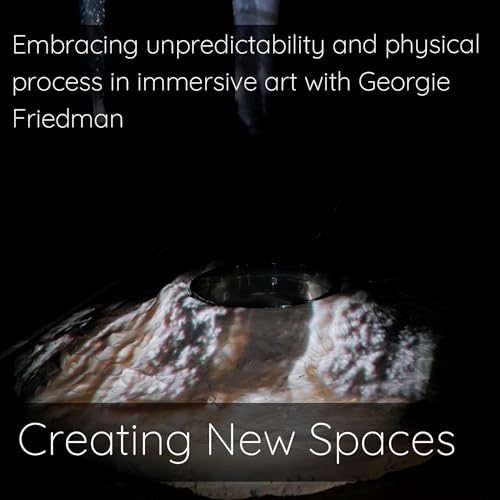
  • Embracing unpredictability and physical process in immersive art with Georgie Friedman
    Jul 12 2025

    In this podcast, discover how physical prototyping, water systems, and shifting sound and light bring Georgie Friedman’s installations to life.

    In this interview, Georgie Friedman explores the creative process behind Dissolution, an immersive installation blending spatial sound, projection-mapped video and dripping water to evoke a dark, cave-like stillness. The work was installed at Gallery A2, part of Artisans Asylum, a collaborative makerspace in Boston.

    Georgie is a Boston-based interdisciplinary media artist and educator. Her background in film, sculpture and digital media informs a practice rooted in physical experimentation, environmental phenomena and spatial design.

    Listen to this podcast to learn about:

    • Why physical prototyping is essential for immersive media work
    • Creating installations that incorporate live water
    • How projection mapping changes when your surfaces sway, drip and shift

    Chapters

    (00:00:00) Introduction to the Dissolution

    (00:00:33) Podcast introduction and acknowledgements

    (00:01:14) Interview with Georgie Friedman begins

    (00:01:35) Exploring the installation Dissolution

    (00:03:06) Concept and inspiration behind the piece

    (00:05:46) Technical aspects and challenges

    (00:09:42) Projection mapping and unexpected outcomes

    (00:16:24) Reflections and future projects

    (00:17:42) Advice for aspiring artists and conclusion

    About Georgie Friedman

    Georgie Friedman is a Boston-based interdisciplinary media artist whose immersive installations explore psychological and societal relationships to natural phenomena. Her work integrates large-scale video projection, sculptural forms, spatial sound and physical elements like water to create contemplative, sensory-rich environments. Drawing on site-based research and footage, she reflects on themes of climate, transformation and human fragility. Georgie holds an MFA from the School of the Museum of Fine Arts at Tufts University, where she currently teaches. Her projects have been exhibited internationally and commissioned for public spaces.

    Links from the podcast with Georgie Friedman

    • Visit Georgie Friedman’s website
    • Follow Georgie on Instagram
    • Learn more about Dissolution
    • Visit Gallery A2
    Afficher plus Afficher moins
    21 min
  • Intervals: Creative responses to space with Johan F. Karlsson
    Jun 3 2025

    In this podcast, you’ll learn how Johan F. Karlsson uses observation, intuition, and the concept of ma to shape site-specific installations that reveal subtle changes in space and time.

    In this interview, Johan F. Karlsson talks about the creative process behind Against the day and The space that remains. The installations are part of the exhibition Forever is nothing, developed during Johan’s residency at Space Department, a Japanese residency program that supports architecture and spatial-based art practices.

    Johan F. Karlsson is a Swedish artist whose work investigates time, space, and ephemeral processes. His practice spans video, performance, photography, and sculpture. He holds an MA in Photography from Aalto University and a BA in Culture and Arts from Novia University of Applied Sciences.


    Listen to this podcast to learn about:

    • How the concept of ma guided a process of waiting, noticing, and responding
    • How intuition and site-specific observation replace fixed planning in creative workflows
    • How time becomes both material and subject in durational video installation

    Chapters

    (00:00:00) Introduction and acknowledgements

    (00:00:38) Exploring the concept of 'ma'

    (00:01:21) Artistic process and residency experience

    (00:02:43) Creating 'Against the day'

    (00:04:37) Creating 'The space that remains'

    (00:07:53) Reflections on artistic practice

    (00:15:07) Advice for aspiring artists

    (00:16:15) Conclusion and farewell

    About Johan F. Karlsson

    Johan F. Karlsson is a Malmö-based artist whose work spans photography, video, performance, and sculptural installations using natural materials. With an MA in Photography from Aalto University and a BA in Culture and Arts from Novia University, his practice explores time, space, and perception through slow, ephemeral processes. Drawing on site-specific phenomena and the transience of materials, Johan's work invites viewers into a deeper connection with the rhythms of nature and the passage of time. His installations often examine how change and duration shape human experience.


    Links from the podcast with Johan F. Karlsson

    • Visit Johan F. Karlsson’s website

    • Visit the Space Department website

    • Read Robin’s reflection on exhibiting at Space Department – House shows: Reflections on space and interaction

    • Learn more about Against the Day

    • Learn more about The Space That Remains

    Afficher plus Afficher moins
    17 min
  • Keith Armstrong on collaborating with forests
    May 3 2025

    What does it mean to make art for a forest—not just about it? Keith Armstrong explores this question through his long-term project Forest Art Intelligence, which blends ecological recovery with creative experimentation.

    Forest Art Intelligence is a project that regenerates a cleared block of land into a native forest. Developed in partnership with the Samford Ecological Research Facility (SERF) and the Terrestrial Ecosystem Research Network (TERN), the project will be supported in 2024 through an ANAT Synapse Residency.

    Keith’s work challenges how we engage with ecological systems—inviting participation, reflection, and action.

    Listen to this podcast to learn about:

    • Creating artworks that support environmental recovery by providing habitat and enhancing ecological systems.
    • Using analogue materials—like logs, soil, and fungi—together with digital tools such as LIDAR and acoustic sensors to interact with a living site.
    • Why long-term, site-specific engagement matters—and how repeated visits shape an artist’s way of observing and responding to place.

    Chapters

    (00:00:00) Introduction and acknowledgements

    (00:00:56) Welcome and project overview

    (00:02:09) Forest art intelligence explained

    (00:03:27) Art intelligence and environmental regeneration

    (00:07:35) Scientific collaboration and data collection

    (00:08:21) Gardening vs. regeneration

    (00:20:51) Collaborating with nature

    (00:26:46) Advice for creatives

    (00:28:31) Conclusion and wrap-up


    About Keith Armstrong

    Keith Armstrong is an artist whose practice is grounded in ecological and social inquiry. He creates participatory, site-specific and technologically embedded works that ask how art can become a tool for rethinking our relationship with the environment and systems. He has led and created more than sixty major art and research-based projects. His work has been supported by fellowships from Creative Australia, the Australian Network for Art and Technology (ANAT), and the Synapse Art-Science Residency program.

    Links from the podcast with Keith Armstrong:

    • Visit Keith Armstrong’s website
    • Follow Keith Armstrong on Instagram
    • Learn more about Forest Art Intelligence
    • Learn more about Analog Intelligence at ISEA 2024
    • Visit the Samford Ecological Research Facility (SERF) website and the Terrestrial Ecosystem Research Network (TERN) website
    • Learn more about Australian Network for Art and Technology (ANAT)
    Afficher plus Afficher moins
    29 min
  • The evolution of Lacunae with Soma Lumia
    Mar 28 2025

    In this podcast, you will learn how Lacunae, an interactive installation by Tasmanian artist collective Soma Lumia, has evolved through multiple iterations. Lacunae is an interactive installation that enables people to dance with others in different locations through projected silhouettes and sound.

    In this conversation, Darryl Rogers and Troy Merritt from Soma Lumia share the journey of Lacunae. The project was born during COVID-19 to rethink how technology shapes human connection. It was originally designed for the Mona Foma festival as events began to re-open after the COVID-19 lockdowns. Since then, it has evolved, layering live and recorded interactions—where dancers move not just across space, but across time. Lacunae has become an ongoing experiment for Soma Lumia.

    Listen to this episode to learn about:

    • The iterative process behind Lacunae and why each version is a new creative experiment.
    • The role of collaboration in how Soma Lumia works.
    • The transition from Kinect sensors to webcams and how this offered different creative possibilities.


    Chapters

    (00:00:00) Introduction and welcome

    (00:00:05) Exploring Lacunae: an interactive art experience

    (00:01:07) Origins and development of Lacunae

    (00:03:17) Evolving versions of Lacunae

    (00:06:20) Audience reactions and memorable moments

    (00:07:41) Prototyping and technical challenges

    (00:15:19) Collaborative process and team dynamics

    (00:20:41) Reflections and advice for future projects

    (00:23:08) Conclusion and final thoughts


    About Soma Lumia

    Soma Lumia is a tech-art collective based in Launceston, Tasmania, founded in 2015. Their work explores the boundary between physical and digital, movement and technology, real and virtual. The collective has presented projects at Illuminate Adelaide, Botanica, Beaker Street, the South Australia Museum, the University of Houston, and Mona Foma.

    Their practice is deeply rooted in experimentation and collaboration, bringing in new voices—technologists, dancers, musicians, and designers—to expand each project’s scope. Lacunae is a prime example of how their work evolves over time, rather than existing as a single fixed installation. The core members are Darryl Rogers, James Riggall, and Troy Merritt.

    • Darryl Rogers is a media artist working with video, installation, and immersive platforms to explore perception and spatial transformation.
    • Troy Merritt is a creative technologist with over two decades of experience in media systems, interactivity, and augmented environments.
    • James Riggall is an entrepreneur and educator working at the intersection of immersive technology, storytelling, and digital experience design.


    Links from the podcast:

    • Learn more about Lacunae on Soma Lumia’s website
    • Learn more about Mona Foma
    • Follow Soma Lumia on Instagram
    Afficher plus Afficher moins
    26 min
  • Media art for public spaces with Ariana Gerstein and ​Monteith McCollum
    Feb 21 2025

    What happens when an artwork is shaped by the unpredictability of public space?

    In this interview Ariana Gerstein and Monteith McCollum discuss What We Bring, an outdoor installation that extends Ariana’s larger documentary project exploring migration, personal history, and overlooked traces of the past. While filming in Athens, Greece, she was drawn to a clothesline hanging in an old neighborhood—a simple yet powerful marker of everyday life. The street, surrounded by century-old markets and remnants of war, embodied layers of history intertwined with personal and familial narratives. This imagery became the foundation of What We Bring, where projected visuals interact with moving fabrics to evoke memory, presence, and impermanence.

    Ariana is an experimental filmmaker whose projection installations and non-traditional cinematic works explore themes of memory, time, and personal narratives. Monteith McCollum is an inter-media artist working with film, sound, and sculpture.

    Listen to this podcast to learn about:

    • Adapting media art for outdoor and public space
    • Overcoming challenges of weather when working outdoors
    • Bridging documentary storytelling with the emotional power of installation art

    Chapters

    (00:00:00) Introduction and acknowledgements

    (00:00:52) Meet the artists: Ariana Gerstein and Monteith McCollum

    (00:01:19) The concept and inspiration behind "What We Bring"

    (00:01:52) Challenges and dynamics of outdoor installations

    (00:04:27) Exploring the technical aspects

    (00:10:25) Sound design and audience interaction

    (00:21:17) Collaboration and creative process

    (00:24:00) Lessons learned and advice for media artists

    (00:30:32) Conclusion and final thoughts


    About Ariana Gerstein

    Ariana Gerstein is an experimental filmmaker and media artist who creates innovative projection installations and cinematic works. A Guggenheim Fellow and a Professor at Binghamton University’s Department of Cinema, her practice explores memory, time, and personal narratives through non-traditional filmmaking techniques. Her work has been screened at venues like the Museum of Modern Art and the European Media Arts Festival and has received awards such as the Gus Van Sant Award for Best Experimental Film. Supported by the Rockefeller Media Arts Fellowship and the National Endowment for the Arts, Ariana’s art challenges conventional storytelling and engages audiences in unique visual experiences.

    About Monteith McCollum

    Monteith McCollum’s acclaimed films have screened at venues such as the Museum of Modern Art, the Hirshhorn Museum, and festivals including SXSW, Hot Docs, and the European Media Arts Festival. A recipient of the IFP Truer Than Fiction Spirit Award, Monteith’s work has also been supported by the Rockefeller Foundation, the National Endowment for the Arts, and the New York Foundation for the Arts. In addition to filmmaking, he creates innovative sound compositions for films and performances, merging his expertise in storytelling and audio to deliver engaging, multi-sensory experiences.

    Links from this interview with Ariana Gerstein and ​Monteith Mccollum:

    • Learn more about What we bring
    • Visit Ariana Gerstein’s website
    • Follow Ariana Gerstein on Instagram
    • Visit Monteith Mccollum’s website
    • Learn more about Isadora
    • Read Robin’s reflection on this conversation – Feeling vs thinking: How art and documentary shape experiences differently
    Afficher plus Afficher moins
    31 min