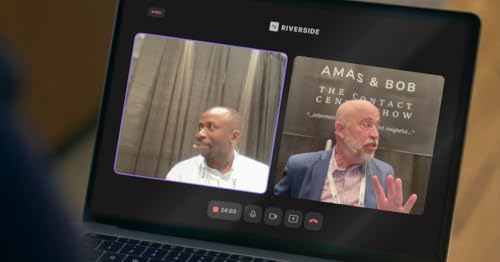
Épisodes

  • Is AI a Threat to CRM?
    Jan 25 2026

    Summary

    In this episode, Amas Tenumah and Bob Furniss delve into the current state of Software as a Service (SaaS) and its intersection with artificial intelligence (AI), particularly in the context of contact centers. They discuss the recent downturn in stock prices for major SaaS companies like Salesforce and ServiceNow, attributing this to Wall Street's skepticism about the actual impact of AI on these platforms. Amas expresses concern that the hype surrounding AI is outpacing the reality of its implementation, suggesting that many companies are not yet ready to fully embrace AI-driven solutions. Bob echoes this sentiment, emphasizing the importance of expertise and experience in successfully implementing these technologies.

    AI hype is ahead of customer readiness.
    Wall Street is skeptical about SaaS companies' future.
    Vibe coding may not replace the need for expertise.
    Experience in implementation outweighs potential of new tech.
    Both extremes of AI adoption are currently inaccurate.

    Sound bites

    "Service now stock hasn't been this cheap in like four years."
    "There's two different stories going on here."
    "Both extremes are wrong today."


    Chapters

    00:00 Introduction and Current Market Overview
    00:53 The Impact of AI on SaaS Companies
    03:42 Building vs. Buying: The New Paradigm
    07:18 Navigating Contract Renewals and New Technologies
    10:49 The Future of AI in the Contact Center Industry
    13:38 Conclusion and Key Takeaways

    Afficher plus Afficher moins
    17 min
  • Stop Chasing Vanity Metrics
    Jan 18 2026

    Most customer experience goals are meaningless. In this episode, Bob Furniss and Amas Tenumah dismantle the way contact centers set annual CX metrics and explain why leaders keep optimizing numbers that customers neither notice nor value.

    Using insights from a John Goodman article on CX goal-setting, the conversation exposes the disconnect between executives, customers, and frontline teams—and why automation, deflection, and "respectable" percentage improvements often make service worse, not better.

    This episode is about shifting from internally convenient metrics to customer-impactful outcomes.

    What You'll Hear
    • Why CX goals are often chosen because they sound reasonable, not because they solve customer problems

    • How executives chase a single "magic number" instead of understanding service complexity

    • The fundamental incentive gap between customers and senior leadership

    • Why customers and frontline agents are aligned—but executives aren't

    • How automation and bots optimize company metrics while frustrating customers

    • Where AI actually helps: analyzing volume, root causes, and systemic friction

    • Why average metrics (ASA, AHT) distort reality and reward the wrong behavior

    • How poor goal-setting punishes leaders who successfully automate the "easy" work

    • The risk of letting someone else define your goals if you don't take control

    • A real-world example of automation done right—and how bad metrics mislabel it as failure

    Key Takeaways
    • Vanity metrics don't fix customer experience

    • Deflection and containment may look good internally while actively harming trust

    • CX leaders must own the narrative or be trapped chasing numbers they don't believe in

    • AI should surface customer pain, not just reduce contact volume

    • Goals should reflect customer outcomes, not executive convenience

    Resources Mentioned
    • John Goodman's article on CX goal-setting (referenced in discussion)

    • HOLD: The Suffering Economy of Customer Service by Amas Tenumah

      • Available on Amazon

      • Signed copies at waitingforservice.com

    Who This Episode Is For
    • Contact center and CX leaders setting 2026 goals

    • Executives relying on NPS, ASA, AHT, or deflection as proxies for success

    • Practitioners tired of fixing the wrong problems

    • Anyone responsible for explaining service performance to leadership

    Afficher plus Afficher moins
    19 min
  • New Year Predictions — What 2025 Got Wrong, What 2026 Gets Right
    Jan 13 2026

    2025 predictions — graded AI-powered knowledge

    Bob's 2025 prediction: AI would dramatically improve knowledge in contact centers.
    Result: Early but mostly wrong.

    The technology moved, but the data did not. Knowledge bases were too fragmented, too dirty, and too poorly governed for AI to meaningfully improve frontline work. The industry instead spent another year chasing bots, automation, and surface-level "AI assistants."

    Grade: C+

    The failure was not AI. It was the state of enterprise knowledge.

    Remote work reversal

    Bob's 2025 prediction: Work-from-home would shrink and revert toward pre-COVID norms.
    Result: Correct.

    Remote and hybrid work has fallen to within five percentage points of pre-COVID levels. Companies quietly reversed course not because it helped customers or employees, but because leadership never learned how to manage distributed teams.

    Hybrid was the worst of both worlds: frontline leaders juggling physical rooms, video calls, and dashboards without the training or structure to do any of it well.

    Grade: A

    Why remote work collapsed

    The reversal was not ideological. It was operational.

    Executives defaulted back to what felt controllable: physical presence. Organizations refused to do the hard work of re-engineering leadership, coaching, quality management, and accountability for a distributed workforce. They solved a people problem with proximity.

    Amas' prediction for 2026

    Voice comes back.

    Digital channels absorbed most of the AI hype: chat, bots, messaging, and self-service. But customers never stopped calling. Voice is where frustration spikes, where trust is tested, and where automation breaks down.

    Amas' call:
    2026 will be the year voice reasserts itself as the center of the customer relationship — and the CCaaS market will look radically different by 2027 because of it.

    Bob's prediction for 2026

    Data becomes the bottleneck.

    AI will only become useful where it has access to clean, structured, reliable data. The industry rushed into AI before fixing the foundations: knowledge, case data, call logs, customer history, and operational context.

    2026 will be the year contact centers slow down, audit their data, and rebuild the plumbing that AI actually runs on.

    No data. No intelligence.

    What the industry is claiming

    Analysts and vendors are promising three things for 2026:

    • Predictive and proactive service
    • Agent empowerment through AI
    • Fewer humans in contact centers

    Bob and Amas reject the third and remain skeptical of the first two without structural change. The hype assumes AI will replace labor. Reality says AI will expose how broken the systems around labor really are.

    Amas' 2026 wish

    Stop calling software "agents."

    For twenty years, "agent" meant a human being doing emotional, cognitive, and relational labor. Rebranding bots as agents erases the workforce and confuses accountability.

    Language shapes power. That battle matters.

    Bob's 2026 wish

    Focus on the employee.

    AI should not be used to replace people. It should be used to remove friction from their work: searching, documenting, switching systems, hunting for answers. Knowledge was always the real use case. The industry just skipped the hard part.

    Core takeaway

    2025 proved that AI without data, governance, and human-centered design does not transform anything. It only adds noise.

    2026 will reward the companies that stop chasing demos and start rebuilding the foundations: voice, knowledge, data, and frontline enablement.

    That is where the real disruption will come from.

    Afficher plus Afficher moins
    13 min
  • HOLD — The Suffering Economy of Customer Service
    Jan 5 2026

    Amas Tenumah explains why customer service is not "broken" but intentionally designed to fail. Drawing on decades inside contact centers, historical research, and real corporate incentives, he argues that long waits, deflection, and automation-first strategies are features—not bugs. The conversation dismantles common CX myths, challenges executive complacency, and frames consumer behavior as the only force capable of triggering real change.

    Core Themes
    • The Suffering Economy of Customer Service:
      When service is universally bad across industries, it's systemic. Incentives—not incompetence—drive outcomes.

    • Why This Is a "How Dare You" Book:
      The indictment is aimed squarely at executives who treat service as a cost center while overfunding marketing narratives.

    • Marketing Replaced Service as Trust Mechanism:
      Historically, service was marketing. Industrialized marketing severed that link, allowing companies to tolerate bad service and buy growth instead.

    • Metrics That Poison Service:
      Deflection, containment, and avoidance KPIs reward companies for not talking to customers—while punishing leaders who try to deliver what customers actually want.

    • Wait Times Are Engineered:
      Hold times are budgeted, modeled, and accepted. They are designed friction, not operational accidents.

    • AI as Distance, Not Salvation:
      AI is currently deployed to protect companies from customers, not customers from friction. It scales avoidance unless incentives change.

    • Executives Don't Experience Their Own Service:
      Many leaders despise customer service—just not their own. Forcing executives to call their own 1-800 numbers is revelatory and uncomfortable.

    • The Revolt Is Consumer-Led:
      Change will not come from CX professionals alone. It comes when consumers punish bad service with their wallets and reward companies that respect their time.

    Notable Moments
    • The opening story of the 1750 BC clay tablet complaint—the first recorded customer service grievance—reads like a modern Amazon review.

    • The Chipotle refund anecdote exposes time theft: hours of customer labor to recover trivial amounts of money.

    • The contrast between automation done for customers versus automation used to avoid them.

    Practical Takeaways
    • For Consumers:
      Vote with your wallet. Pay slightly more. Wait one more day. Call customer service before you buy big-ticket items.

    • For Service Leaders:
      If your CEO doesn't believe in service as value creation, your job is to change their mind—or change jobs. Data plus customer stories are the leverage.

    • For Executives:
      Service is deferred revenue protection. Treating it purely as cost is strategic malpractice.

    Resources Mentioned
    • Book: HOLD: The Suffering Economy of Customer Service — And the Revolt That's Long Overdue

    • Signed Copies & Tools: waitingforservice.com

      • Consumer scripts

      • Cancellation guides

      • Practitioner playbooks

      • No email required

    Afficher plus Afficher moins
    34 min
  • Empowering Sales Teams through AI
    Dec 8 2025

    Summary

    The conversation explores the integration of AI in sales, focusing on how it enhances customer engagement and improves sales efficiency. Bob Furniss discusses the importance of using data to empower salespeople rather than reducing their numbers, emphasizing a customer-centric approach to AI in sales.

    Takeaways

    AI can enhance customer engagement in sales.
    The focus should be on empowering salespeople with data.
    AI is not just about reducing costs but improving efficiency.
    Sales strategies should prioritize customer needs.
    Data-driven insights can lead to better sales outcomes.
    AI can make sales calls faster and smarter.
    The role of AI is to support, not replace, sales personnel.
    Understanding customer needs is crucial in sales.
    AI tools should be designed to assist sales processes.
    The future of sales lies in the integration of technology and human touch.

    Afficher plus Afficher moins
    22 min
  • Unlocking Value in Contact Centers with Brad Cleveland
    Nov 21 2025

    Summary

    In this conversation, Amas Tenumah, Bob Furniss and Brad Cleveland discusses the three levels of value that contact centers create: efficiency, customer satisfaction and loyalty, and strategic insights provided by AI. He emphasizes the importance of these levels in improving products, services, and processes.


    Takeaways

    there's three levels of value that contact centers create
    Level one is efficiency
    customer satisfaction, loyalty, if we do a good job
    it's the strategic insight that AI can provide
    it can still tell us, hey, here's a trend I'm seeing
    Here's an opportunity to improve products and services
    AI doesn't have to be perfect to provide value
    Strategic insights can drive business improvements
    Understanding trends is crucial for growth
    Contact centers play a vital role in customer experience


    Titles

    Unlocking Value in Contact Centers
    The Role of AI in Customer Service


    Sound bites

    "Level one is efficiency"
    "customer satisfaction, loyalty, if we do a good job"
    "it's the strategic insight that AI can provide"


    Chapters

    00:00 Introduction to the Contact Center Show
    00:27 AI and Its Impact on Customer Interactions
    00:31 Future Jobs in the Contact Center Industry

    Afficher plus Afficher moins
    27 min
  • Stacy Sherman: Why 'Satisfied' Is the New 'Fine' And 12 Reasons That's Not Good Enough"
    Nov 18 2025
    Low-Cost, High-Impact CX Improvements The Power of Language: Transform "I can't" into "How can we"Shift from "I have to" to "We get to"Being "impeccable with your word" (inspired by The Four Agreements)Words trigger emotional responses that shape customer perception Getting CX Buy-In Across Organizations The Alignment Problem: CX initiatives fail when metrics aren't shared across departmentsSuccess came when executives adopted the same CX metrics as the CX teamWithout shared goals, customer insights get shelved with "we'll get to it later" The Pilot Program Strategy: Start small before asking for big budgetsShow proof of concept with intentional, measurable pilotsUse success to rally and align different areas of the company Real Example - CX Day Success: Introduced first-ever CX Day celebration at 145-year-old engineering companyStarted small despite skepticismNow an annual tradition that continues after her departure Rethinking CX Metrics Beyond Traditional Measurements: NPS and effort scores are starting points, not endpoints"Satisfaction" is no longer good enough (it's the equivalent of "fine")New focus: Emotional altitude across every touchpoint The Emotional Impact: Brains constantly cycle between thinking and feelingEmotions create lasting imprints that shape brand perceptionResearch shows: 12 positive experiences needed to overcome 1 negativeMeasure emotional highs to identify gaps and successes The Four Rs of CX Impact: RevenueRetentionReputationReferrals The Future of Contact Centers Human + AI Integration: Smart companies intentionally map where humans add value vs. where AI should handle interactionsThe answer is "both/and" not "either/or"Critical: Validate designs with real customers, not just internal teams The Contact Center Superpower: Contact center teams speak to more customers in a week than other departments do in a yearThis proximity to customers gives agents unique power to be organizational change agentsVoice of customer insights should inform product development, marketing messaging, and more Words Matter in the AI Era: Example: Website offering "24/7 support, our guides are happy to help you""Guides" for both humans and AI feels impersonalNaming and framing still matters The Power of Customer Voice The 10-Minute Video Story: A contact center leader captured customer feedback about a failed new product. At an executive meeting, he played a 10-minute compilation of customer complaints. The CEO's initial advisor said it was a career-ending mistakeThe CEO walked out during the videoResult: CEO returned and said it was "the best 10 minutes anybody's ever played" and named him employee #1Customer voice changed the company's trajectory The Validation Imperative: Internal perspective isn't enoughCustomer validation must be iterative, not one-timeCan't use internal team as proxy for outside voiceBoth internal knowledge AND customer validation matter The Fundamental C-Suite Challenge When C-suite leaders aren't aligned in their meetings, misalignment trickles down through the entire organization. This is the root problem preventing effective CX implementation. Notable Stories The Morgan & Morgan Tattoo Story: Leadership promised to get company logo tattoos if the team hit an unprecedented conversion rate goal. When they achieved it, 40 leaders got matching tattoos - four tattoo artists came in for the day. The question became: "Is your brand tattoo-worthy?" Stacey's Podcast Origin: Bought her first microphone for under $50, then waited six months before taking it out of the box due to fear. That mic ignited her journey to intentionally sharing her voice through podcasting. Living Podcasting: At the conference, Stacey pulled out her mic to record a 10-minute session where Amas (who has Parkinson's) gave direct advice to her relative with a similar condition - creating immediate, personal value rather than secondhand communication. Takeaways for Contact Center Leaders Language shapes reality - Small word changes create emotional shifts in customer experienceDemand metric alignment - CX can't succeed unless executives share the same measurementsStart with pilots - Prove value small-scale before requesting major investmentLeverage your proximity to customers - Use it to become the organizational glue and change agentValidate everything with real customers - Internal assumptions aren't enoughMap the human-AI journey intentionally - Design where each adds value, then test with customersBring customer voice to leadership - Sometimes the most powerful thing is making them listen directlyAverage isn't acceptable - Move beyond satisfaction to creating emotional highs
    Afficher plus Afficher moins
    23 min
  • Live from ICMI Conference - HR as a Contact Center with Bianca
    Nov 11 2025
    Episode Summary

    Broadcasting live from the ICMI conference in Orlando, Amas and Bob discuss the evolving role of AI in contact centers, the ongoing struggle for strategic recognition, and welcome special guest Bianca, who shares her unique perspective on running HR as a contact center at Michigan State University.

    Afficher plus Afficher moins
    30 min