Épisodes

  • Beyond the Text: Moderation and Memory: Rapin de Thoyras and the Making of English Party
    Apr 13 2026

    Send us Fan Mail

    🎓 A milestone moment in the PhD journey…

    Last term, I had the privilege of delivering my first presentation of my doctoral research at the Humanities Research Day at the University of Buckingham — and what a moment it was.

    Presenting “Moderation and Memory: Rapin de Thoyras and the Making of English Party” felt like more than just an academic exercise. It was the first time my work stepped out into the world — tested, shared, and given voice beyond the page.

    💭 To stand and articulate months (and years!) of thought — on party, moderation, and the strange, indeterminate nature of the English constitution — was both daunting and deeply rewarding.

    Rapin asks us: if England is neither monarchy, aristocracy, nor democracy… what is it? And from that question emerges my broader argument — that political parties are not failures of the system, but necessary expressions of it.

    📚 This presentation marked a turning point:

    • From research to communication
    • From private writing to public argument
    • From uncertainty to a growing confidence in my work

    Most of all, I felt incredibly proud — not just of the ideas themselves, but of reaching a stage where I could contribute meaningfully to the wider academic conversation.

    Here’s to many more discussions, debates, and discoveries ahead.

    #PhDLife #IntellectualHistory #UniversityOfBuckingham #HistoryOfIdeas #AcademicJourney

    Afficher plus Afficher moins
    14 min
  • Beyond the Text: Edmund Burke and the Moral Imagination
    Apr 13 2026

    Send us Fan Mail

    💭 Can feeling and imagination preserve what reason alone cannot? In this episode, Jack Thomson explores the political vision of Edmund Burke and the enduring power of moral imagination.

    Through Reflections on the Revolution in France, we trace Burke’s defence of order, tradition, and inherited wisdom — the idea that society is not constructed by abstract reason alone, but shaped by custom, sentiment, and historical continuity. This episode examines how Burke articulates a vision of politics grounded in prudence, prejudice (in its proper sense), and the accumulated experience of generations.

    🎧 In this episode:

    • Burke’s Reflections and the politics of moral imagination
    • The defence of tradition against abstract rationalism
    • Society as a living inheritance rather than a constructed system
    • The moral and emotional foundations of political order

    This is part of our Heritage Series, tracing the evolution of conservative and traditionalist thought — from Plato and Augustine of Hippo to Joseph de Maistre and beyond — exploring how ideas shape the foundations of Western civilisation.

    📚 Hosted by the History of Ideas Reading Club (University of Buckingham)
    🎙️ Produced by Beyond the Text: The Intellectual Historian’s Podcast
    🎧 Available on Spotify, Apple Podcasts & all major platforms

    #BeyondTheText #HeritageSeries #EdmundBurke #PoliticalPhilosophy #IntellectualHistory

    Afficher plus Afficher moins
    43 min
  • History of Ideas Clubs: Industrialisation and Karl Marx
    Apr 6 2026

    Send us Fan Mail

    Step into the upheaval of the long nineteenth century in this History of Ideas Club recording 🎙️

    “Industrialisation and Marx: The Making of Modern Society” explores a world transformed by unprecedented socio-economic change ⚙️. Breakthroughs in mechanical textiles, chemistry, iron production, and transport - most notably the steam engine 🚂 - drove rapid industrialisation, reshaping everyday life and pulling work out of the home and into expanding urban centres.

    Cities such as Manchester, Birmingham, Sheffield, and Leeds became the beating heart of this new industrial world 🏭 - but not without profound social consequences.

    At the centre of our discussion is Karl Marx, whose attempt to make sense of these transformations produced one of the most influential theories of history ever written 📚. Drawing on the philosophy of Georg Wilhelm Friedrich Hegel, Marx reinterprets the dialectic as a material process - a history driven not by ideas alone, but by economic forces and class struggle ⚖️.

    This was not a purely abstract concern. The realities of industrial life were captured vividly in literature, from Charles Dickens in England 🇬🇧 to Victor Hugo in France 🇫🇷, whose works echo many of Marx’s concerns about inequality, poverty, and social change.

    In this session, we explore Marx’s theory of history in its original context - setting aside later interpretations to better understand what he was responding to, and what he was trying to explain 🔍.

    This recording captures the spirit of the History of Ideas Club ⚡ - unpacking the intellectual and human consequences of industrialisation, and asking what it really meant to live through such a transformation.

    Join us as we explore industrialisation and the making of modern society 🎧

    #HistoryOfIdeas #Marx #IndustrialRevolution #Modernity

    Afficher plus Afficher moins
    1 h et 12 min
  • History of Ideas Club: The Birth of the Modern Republic: France, America, Haiti
    Mar 23 2026

    Send us Fan Mail

    Step into one of the defining political transformations of modern history in this History of Ideas Club recording 🎙️

    “The Birth of the Modern Republic: France, America, Haiti” explores the emergence of republican government as a central feature of modernity 🏛️. Across Europe and the Atlantic world, inherited systems of monarchy were challenged - intellectually, politically, and often violently ⚔️.

    We trace how thinkers and revolutionaries drew on competing visions of human nature, freedom, and authority 📖. From philosophical arguments grounded in anthropology and natural rights, to religious and scriptural justifications for resistance, the idea of the republic took many different and often conflicting forms.

    In America 🇺🇸, figures such as James Madison sought to balance liberty with stability, constructing a durable constitutional order. In France 🇫🇷, the revolutionary project - shaped by voices like Maximilien Robespierre - pursued a far more radical reimagining of society, with profound and often turbulent consequences 🔥.

    Meanwhile, in Haiti 🇭🇹, leaders such as Toussaint Louverture forged a republic through revolution against colonial rule, redefining the very meaning of freedom and sovereignty in the modern world ✊🏿.

    Yet these republics differed radically - not only in their ideals, but in how they were realised and sustained. Why did some endure while others faltered? What were the hidden costs of these revolutionary experiments? And what do they reveal about the promises - and limits - of republican thought?

    This session captures the energy of the History of Ideas Club ⚡ - examining the ambitions, contradictions, and legacies of the first modern republics.

    Join us as we explore the birth of the modern republic 🎧

    #HistoryOfIdeas #Republics #Revolution #PoliticalThought

    Afficher plus Afficher moins
    1 h et 11 min
  • History of Ideas Club: Revolution of Modernity: Descartes, Kant, Hegel
    Mar 9 2026

    Send us Fan Mail

    Step into one of the most transformative moments in intellectual history in this History of Ideas Club recording 🎙️

    “Revolution of Modernity: Descartes, Kant, Hegel” explores the deep tensions at the heart of modern thought - an age defined by radical doubt 🤔 and extraordinary philosophical ambition 📚. What happens when inherited truths and institutions begin to crumble? And how do thinkers rebuild knowledge in their wake?

    We begin with René Descartes, whose method of doubt seeks to reconstruct certainty from the ground up 🧠. Yet this raises a crucial question - can there really be a “view from nowhere”?

    Enter Immanuel Kant, who transforms the debate entirely 🔄. Rejecting both rationalist hubris and empirical simplicity, Kant argues that the human subject is central to the possibility of knowledge itself - grounding reason and morality in human experience ⚖️.

    Finally, we turn to Georg Wilhelm Friedrich Hegel, where the story becomes fully historical 🌍. For Hegel, reason is not static but develops through time, shaped by human relationships and the unfolding of history itself ⏳.

    Along the way, we situate these ideas within the wider upheavals of modernity, including the theological challenges of Martin Luther ✝️ and the emergence of systematic approaches to law and political order.

    This session captures the intellectual energy of the History of Ideas Club 🔥 - unpacking the paradoxes of early modern philosophy: doubt and certainty, subject and object, reason and history.

    Join us as we attempt to untangle the revolution of modernity 🎧

    #HistoryOfIdeas #Modernity #Descartes #Kant #Hegel

    Afficher plus Afficher moins
    1 h et 19 min
  • Beyond the Text: Joseph de Maistre: Order, Authority, and the Counter-Revolution
    Mar 2 2026

    Send us Fan Mail

    In this episode of Beyond the Text, Sam Woodall and Jack Thomson explore the provocative political thought of Joseph de Maistre, one of the most formidable critics of the Enlightenment and a central voice of the Counter-Revolution. Drawing on Jack Thomson’s research, the conversation examines Maistre’s defence of monarchy, tradition, and religious authority in the aftermath of the French Revolution. ⚜️📜

    The episode considers Maistre’s striking claim that reason alone cannot sustain political order, and that authority, sacrifice, and providence play a far deeper role in human societies than Enlightenment thinkers were willing to admit. From his reflections on violence and sovereignty to his vision of a divinely ordered political world, Maistre’s ideas remain unsettling and fascinating in equal measure. 🏛️⚔️

    As always on Beyond the Text, the discussion situates a major thinker within their intellectual and historical context, asking what their ideas meant in their own time and what they might still reveal about the enduring tensions between reason and tradition, revolution and order. 🌍📚

    Join us as we step beyond the text to unpack one of the most controversial and compelling thinkers of modern political thought. 🎙️

    #BeyondTheText, #JosephDeMaistre, #IntellectualHistory, #HistoryOfIdeas, #CounterRevolution, #FrenchRevolution, #PoliticalThought, #Philosophy, #EnlightenmentDebate, #Conservatism, #PoliticalPhilosophy, #IdeasMatter

    Afficher plus Afficher moins
    50 min
  • History of Ideas Club: The Copernican Revolution in Astronomy
    Feb 23 2026

    Send us Fan Mail

    Copernicus demonstrated for the first time that the Earth orbits the sun, and not the reverse as was previously thought. Previous measurements had lended themselves to the latter view, but the number of 'epicycles' needed to model the known orbits and their coincidence at specific times became impractical. Copernicus' revision of the fundamental point of reference simplied the model drastically. More importantly it challenged our peceived sense of central significance in the cosmos, a kind of demystification of the place of man in the universe. Copernicus' work influenced Gallileio, and both astronomers' works were censored by the Church, not exactly because of the apparent contradiction with scripture, as is often claimed, but because of the competing epistemologies: the nature and scope of scientific truth in relation to philosophical and theological truth was not yet understood. We examine the deep philosophical and anthropological conflict underlying this important episode in modern history.

    Afficher plus Afficher moins
    58 min
  • Beyond the Text: Augustine’s City of God
    Feb 16 2026

    Send us Fan Mail

    In this episode of Beyond the Text, Jack and Sam return to one of the foundational works of Western intellectual and political thought – City of God by Augustine of Hippo – as part of our ongoing catch-up discussions from the Heritage Series of the History of Ideas Reading Club, following the conclusion of the series itself.

    Written in response to the sack of Rome in 410, The City of God is Augustine’s monumental attempt to make sense of political collapse, moral decline, and historical meaning. Rejecting the claim that Christianity was responsible for Rome’s fall, Augustine instead offers a radical reorientation of history, distinguishing between the earthly city – defined by power, pride, and domination – and the heavenly city, ordered by love, humility, and ultimate justice.

    Jack and Sam explore Augustine’s critique of Roman virtue, his account of sin and providence, and his deep scepticism about the possibility of political perfection. The discussion situates The City of God within the broader intellectual inheritance explored throughout the Heritage Series, tracing its influence on medieval political theology, early modern debates about authority and sovereignty, and later traditions wrestling with the moral limits of the state.

    This episode reflects on why Augustine remains indispensable to the history of ideas – not as a theorist of utopia, but as a thinker who confronts the tragic tension between moral aspiration and political reality, and who continues to shape how we think about power, justice, and the purpose of society itself.

    About Beyond the Text
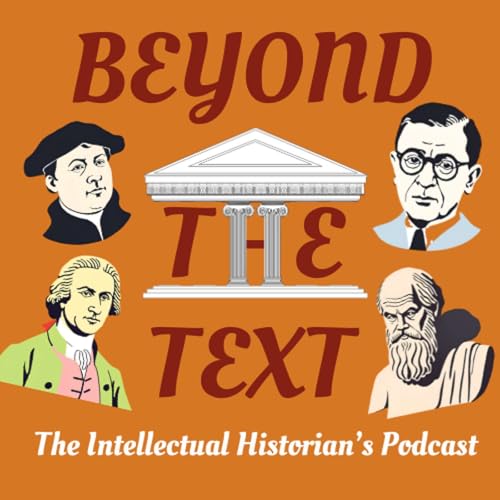
    Beyond the Text is a podcast exploring the history of ideas, political thought, and intellectual history across time. Hosted by Jack Thomson and Sam Woodall, the podcast brings classic texts, major thinkers, and enduring debates into conversation with the present – asking not just what ideas meant in their own moment, but why they still matter now. Episodes grow out of the History of Ideas Reading Club and wider research discussions, combining close reading with historical context and philosophical reflection.

    #BeyondTheText #HistoryOfIdeas #IntellectualHistory #Augustine #CityOfGod #PoliticalThought #HeritageSeries #ReadingGroup #PhilosophyPodcast #HistoryPodcast #IdeasThatMatter

    Afficher plus Afficher moins
    48 min