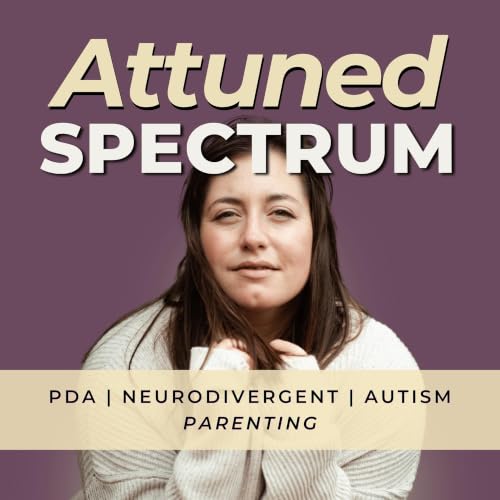
Couverture de Attuned Spectrum: Pathological Demand Avoidance (PDA) Autism Parenting Support | Low Demand Parenting

Attuned Spectrum: Pathological Demand Avoidance (PDA) Autism Parenting Support | Low Demand Parenting

Attuned Spectrum: Pathological Demand Avoidance (PDA) Autism Parenting Support | Low Demand Parenting

De : Chantal Hewitt - PDA Autism Support & Low Demand Parenting
Écouter gratuitement

Is your home a constant battlefield of power struggles and emotional burnout?


Welcome to Attuned Spectrum, the podcast for parents navigating the complex reality of Pathological Demand Avoidance (PDA) and neurodivergent life.


Hosted by Chantal Hewitt, we move beyond "behavior management" to focus on nervous system safety. If you are searching for support with "Pathological" Demand Avoidance in children, you know that traditional parenting tools don’t work—but a low-demand parenting and lifestyle does.


We dive deep into the strategies that actually create peace at home: declarative language, co-regulation, and building autonomy. Whether you’re dealing with school refusal, autism meltdowns, or sensory overload, this show provides the neuroaffirming wraparound support you’ve been looking for.


Move from crisis to connection.


Subscribe & Follow to join a community that understands the PDA profile and the beautiful, complex reality of raising PDA children.

© 2026 © 2026 Attuned Spectrum: PDA & Autism Parenting Support
Développement personnel Hygiène et vie saine Parentalité Psychologie Psychologie et psychiatrie Relations Réussite personnelle
Épisodes
  • Interoception Changes How We Teach Regulation for PDA Autistic and Neurodivergent Kids (Guest Kelly Mahler)
    Jun 4 2026

    Meltdowns, shutdowns, and “out of nowhere” explosions often get labelled as behaviour problems, but what if they come from not supporting our children to really listen to their bodies, first?

    I sit down with award-winning occupational therapist and author Kelly Mahler to talk about interoception, the often-missed sense that helps us notice what’s happening inside the body. When autistic children and other neurodivergent kids struggle to name feelings, it’s not a moral failing or a motivation issue. It can be a signal-detection issue, and the signals are invisible.

    We dig into why starting with emotion words, facial charts, or generic coping strategies can set kids up to mask rather than understand themselves. Kelly shares a simpler starting point: body signals before emotion labels, and curiosity before compliance. We talk about why deep breathing is not a universal fix, how adult modelling can teach interoception without creating pressure, and why many of us as parents find this hard after a lifetime of pushing through our own needs. Along the way, we name the accidental messages kids hear, like “you should always be calm”, and how validating messy, confusing body feelings can build real resilience.

    If your family lives with PDA demand avoidance or a strong drive for autonomy, this part matters: we explore how internal sensations like hunger, toileting needs, fatigue, overwhelm, and even sleep supports kicking in can feel like demands. We also connect interoception to nervous system regulation and felt safety, because strategies land differently when a child’s body feels under threat. Kelly points you to free resources at KellyMahler.com, including a printable adult modelling booklet to help you start today.

    If this conversation helps, please subscribe, share it with a parent who needs a kinder lens, and leave a review so more families can find neurodiversity-affirming autism support. What support do you need most right now?

    Resources from Kelly :) https://www.kelly-mahler.com/

    Text me and tell me- What do you want to hear for future episodes?

    If something in this episode hit home, you don't have to figure out the next step on your own. I support families at a few different levels — from community resources through to one-on-one coaching. Come find me on Instagram at @chantal.hewitt and send me a DM. Tell me what's going on for your family and we'll work out what support looks like for you.

    Support the show

    Raising PDA Community | Join FREE for 7 Days! Includes immediate support.

    Explore these topics:

    • ⚡ Regulation & Safety: Understand why PDA is a Nervous System Response.
    • 🗣️ PDA Foundations: Master the shift to Declarative Language & Safety.
    • 🏫 Education & Advocacy: Navigating masking and School Refusal.

    🔗 JOIN A SUPPORTIVE COMMUNITY:

    Raising PDA Community | Join FREE for 7 Days! Includes immediate support.

    Free PDA Language Guide: FREE GUIDE

    Free PDA Boundary Setting Workbook: FREE WORKBOOK

    Free 30 Minute Connection Call: BOOK HERE

    Free Calm Parent Checklist: FREE CHECKLIST

    Afficher plus Afficher moins
    29 min
  • PDA Parenting: Your Child Does Not Need Fixing, but Your Home Might
    May 22 2026

    PDA can make parenting feel like a full-time job in nervous system management, and it’s easy to believe the answer is learning more techniques for your autistic child. We’re taking a different angle: the family system. When one person is chronically stressed or dysregulated, it doesn’t stay contained, it ripples through the whole household. That’s why real relief often comes from shifting the environment around your child, not trying to change who they are.

    We talk family systems theory in plain language and bring it straight back to daily life in a PDA home: family values, expectations you may not even realise you’re carrying, and the “rules” that can quietly create demand pressure. I share a personal, often-judged example that many parents wrestle with: screen time. We look at how predictable technology can be genuine nervous system regulation for neurodivergent kids, how inconsistency can spike anxiety, and how to separate intentional support from the fear of what others might think.

    We also unpack neuroception and polyvagal theory to explain why your child may be constantly scanning for threat, and why a consistently safe, low-demand, autonomy-supporting home helps them rest and recover. The key takeaway is simple and grounding: your child is not broken, your family is not broken, but you may be stuck in patterns that no longer fit your needs.

    If you want help getting unstuck, check the link for a free 30-minute connection call and try the homework prompt to identify one family value or expectation creating friction. Subscribe, share this with a parent who needs it, and leave a review or comment telling me: what support do you need?

    Text me and tell me- What do you want to hear for future episodes?

    Support the show

    Raising PDA Community | Join FREE for 7 Days! Includes immediate support.

    Explore these topics:

    • ⚡ Regulation & Safety: Understand why PDA is a Nervous System Response.
    • 🗣️ PDA Foundations: Master the shift to Declarative Language & Safety.
    • 🏫 Education & Advocacy: Navigating masking and School Refusal.

    🔗 JOIN A SUPPORTIVE COMMUNITY:

    Raising PDA Community | Join FREE for 7 Days! Includes immediate support.

    Free PDA Language Guide: FREE GUIDE

    Free PDA Boundary Setting Workbook: FREE WORKBOOK

    Free 30 Minute Connection Call: BOOK HERE

    Free Calm Parent Checklist: FREE CHECKLIST

    Afficher plus Afficher moins
    15 min
  • PDA Parenting: What If Being Strong Makes It Worse?
    May 8 2026

    “Staying strong” sounds like good parenting, until you realise it can be the very thing that keeps your home stuck in stress. When we push through, mask our distress, and put ourselves last, our kids often feel it anyway because their nervous systems are constantly scanning us for cues of safety. If you’re parenting an autistic child with a PDA profile, that sensitivity can be even sharper, and it can turn the smallest crack in our calm into a bigger threat response.

    We dig into co-regulation as a biological process, drawing on attachment theory and polyvagal theory to explain why your state matters more than the perfect words. I also clear up a common pain point for neurodivergent families: attachment doesn’t have to look like eye contact, constant hugs, or “typical” connection to be real and secure. Many autistic kids show trust in different ways, and outdated research can misread that.

    From there, we get practical. If you’ve collected a hundred strategies but still feel like everything falls apart in the hard moments, you’re not broken, you’re exhausted. We talk about why a dysregulated nervous system can’t regulate another dysregulated nervous system, and why the simplest shift might be the biggest: stop trying to hold it all together and aim to be regulated enough to be present. One of my most powerful tools is also the least flashy, saying less during meltdowns and sitting with my child so my body can become the safety cue.

    If you want a calmer, more sustainable way to support your PDA child while protecting your own capacity, press play. Subscribe, share this with a parent who needs it, and leave a review so more families can find neurodiversity-affirming support.

    Text me and tell me- What do you want to hear for future episodes?

    Support the show

    Raising PDA Community | Join FREE for 7 Days! Includes immediate support.

    Explore these topics:

    • ⚡ Regulation & Safety: Understand why PDA is a Nervous System Response.
    • 🗣️ PDA Foundations: Master the shift to Declarative Language & Safety.
    • 🏫 Education & Advocacy: Navigating masking and School Refusal.

    🔗 JOIN A SUPPORTIVE COMMUNITY:

    Raising PDA Community | Join FREE for 7 Days! Includes immediate support.

    Free PDA Language Guide: FREE GUIDE

    Free PDA Boundary Setting Workbook: FREE WORKBOOK

    Free 30 Minute Connection Call: BOOK HERE

    Free Calm Parent Checklist: FREE CHECKLIST

    Afficher plus Afficher moins
    13 min
adbl_web_anon_alc_button_suppression_t1
Aucun commentaire pour le moment