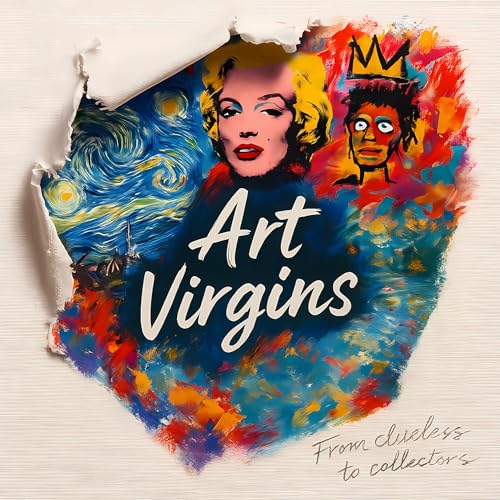
Couverture de Art Virgins : From Clueless to Collectors

Art Virgins : From Clueless to Collectors

Art Virgins : From Clueless to Collectors

De : Zahra & Sami
Écouter gratuitement

À propos de ce contenu audio

🎨 Art Virgins: From Clueless to Collectors 🎨

Ever walked into a museum and felt totally lost? Or thought art collecting was only for millionaires? We get it—because that was us. Two friends, complete beginners, decided to start collecting art with zero knowledge (unless you count knowing that Da Vinci painted the Mona Lisa).

Each week on Art Virgins, we share our step-by-step journey into the art world—learning, laughing, and exploring over coffee. Together, we’ll uncover how to actually enjoy art, understand different movements, and build a collection no matter your budget.

We explore the questions every beginner has but is too shy to ask, like:

  • How do you enjoy a museum without feeling overwhelmed?
  • Do you need to be rich to start an art collection?
  • How does context change the way we experience a piece of art?
  • How do artists redefine movements—and how does personal style and courage shape an artist’s legacy?
  • What’s the difference between surrealism, pop art, abstract art, and contemporary art?
  • Can street art be both business and authentic expression?
  • How do you prepare for an exhibition so you actually enjoy it?

Along the way we share beginner-friendly breakdowns of movements, stories of famous and contemporary artists, visits to exhibitions, museums, and street art shows, plus tips on how to start your own collection—no matter your budget.

Art Virgins is for you if you’ve ever felt:

  • Intimidated by galleries and art jargon.
  • Curious about art but unsure where to start.
  • Overwhelmed by centuries of art history.
  • Like you don’t “belong” in museums.
  • Or simply eager to impress your friends, partner, or colleagues with real art knowledge.

Whether you want to enjoy museums without feeling lost, start an affordable collection, or simply sound smart about art at dinner parties—Art Virgins will take you there.

👉 Subscribe now to begin your journey into the art world, one question (and one coffee) at a time.

Copyright 2025 All rights reserved.
Art Développement personnel Réussite personnelle
Épisodes
  • Episode 19: Collecting Time: The Shah, Seiko, and the Stories Watches Tell
    Mar 4 2026

    To make the most out of your listening experience, follow along with the episode's Wingman post on our Instagram: @artvirgins.

    Show Notes:

    In this episode, Zahra dedicates the conversation to the people of Iran and their fight for freedom. Following recent events in her home country, she explores a collectible the podcast has never covered — watches — through the lens of Muhammad Reza Shah Pahlavi, the last king of Iran, who collected bold, innovative, and controversial pieces.

    Inspired by their friend Lucile's recent watch presentation, Zahra dives into four watches that defined an era. Three luxury sports watches that broke every traditional watchmaking rule in the 1970s — the Audemars Piguet Royal Oak, Patek Philippe Nautilus, and Vacheron Constantin 222 — watches so controversial that collectors initially rejected them. And one military-issued Seiko that connects to her own family story.

    Between investment strategies through fractional platforms like Timeless, stories of her grandfather in the Iranian army, and debates about Apple Watch versus analog craftsmanship, this episode reveals why the best collections tell personal stories that resonate across generations.

    Highlights:

    • Dedication to the Iranian people's fight for freedom
    • Mohammad Reza Shah Pahlavi — collector of controversial, innovative pieces
    • Fractional watch investing through Timeless platform (50€ entry point)
    • Audemars Piguet Royal Oak (1972): Gerald Genta's "luxury sports watch" revolution — steel instead of gold, exposed screws, integrated bracelet
    • Why collectors initially hated the Royal Oak and called it controversial
    • Patek Philippe Nautilus (1976): Genta's second revolutionary design inspired by ship portholes
    • Vacheron Constantin 222 (1977): the "holy trinity" completed
    • Seiko — the military watch with personal family connection (grandfather and father in Iranian army)
    • Apple Watch vs traditional watches: connectivity vs style, digital vs analog reliability
    • Why the best collections tell your story, not just investment value
    Afficher plus Afficher moins
    52 min
  • Episode 18 - How Rembrandt, Toulouse-Lautrec & Warhol Actually Made Prints (And Why They're Valuable)
    Feb 25 2026

    To make the most out of your listening experience, follow along with the episode's Wingman post on our Instagram: @artvirgins.

    Show Notes:

    In this episode, Sami confesses his collector heartbreak — a collaboration between Invader and Damien Hirst that he didn't buy. It's officially his "one that got away" story. But the near-purchase sparked a question: why does the art virgin in him struggle to see prints as valuable when they're reproduced and "just printed"?

    So he dives into printmaking itself. From 16th-century etching to Warhol's screen printing genius, Sami breaks down five major techniques and explains how each works, how long they take, and why printmaking is serious craft, not just reproduction.

    Then comes the valuable part: understanding edition sizes, print types, and what drives value. What's a BAT? Why are Artist Proofs expensive? What makes a small edition rare versus a large edition worthless? The jargon, decoded.

    Highlights:

    • The Invader x Damien Hirst print that got away
    • Five printmaking techniques explained: woodcuts, etching, lithography, screen printing, digital/Giclee
    • Woodcuts: Japanese Ukiyo-e
    • Etching: Rembrandt's acid-and-metal process (takes weeks to months)
    • Lithography: Toulouse-Lautrec's elegant limestone technique using oil-water principles
    • Screen printing: how Warhol, Banksy, and KAWS layer colors — UV burning process explained
    • The 9-phase printmaking process: from concept to matrix cancellation
    • Edition sizes decoded
    • Print types by value: BAT, PP, AP, numbered editions

    Videos we promised:

    • Sreenprinting: https://youtu.be/O8HB2cQm_Ag?si=mATbAayYN5gD4ym6
    • Lithography: https://www.youtube.com/watch?v=SSQfGR8Q2wg
    • Etching: https://youtu.be/0jzVjjRudfo?si=wp1V7IgmO1Rd6DKR

    Afficher plus Afficher moins
    57 min
  • Episode 17 - Impressionism & Paul Durand-Ruel: The Gambler Who Changed Art Forever
    Feb 18 2026

    To make the most out of your listening experience, follow along with the episode's Wingman post on our Instagram: @artvirgins.

    Show Notes:

    In this episode, Sami and Zahra complete the Impressionism story. While last week's VR experience showed one evening in 1874 Paris, this episode reveals what happened before and after — spanning 12 years, eight exhibitions, and one art dealer who changed everything.

    Zahra becomes obsessed with Paul Durand-Ruel, the gambler who bet his fortune on rejected artists and invented the modern art market. From bankruptcy to buying everything Monet painted, from French mockery to American triumph, his story runs parallel to the movement he saved.

    Meanwhile, Sami walks through all eight Impressionist exhibitions (1874-1886), tracking how 30 struggling rebels became individual stars who no longer needed each other. Paint tubes, financial disasters, and the moment America said yes when France kept saying no.

    Highlights:

    • 1874 Paris: Haussmann's reconstruction, the new middle class, and perfect timing
    • How paint tubes (invented 1841) made outdoor painting possible — goodbye animal bladders
    • Paul Durand-Ruel — the dealer who shaped modern art dealing and risked everything
    • All eight Impressionist exhibitions: from 165 works to 246, rebellion to victory
    • Why France laughed while America bought — cultural differences that changed art history
    • Key artists: Monet, Renoir, Degas, Pissarro, Cézanne, Berthe Morisot, Alfred Sisley, Georges Seurat
    • Seurat's "A Sunday Afternoon on La Grande Jatte" — millions of tiny dots
    • How Impressionism became the first commercially viable art movement
    • Post-Impressionism's birth: Cézanne, Van Gogh, Gauguin, Toulouse-Lautrec, and Modernism
    Afficher plus Afficher moins
    1 h et 11 min
Aucun commentaire pour le moment