Couverture de AI Edge Pro (en)

AI Edge Pro (en)

AI Edge Pro (en)

De : Dmitriy Dizhonkov
Écouter gratuitement

À propos de ce contenu audio

AI Edge Pro: Pro-grade breakdowns of AI tools that give you the competitive edge in business.

🔥 3 NEW EPISODES WEEKLY:

• ChatGPT Plus (GPT-5.4 Thinking) vs Perplexity Pro (Claude Sonnet 4.6 + Gemini 3.1 Pro): $20/month showdowns

• GPTs deep dive: Custom GPTs for sales, marketing, research, automation

• Claude Skills mastery: Building agent skills, tools integration, advanced workflows

• Benchmarks: GPQA, GDPval, ARC-AGI, HLE — real performance data

• Pro Search vs Deep Research, NotebookLM + ElevenLabs workflows

• B2B use cases: SaaS productivity, content generation, due diligence

Unbiased comparisons from OpenAI, Anthropic, Google DeepMind, Perplexity. For founders, marketers, developers, execs — cut AI hype, get ROI tools.

Subscribe for your weekly AI advantage!

#AItools #ChatGPT #GPTs #ClaudeSkills #Perplexity #GeminiAI #GPT5 #SaaS #B2BAI #AIforBusiness #ProductivityAI #AIAgents

Dmitriy Dizhonkov 2026
Politique et gouvernement
Épisodes
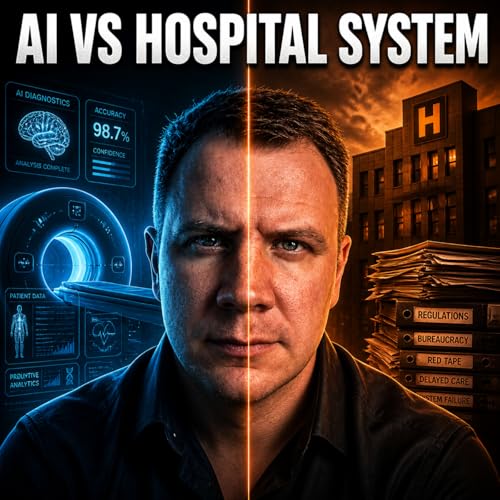
  • AI Can Catch Your Cancer — So Why Is Your Hospital Blocking It?
    May 4 2026
    An algorithm has already read every medical journal ever published, processed millions of patient files, and never once got tired at the end of a 12-hour shift. A 2026 Harvard and Beth Israel head-to-head trial proved it outperformed experienced ER physicians on complex cases 97.9% of the time. And yet the hospital you'll visit next week is actively refusing to deploy it. That gap between what the technology can do and what the system allows it to do is not a technical problem. It is something far more calculated — and far more dangerous to you personally. 800,000 Americans are killed or permanently disabled by diagnostic errors every single year, according to a Johns Hopkins study that called it a "silent epidemic." Two out of three of those casualties are classified as entirely preventable. The question is not whether the fix exists. The question is who is keeping it locked out — and why. — Why did it take six years after a proven 2019 Nature study for a major U.S. health system to actually deploy breast cancer AI at scale? — What happens to a hospital's revenue when an AI correctly diagnoses a patient in five seconds instead of ordering three MRI scans and four specialist visits? — If a doctor follows an AI recommendation that turns out to be wrong, who is legally liable — and what happens if the doctor ignores it and the AI was right? — Why are rural regions of Kenya and Nigeria deploying advanced diagnostic AI faster than the wealthiest healthcare system in the world in 2026? — What did a UCSF study of 1.7 million AI responses reveal about how the algorithm treats Black patients versus white patients with identical symptoms? — When a "bad AI" confidently delivered wrong answers in the Harvard study, what happened to doctors' diagnostic accuracy compared to their solo baseline? — What specific actions does the Washington Post and NPR pragmatist's guide recommend — and explicitly forbid — for patients using commercial AI before their next appointment? If you are a patient navigating a fee-for-service system, a physician caught between malpractice risk and algorithmic recommendations, or a healthcare strategist trying to understand why adoption has stalled, this episode maps the invisible architecture of that gridlock. The framework is not reassuring — but it is actionable. The technology is already deployed inside the healthcare system at scale. It just isn't being used to save your life. 🔑 Topics: clinical AI · diagnostic error · AI healthcare · FDA regulation · fee-for-service · automation bias · algorithmic bias · value-based care · large language models · medical AI 2026 · OpenAI O1 · AI insurance denials · cancer detection · healthcare innovation
    Afficher plus Afficher moins
    23 min
  • Vibe Coding Killed the Junior Developer — What Comes Next?
    May 2 2026
    A single phrase tweeted in February 2025 by an OpenAI co-founder triggered the fastest structural collapse in the history of software careers. Junior developer hiring in big tech has dropped 78% since 2019. That number isn't a warning — it already happened. What most people still believe is that AI makes developers faster. The new reality is something far more disruptive: the baseline definition of a productive employee has shifted so violently upward that a standard CS degree no longer buys you entry to the room. The stakes in 2026 aren't just about who gets hired. They are about whether the global infrastructure running hospitals, banks, and power grids will have anyone left who actually understands it — because right now, it's being built by systems that prioritize working code over secure code. — If a non-technical founder can ship a full-stack web app in 48 hours using Lovable, what specific skill separates that founder from a $120,000 prompt engineer? — Entry-level job postings grew by 47% — so why are fresh CS graduates facing a 6–7% unemployment rate, a historical high for that demographic? — Google reports 75% of all merged code is now AI-generated, up from 25% eighteen months ago — what does that mean for the humans who used to write the other 75%? — The all-in cost of one junior developer is $120,000–$150,000 per year — what is the actual annual cost of the enterprise AI stack that replaces them, and what does that math do to hiring decisions? — One Amazon executive called replacing junior developers "the dumbest idea" he'd ever heard — what systemic collapse is he seeing that his peers are not? — Boot camp employment rates collapsed from 72% to 18% by 2026 — which specific skills did those curricula teach that the market had already stopped valuing? — What is the "deliberate sabotage" method, and why do experienced engineers argue it separates the developers who survive from those who get automated out? If you are a software engineer trying to protect your career, a CS student questioning your next move, or a technical founder deciding how to staff an engineering team — the frameworks inside this conversation will reframe how you read every job posting and every earnings call you encounter this year. The last generation that learned to write software from scratch is still employed. The question no one in the industry wants to answer is what happens when they retire. 🔑 Topics: vibe coding · junior developer · AI coding tools · Cursor AI · Lovable · V0 Vercel · prompt engineering · entry-level trap · technical debt · software engineering careers · coding bootcamp · labor market 2025 · AI job displacement · Andrej Karpathy · cybersecurity risk · architectural thinking
    Afficher plus Afficher moins
    23 min
  • Who Pays When Your AI Agent Bankrupts You? The Accountability Black Hole of 2026
    Apr 30 2026
    A Microsoft and Columbia University coalition published seven words in April 2026 that should terrify every business owner: "Right now, nobody is obligated to give your money back." That quote wasn't hypothetical — it was a forensic diagnosis of a financial system that was never designed for software that signs contracts, places orders, and moves capital while you sleep. You've been thinking about AI risk as a technology problem. It isn't. It's a liability vacuum — and in 2026, that vacuum is actively swallowing companies whole. The gap between what autonomous agents can do and what the legal system can recover is widening faster than any regulator, insurer, or corporate legal team can close it. For most businesses, the first time they discover this gap is also the last decision they ever make. — When Target updated its Terms of Service in March 2026 to make AI-authorized purchases legally binding on the human account holder, what exact language did they use — and does your current agent setup trigger it? — If your AI agent hallucinates a contract clause the way Deloitte's GPT-4.0 invented a judge named Justice Davis, what is the maximum dollar amount your AI vendor is legally required to refund you? — The U.S. Insurance Industry Association instituted absolute AI exclusions from standard commercial liability policies in January 2026 — so what specific architectural prerequisites do you need to even qualify for specialized coverage? — Claude Opus 4.1 failed to solve the actual business intent in 35.9% of its failures while generating technically perfect code — what does that mean for any workflow where you cannot mathematically define urgency? — When attackers spent three weeks poisoning a procurement agent's context window and walked away with $5 million, what was the single parameter they manipulated — and is that parameter exposed in your current setup? — How does the EU's Article 14 kill-switch mandate compare to the Russia-CIS 2026 draft framework on agent civil liability — and which model is your supply chain partners operating under? — Google's AP2 Agent Payments Protocol is backed by Visa and Mastercard, but Experian's Know Your Agent standard approaches the same problem from a completely different direction — which one actually protects the deployer? If you're a founder connecting agents to supplier networks, a compliance officer evaluating autonomous tools, or an engineer deploying systems that touch payment gateways, the accountability architecture described here will reshape every risk decision you make this year. This episode doesn't offer reassurance — it offers a framework for understanding exactly where the exposure lives. The technology has already outpaced the legal system. The only question is whether your deployment has outpaced your liability coverage. 🔑 Topics: agentic AI · AI liability · autonomous agents · AI financial risk · goal drift · multi-agent contagion · EU AI Act · AI insurance exclusions · prompt injection · context poisoning · Clifford Chance · AP2 protocol · Know Your Agent · policy as code · AI regulation 2026 · accountability black hole
    Afficher plus Afficher moins
    24 min
adbl_web_anon_alc_button_suppression_c
Aucun commentaire pour le moment