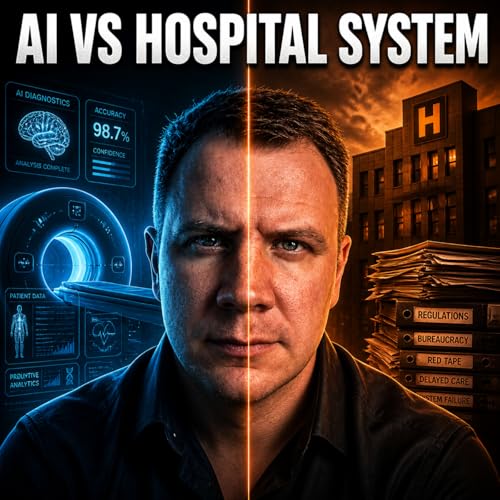
Couverture de AI Can Catch Your Cancer — So Why Is Your Hospital Blocking It?

AI Can Catch Your Cancer — So Why Is Your Hospital Blocking It?

AI Can Catch Your Cancer — So Why Is Your Hospital Blocking It?

Écouter gratuitement

Voir les détails

À propos de ce contenu audio

An algorithm has already read every medical journal ever published, processed millions of patient files, and never once got tired at the end of a 12-hour shift. A 2026 Harvard and Beth Israel head-to-head trial proved it outperformed experienced ER physicians on complex cases 97.9% of the time. And yet the hospital you'll visit next week is actively refusing to deploy it. That gap between what the technology can do and what the system allows it to do is not a technical problem. It is something far more calculated — and far more dangerous to you personally. 800,000 Americans are killed or permanently disabled by diagnostic errors every single year, according to a Johns Hopkins study that called it a "silent epidemic." Two out of three of those casualties are classified as entirely preventable. The question is not whether the fix exists. The question is who is keeping it locked out — and why. — Why did it take six years after a proven 2019 Nature study for a major U.S. health system to actually deploy breast cancer AI at scale? — What happens to a hospital's revenue when an AI correctly diagnoses a patient in five seconds instead of ordering three MRI scans and four specialist visits? — If a doctor follows an AI recommendation that turns out to be wrong, who is legally liable — and what happens if the doctor ignores it and the AI was right? — Why are rural regions of Kenya and Nigeria deploying advanced diagnostic AI faster than the wealthiest healthcare system in the world in 2026? — What did a UCSF study of 1.7 million AI responses reveal about how the algorithm treats Black patients versus white patients with identical symptoms? — When a "bad AI" confidently delivered wrong answers in the Harvard study, what happened to doctors' diagnostic accuracy compared to their solo baseline? — What specific actions does the Washington Post and NPR pragmatist's guide recommend — and explicitly forbid — for patients using commercial AI before their next appointment? If you are a patient navigating a fee-for-service system, a physician caught between malpractice risk and algorithmic recommendations, or a healthcare strategist trying to understand why adoption has stalled, this episode maps the invisible architecture of that gridlock. The framework is not reassuring — but it is actionable. The technology is already deployed inside the healthcare system at scale. It just isn't being used to save your life. 🔑 Topics: clinical AI · diagnostic error · AI healthcare · FDA regulation · fee-for-service · automation bias · algorithmic bias · value-based care · large language models · medical AI 2026 · OpenAI O1 · AI insurance denials · cancer detection · healthcare innovation
adbl_web_anon_alc_button_suppression_c
Aucun commentaire pour le moment