Couverture de 1010 Thrive

1010 Thrive

1010 Thrive

De : 1010 Thrive -- Home of the 1010 Podcast
Écouter gratuitement

3 mois pour 0,99 €/mois

Après 3 mois, 9.95 €/mois. Offre soumise à conditions.

À propos de ce contenu audio

A daily podcast each weekday sharing Biblical truth designed to help listeners find hope, meaning and fulfillment in life. Each weekday we air a new episode that features a devotional grounded in our 10-10 principles. Many episodes include original music and dramatizations.© 2020 1010 Thrive -- Home of the 1010 Podcast Art Spiritualité
Les membres Amazon Prime bénéficient automatiquement de 2 livres audio offerts chez Audible.

Vous êtes membre Amazon Prime ?

Bénéficiez automatiquement de 2 livres audio offerts.
Bonne écoute !
    Épisodes
    • Episode 1344: The Second Commandment in the Teachings of the Apostle Paul
      Jan 29 2026

      Paul interprets the Second Commandment as a comprehensive principle of liberation rather than a mere religious restriction. He identifies the core human problem in Romans 1 as a deliberate "exchange" where we trade the overwhelming, sovereign reality of the immortal God for manageable, man-made distortions. This isn't just about carved statues; it is about the "apparatus of human distortion"—false theologies, deceptive philosophies, and misshapen visions of the good life. By reducing God to an image we can control, we create a lie that fundamentally misrepresents the truth, protecting ourselves from the demanding nature of the living Creator but ultimately darkening our own understanding.

      A central insight in Paul’s writing is that worship is inherently formative: we inevitably become like what we value. If we worship a god of power, we become domineering; if we worship a god of appetite (our "stomach"), we become enslaved to our desires. Paul’s urgent command to "flee from idolatry" stems from the reality that participating in false worship bonds our identity to a lie, leading to internal fragmentation. Because humans are image-bearing creatures, the question is not whether we will be shaped by an image, but which one. Contemplating false images results in a distorted humanity, whereas beholding the true glory of God in Christ transforms us into His likeness with "ever-increasing glory."

      Ultimately, Paul reveals that the Second Commandment is fulfilled in Jesus, who is the "image of the invisible God." God forbade human-made images to clear the way for His own perfect self-revelation—not in a static concept or a stone monument, but in a living person. Christian formation is the process of "putting off" the old self, corrupted by deceitful desires and false mental images, and "putting on" a new self-created to be like God in true righteousness. The commandment is thus an invitation to stop being shaped by the hollow traditions and "elemental forces" of the world and to be reshaped by the only image that is alive, relational, and true.

      Afficher plus Afficher moins
      10 min
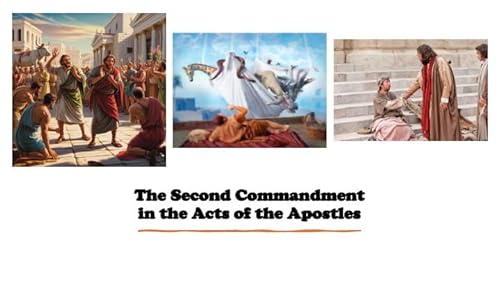
    • Episode 1343: The Second Commandment in the Acts of the Apostles
      Jan 28 2026

      The book of Acts serves as the practical lived experience of the Second Commandment, demonstrating how a community encounters the living God without the need for physical shrines, images, or mediators. Following Jesus' ascension, the disciples find that God refuses to be localized or managed; instead, the Holy Spirit arrives at Pentecost as wind, fire, and voice—elements that are active and relational rather than static or possessable. This shift fulfills the logic of the commandment by showing that God does not provide an image of Himself but gives Himself directly and personally, ensuring His presence cannot be turned into a talisman or a commodity.

      Throughout the narrative, the apostles consistently refuse to let themselves or their theology become idols. Peter and John immediately redirect the crowds' wonder away from their own "power or godliness" toward the God of Abraham, while Peter later rebukes Simon the Sorcerer for trying to purchase the Spirit as if it were a transferable technique. Even Peter’s own theological system is dismantled through a vision of unclean animals, teaching him that divine holiness cannot be trapped within a single culture's image or religious purity code. This illustrates a profound lesson: even "correct" systems become idols when they are used to limit or define what God is allowed to do.

      Finally, Acts highlights the severe consequences of violating this commandment while celebrating the liberation it brings. The death of Herod, who accepted divine worship, stands as a stark warning against human representations of the divine, while Paul’s speech at the Areopagus systematically argues that the Creator of heaven and earth does not live in man-made temples or silver images. By shifting worship from the Temple to the "table"—centering on homes and local communities—the early church discovered that God is not diminished by the absence of a physical form. Instead, the Second Commandment frees believers from dependence on mediators and opens them to a direct, unmanageable encounter with the God who transcends all human imagination.

      Afficher plus Afficher moins
      10 min
    • Episode 1342: The Second Commandment in the Teachings of Jesus
      Jan 27 2026

      Jesus entered a world dominated by mental and theological idols—rigid categories that reduced the living God to a manageable entity accessed through specific locations, rituals, and outward performances. As the "Second Commandment made incarnate," Jesus systematically dismantled these distortions, not to be difficult, but to clear the path for genuine relationship. By telling the Samaritan woman that God is Spirit—uncontainable by any mountain or building—He rejected the premise that divine presence could be trapped in human forms. This radical shift moved worship from a transactional ritual to a relational, heart-centered response to the Father.

      In the Sermon on the Mount and His interactions with religious leaders, Jesus continued this "Second Commandment work" by purifying the distorted image of a God who is satisfied with surface compliance. He revealed that God is not impressed by public righteousness or human tradition, but is intimately concerned with the interior truth of the heart. By challenging the Sadducees' limited logic and the Pharisees' tradition-heavy systems, Jesus insisted that God is always greater than our conceptual limits. He refused to be the "gentle moral teacher" or the political messiah people projected their desires onto, consistently withdrawing from those who tried to make Him a tool for their own interests.

      Ultimately, Jesus fulfilled the Second Commandment by revealing that God alone chooses how He is seen. While humans are forbidden from creating images because we inevitably shrink and distort God, the Father provided His own perfect revelation in His Son. Jesus is the only image that works because He is not a static representation we can control; He is a living person we must follow. In the climax of His ministry, Jesus invited Philip—and all of us—to stop looking for a separate vision of the Father and to find Him in the life, suffering, and radical love of Christ. This invitation calls us to abandon our certainties and trust a God who is larger than our categories and deeper than our pain.

      Afficher plus Afficher moins
      10 min
    Aucun commentaire pour le moment