

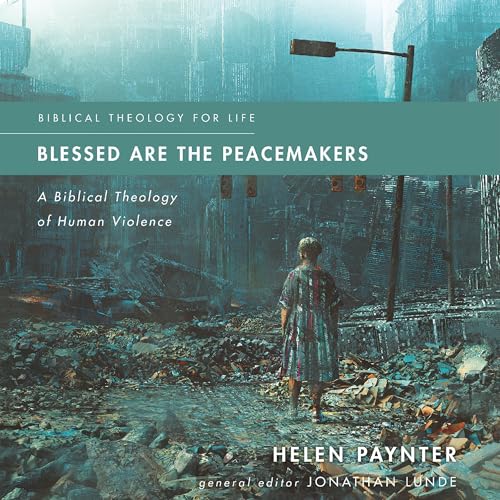
Blessed Are the Peacemakers
A Biblical Theology of Human Violence
Impossible d'ajouter des articles
Échec de l’élimination de la liste d'envies.
Impossible de suivre le podcast
Impossible de ne plus suivre le podcast
Bénéficiez gratuitement de Standard pendant 30 jours

Blessed Are the Peacemakers
Acheter pour 21,99 €
-
Lu par :
-
Helen Paynter
Read by the author.
This volume in Biblical Theology for Life series dives deeply into the topic of human violence. Before exploring what the Bible says about violence, Old Testament scholar Helen Paynter sets out the contours for the study ahead by addressing the various definitions of violence and the theories of its origins, prevalence, and purpose. What is violence? Is there such a thing as "natural violence"? Is violence a human or social construct or can we describe natural phenomena as violent? How does the concept of violence relate to the concept of evil? Violence is everywhere; is it escapable? How do we resist violence?
Having queued up the questions, Paynter takes us to the Bible for answers. Starting with the creation narratives in Genesis considered in comparison with the ancient Near Eastern myths and moving to the conquest of Canaan--the most problematic of biblical narratives--she investigates how these deep myths speak to the origins of human violence and its consequences. The prevalence of violence through biblical history is inescapable. Scripture reveals the hydra-like nature of human violence, investigating types of violence including but not limited to: structural violence, verbal violence, sexual violence, violence as public /political act, racialised violence, including "othering." Through the voices of the prophets and then in the teaching of Jesus, the Bible reveals that the seeds of violence exist within every human heart. Even though we see evidence of resistance movements in the Bible, such as the responses to attempted genocide in Exodus and Esther, it is only on the cross that an absorption of violence by God takes place: a defeat of violence by self-sacrifice. Along the way, Paynter considers other relevant biblical themes, including the apocalypse, "crushing the serpent's head," and the concept of divine vengeance, culminating in the resurrected Christ's lack of vengeance against those who did him to death. In light of the New Testament, we will consider how the first Christians responded to the structural violence of slavery and patriarchy and how they began to apply Jesus' redemptive, non-vengeful theology to their own day.
The book concludes by discussing of what this means for Christians today. For many of us who live without routine encounters with or threats of violence, we must consider our responsibility in a world where our experience is the exception. With attention to the multi-headed hydra that is violence and the concealed structures of violence in our own Western society, Paynter challenges readers to consider their own, perhaps inherited, privilege and complicity. The question of how we regard "others," both as individuals and as societies, is a deeply relevant and urgent one for the church: The church can and should be a wholly non-othering body. So what implications does this have for the church and, for example, Black Lives Matter or the rampant xenophobia in our society or immigration and global migration issues? How do we resist evil? What does it mean to turn the other cheek when the cheek that has been slapped is not our own? How do we resist the monster without becoming the monster?
Diagrams, tables, and reflection questions can be found in the audiobook companion PDF download.