Couverture de Live Like a Leader with John Bates

Live Like a Leader with John Bates

Live Like a Leader with John Bates

De : John Bates - Executive Speaking Success
Écouter gratuitement

Live Like a Leader Show — Where Great Leaders Master Great Communication L = f (c): Leadership is a function of Communication. Great leadership is a function of great communication. Join leadership communication expert, TEDx speaker, author, and executive coach John Bates, founder of Executive Speaking Success, as he explores the communication, leadership, and life secrets of the world’s top leaders. From NASA astronauts and bestselling authors to Navy SEALs, global executives, entrepreneurs, and Keynote/TED/TEDx speakers — discover the lessons, stories, and strategies that empower them to lead with authenticity and impact. If you want to level up your leadership development, build an authentic executive presence, and master the art of public speaking, this podcast is your ultimate resource. Each episode offers immediately actionable insights to help you become a more inspiring leader, a more compelling speaker, and a more confident communicator. Whether you’re an aspiring leader, a seasoned executive, or a professional ready to amplify your influence, you’ll love the inspiring, heart-centered conversations on LiveLikeaLeader.show.John Bates
Épisodes
  • Leadership in the Age of AI with Pete Sacco
    May 27 2026
    Today I sit down with Pete Sacco—entrepreneur, technologist, “modern-day mystic,” and a 30-year veteran of designing, building, and operating serious data centers. Pete is also the founder of Gray Wolf Data Centers, and he has a front-row seat to what AI is about to demand from our infrastructure—and from us as leaders. What I loved about this conversation is the range: we go from the brutally practical realities of leadership (cash flow, culture, motivating people) to the big human questions AI forces into the open: Who are we when our “work” no longer defines our value? And how do we stay grounded, connected, and useful in the middle of a technological hockey stick? In this episode, we covered: 1) Pete’s 4-part framework for modern leadership Pete lays out what he sees as “endemic” to great leadership today: Master cash flow (because nothing survives without it)Know whether you’re a visionary or an integrator (and don’t pretend you’re both)Be the master motivator (the era of fear-based leadership is over)Own the culture (and use story as one of your most powerful tools to shape it) 2) Storytelling as culture-engineering We dig into why stories are more than “nice to have.” Stories become the myths that create the mythology of a company—how values become behavior at scale. And if you want to influence culture, yesterday was easier than today. 3) The next AI infrastructure shift: from training to inferencing Pete breaks down the difference between: Training LLMs (building the model)Inferencing (asking the model questions in real time—what most people experience as “prompting”) Then he takes it further: the next wave isn’t human inferencing—it’s machine inferencing. Robots, cars, devices, sensors… constantly asking “what do I do next?” at massive scale. 4) Why “edge” data centers are coming back Pete predicts we’ll move away from only massive, centralized “mega” campuses toward distributed, high-performance data centers near the edge—“in every town,” similar to telecom “points of presence” in the 1990s. That’s the strategic thesis behind Gray Wolf Data Centers. 5) The modern mystic: mind, body, and the inner game Pete shares a candid chapter of his own life—anxiety, therapy, CBT, and a pivotal lesson: don’t make the events you can’t control your “problems.” He connects this to resilience through sleep, health practices, and the belief that we can reshape the mind through neuroplasticity—and even how he sees us as “quantum beings,” responsible for how we observe and choose our reality. 6) A hopeful thesis: “good AI” vs “bad AI” + post-scarcity We touch the fear many people carry (yes, I mention growing up in the Terminator era), but Pete offers a provocative counter: the way we beat bad AI is with good AI—models designed around human flourishing and shared broadly as a public service. He believes we’re headed through disruption toward post-scarcity, and that our descendants will wonder why we didn’t support each other sooner. 7) The closing leadership message: “we are all one” Pete’s final note is the one that matters most to me: we’re all connected—and we’re here for each other. In my book, that’s not just a spiritual idea; it’s a leadership standard. ----- Resources Mentioned: Pete’s company: Gray Wolf Data Centers Pete’s book: Living in Bliss: Achieve a Balanced Existence of Body, Mind and Spirit Pete’s site: PeteSacco.com (signed copies + meditation materials) Dr. David Burns: The Feel Good Handbook Dan Sullivan: Who Not How (and other referenced works) Peter Diamandis: longevity reference ----- If you want to apply this immediately: Ask yourself: Am I the visionary or the integrator here? (And who do I need as my counterbalance?)Choose one cultural value you care about—and tell a story that proves it.If AI is making you anxious, zoom out: are you preparing for the training era, or the inferencing era? ----- https://petesacco.com Pete Sacco is a visionary entrepreneur, technologist, and modern-day mystic who blends conscious leadership with breakthrough innovation. As the founder of multiple ventures—including PTS Data Center Solutions, INTUVA, GRID7, InstaGuardIP, and Gray Wolf Data Centers—Pete has led transformative initiatives across AI, energy, blockchain, and digital infrastructure. His journey from electrical engineer to spiritual author and advisor reflects a rare fusion of high performance and inner awakening. Pete is the author of Living in Bliss: Achieve a Balanced Existence of Body, Mind, and Spirit, a guide for high achievers seeking fulfillment beyond success. A finalist for Ernst & Young’s Entrepreneur of the Year, Pete holds a B.S. in Electrical Engineering from Fairleigh Dickinson University, and serves on the advisory board of its School of Computer Sciences and Engineering. Based in New Jersey, he helps ...
    Afficher plus Afficher moins
    51 min
  • Executive Branding in the Age of AI: How to Build Trust (Without Selling Your Soul) with Jess Jensen
    Jan 29 2026
    Today I sit down with Jess Jensen, founder and CEO of Copilot Communications, where she helps executives build trust, credibility, and warmth online so they can open doors to clients, partners, and opportunity. Jess has lived through the “birth, boom, and backlash” of social — from launching the first Adidas Facebook page in the early days of brand pages, to building global governance at Microsoft when every country team was spinning up pages with no consistency, to leading executive digital comms at Qualcomm after realizing that people connect with people, not brands. We also go to the deeper place: the moment Jess found herself explaining her work to someone outside tech — and felt that pause, that sadness, that “do I need to apologize?” — because social media had become increasingly divisive and weaponized. From there, we turn toward what’s working now — especially LinkedIn as a platform for professional trust-building and thought leadership. Key Takeaways from this Episode Your digital presence is portable. You may not stay at one company for 30 years, but your platform goes with you — and it compounds over time.Social is a “rented” platform (this is a brilliant point!). Think owned, earned, paid — and rented. Algorithms change, and you don’t control the land you’re building on.Brands are losing lift; leaders are gaining it. At Qualcomm, Jess saw corporate campaigns decline while executive voices gained traction — because people want a human point of view.LinkedIn is no longer just a resume. Jess shares why it’s become a writing platform and an editorial home for experts — not just job seekers.Pick 3–4 narrative themes and repeat them. The strongest executive brands aren’t random — they’re built on an editorial strategy that consistently returns to a few clear territories.Your voice matters (especially now). Many leaders think they have “nothing to say,” but your experience and point of view are valuable — and the world needs more constructive voices. Addressing Relevant Issues Algorithmic amplification and polarization: We discuss how feeds shifted away from chronological and toward “what keeps you engaged,” fueling echo chambers and intensity.The ethical wake-up call of social media: Jess describes the internal pivot moment — realizing the space had become toxic in corners, and questioning how to use her skills more constructively.Mental health and unintended consequences: I reference a stark data point Jess brings up — a 65% increase in the suicide rate for high school girls from 2010 to 2019 — and we talk about responsibility and systems.AI and the rising importance of trust: In an AI-dominated age, credibility, warmth, and real human presence become competitive advantages, not “nice-to-haves.” Next Steps Get Jess’s free LinkedIn Audit: Jess offered to review both your profile and your editorial strategy and give actionable next steps. Mention you heard her on Live Like a Leader.Define your 3–4 “narrative pillars.” Decide what you want to be known for — and build content around those themes consistently.Publish what you already say internally. Turn your best internal leadership messages into public leadership content — and let it travel. Learn more about Copilot Communications: https://copilotcommunications.com/ Connect with Jess Jensen on LinkedIn: https://us.linkedin.com/in/jessicakjensen ----- Jess Jensen is the founder of Co-pilot Communications, a Portland-based advisory helping bold executives sound like themselves online—clear, confident, and human. After 20 years inside Fortune 100 companies like Microsoft, Qualcomm, Nestlé, and Adidas, Jess left corporate life to help leaders stop playing small and start showing up online as their full selves—story-rich, imperfect, and unapologetically human. Through sharp messaging, editorial strategy, and smart use of platforms like LinkedIn and podcasting, she helps clients build a digital presence that earns trust, inspires action, and sounds like them. --------John Bates provides 1:1 Executive Communications Coaching, both in-person and online. He also gets 92+ Net Promoter Scores for his large and small group leadership development trainings at organizations like Johnson & Johnson, NASA, Google, Intuit, Boston Scientific, and many more. Find more at https://executivespeakingsuccess.com.Sign up for his weekly micro-trainings for free at https://johnbates.com/mini-trainings and create a great leadership communications habit that makes you the kind of leader who inspires trust, loyalty, and connection.
    Afficher plus Afficher moins
    43 min
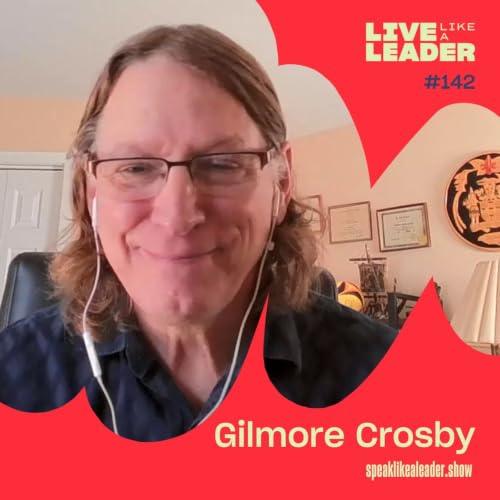
  • Leadership and the Front Line Workforce: Lessons from the Targets of Change with Gilmore Crosby
    Jan 26 2026
    In this episode of Live Like a Leader, I sit down with organizational development expert Gil Crosby (https://www.crosbyod.com/) to explore timeless principles for change, leadership, and frontline empowerment. Learn why most “programs” fail, how to balance authority with freedom, and how leaders can unlock performance by listening to the people closest to the work.Gil Crosby has been an Organization Development Professional since 1984. He applies the Social Science of Kurt Lewin to help organizations navigate change and improve performance, as the same principles apply in both business and society. He is also a Professor at the Leadership Institute of Seattle, and he has just published his 7th book, Leadership and the Front-Line Workforce, for anyone in an organization. Here's what we get into: Kurt Lewin’s social science—and why it still worksGil explains Lewin’s core insight: when people who live with the problem talk it through together, design solutions that make sense to them, and test them, change actually sticks. Whether it’s improving productivity in a plant or reducing violence in a community, people implement what they help shape. Why “forcing best practices” often failsWe talk about how organizations take something like Lean or the Toyota Production System and try to copy-paste it—usually by forcing compliance. Gil highlights what gets left out: at Toyota, when a worker stops the line, the supervisor’s first response is “Thank you.” That level of respect and engagement is the point—and when it’s missing, the system becomes just another top-down “program of the month.” A perfect frontline story: the Channel Locks lessonGil tells an incredible example from a manufacturing plant: management tried to reduce theft by making workers check out channel locks (basic tools used constantly), which slowed production every time someone needed one. When we asked the obvious question—what does downtime cost compared to a $15 tool?—The plant manager immediately changed course: “Tomorrow, we’re putting channel locks everywhere.”And the best part? Once workers saw leadership was actually listening, they didn’t steal them. Trust went up, friction went down, and productivity improved. Empowerment isn’t “nice”—it’s operationalI share why bad customer service drives me crazy (including what I’ve seen in Slovakia), and the pattern underneath it: people on the front line aren’t empowered to make decisions. If the people closest to the work can’t act, everything bottlenecks—and leadership often doesn’t even know what’s broken. Battlefield leadership and “commander’s intent.”We connect this to military lessons: when leaders hoard information and control, people suffer. When teams understand the goal and the intent, they can make smarter decisions in real time. That’s true in combat, and it’s true in business. Democracy vs. autocracy—at work and in societyGil shares Lewin’s conclusion that hit me hard: every generation has to learn how to be effective democratic citizens, because democracy isn’t self-sustaining. The same is true inside organizations: if people aren’t taught how to think, participate, and take ownership, you’ll get passivity… or rebellion. The leadership sweet spot: structure + freedomOne of my favorite parts: Gil breaks leadership down as a balance of structure and freedom.People need clarity, information, accountability, and guidance.They also need autonomy and space to think.Too much control creates compliance-without-commitment. Too little structure turns into leaderless chaos. Meetings, fear, and why delegation is so hardWe talk about why leaders struggle to delegate well: endless meetings, unclear authority structures, and fear—fear of upsetting someone, fear of saying no, fear of authority (often rooted way earlier than work). I share a line I coach leaders to use when they’re overloaded: “I’d be happy to do that. I’m maxed out—what would you like me to deprioritize so I can take this on?” Gil’s low moment, and a leadership lessonGil opens up about the Great Recession: no safety net, consulting work dried up, and he drove a taxi to survive. His takeaway is powerful: do your best, no matter the role. And don’t get cocky when money is flowing, because it can stop.MY BIGGEST TAKEAWAYIf you want performance, stop trying to “roll out” solutions to people. Build solutions with them. The front line sees what leadership can’t—and when you treat them like owners instead of obstacles, everything improves: morale, execution, and results. --------John Bates provides 1:1 Executive Communications Coaching, both in-person and online. He also gets 92+ Net Promoter Scores for his large and small group leadership development trainings at organizations like Johnson & Johnson, NASA, Google, Intuit, Boston Scientific, and many more. Find more at https://executivespeakingsuccess.com.Sign ...
    Afficher plus Afficher moins
    50 min
adbl_web_anon_alc_button_suppression_t1
Aucun commentaire pour le moment