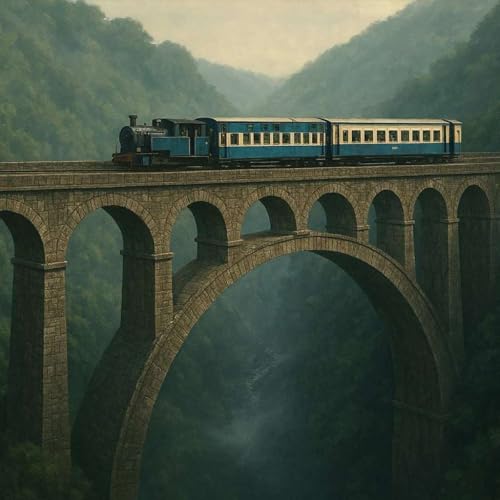
Couverture de Nilgiri Mountain Railway: The Victorian Toy Train Still Climbing Asia's Steepest Track Through India's Blue Mountains

Nilgiri Mountain Railway: The Victorian Toy Train Still Climbing Asia's Steepest Track Through India's Blue Mountains

Nilgiri Mountain Railway: The Victorian Toy Train Still Climbing Asia's Steepest Track Through India's Blue Mountains

Écouter gratuitement

Voir les détails
In 1854 a British engineer looked up at the Nilgiri Hills and proposed building a railway to the top.His superiors said no.He proposed it again. No. A third time. No. A fourth time. No.For forty-five years, through multiple proposals, multiple engineers, multiple committees and multiple rejections, the answer was always some version of no. The gradients were too steep. The terrain was too difficult. The engineering challenge was too great.In 1899 the first train finally climbed from Mettupalayam at the base of the hills to Coonoor in the Blue Mountains above, hauled by a Swiss steam locomotive using a rack-and-pinion mechanism borrowed from the Alpine railway tradition. A toothed rack between the rails. A pinion gear on the locomotive. A positive mechanical grip on the track that cannot slip regardless of how steep the gradient becomes.One hundred and twenty-seven years later that same mechanism is still in use. On the same tracks. Through the same sixteen tunnels and across the same 257 bridges. The Swiss steam locomotives are still hauling the steepest section. The wooden blue and cream coaches are still carrying passengers through the same forest gorges and tea-covered hillsides that every passenger on this railway has experienced since 1899.The Nilgiri Mountain Railway is a UNESCO World Heritage Site. It is the only rack-and-pinion railway in India. It is the steepest railway in Asia. And it is one of the most extraordinary travel experiences available anywhere in the subcontinent.In this episode we tell the complete story of the Nilgiri Mountain Railway. The forty-five year battle to build it. The Swiss engineers and the Victorian bureaucrats who argued about whether it was possible. The rack-and-pinion mechanism that made it possible. The sixteen tunnels cut through solid granite. The 257 bridges spanning deep forest gorges. The Bollywood connection that made this railway one of the most recognisable backdrops in Indian cinema history. And the complete guide to riding it today through the extraordinary Blue Mountains of South India.What You Will Discover in This EpisodeThe complete story of how the Nilgiri Mountain Railway took forty-five years to build from first proposal in 1854 to first service in 1899, the specific engineering challenges that caused decades of rejection and the Swiss rack-and-pinion solution that finally made the impossible possibleWhy the Nilgiri Mountain Railway is the steepest railway in Asia with a maximum gradient of 8.33 percent on the section between Mettupalayam and Coonoor, what this gradient feels like from inside the wooden coaches and why it required a completely different technology from any conventional railway in IndiaThe Swiss X Class steam locomotives that still haul the steepest section of the Nilgiri Mountain Railway today, not replicas and not restored antiques but working machines of the original design still performing the same engineering task they were built for in the 1890s on the same track through the same tunnelsThe sixteen tunnels of the Nilgiri Mountain Railway and what the experience of complete darkness inside a mountain gorge tunnel cut by Victorian engineers a hundred and twenty-seven years ago actually feels like from inside a slow-moving heritage wooden carriageThe 257 bridges of the Nilgiri Mountain Railway spanning the deep forest gorges of the lower Nilgiris, the specific experience of looking down through the gaps between the sleepers at the valley floor far below and the extraordinary change in sound as the train moves from solid ground onto the bridge deckThe transformation of the landscape outside the carriage window during the journey from Mettupalayam to Coonoor, from the agricultural flatlands of the Tamil Nadu plains through the dense forest gorges of the lower Nilgiris to the extraordinary moment when the tea gardens of Coonoor first appear on the hillsides above the forest lineThe Coonoor to Ooty section of the journey through the tea estates of the upper Nilgiris, the small heritage stations with their Victorian stone buildings and their chai vendors, the extraordinary pastoral beauty of the Blue Mountains visible through the large wooden carriage windows and the specific experience of travelling at walking pace through a landscape of extraordinary beauty with no hurry and no agendaThe Chaiyya Chaiyya connection, how the director Mani Ratnam filmed the iconic Shah Rukh Khan and Malaika Arora sequence from the 1998 Bollywood film Dil Se on the roof of the Nilgiri Mountain Railway and why this sequence has made the Blue Mountains one of the most recognisable landscape backdrops in Asian cinemaThe practical guide to riding the Nilgiri Mountain Railway in 2026, which section to choose between the full Mettupalayam to Ooty route and the shorter Coonoor to Ooty section, why tickets sell out months in advance during peak season, where to sit for the best views and what to bring for the journeyHow the Nilgiri Mountain Railway fits ...
adbl_web_anon_alc_button_suppression_c
Aucun commentaire pour le moment