Épisodes

  • Spinosaurus: The Greatest Dinosaur Mystery
    Feb 2 2026
    The Spinosaurus is a massive predator whose lifestyle has been debated due to limited fossil evidence, especially after the original 1915 fossils were destroyed. Recent discoveries of dense bones, short hind legs, and paddle-like tails suggest adaptations for an aquatic life, though evidence on buoyancy and balance also supports land-based wading behavior. With only a few incomplete specimens, scientists remain divided on whether it acted more like a swimming crocodile or a shore-dwelling predator, and new fossil finds continue to reshape understanding of its appearance and habitat.

    You can listen and download our episodes for free on more than 10 different platforms:
    https://linktr.ee/wild_wonders1

    Produced by:
    https://www.podcaistudio.com/
    Afficher plus Afficher moins
    13 min
  • The Capybara's Strange Survival Strategy
    Feb 1 2026
    The capybara, the world’s largest rodent, is a semi-aquatic mammal native to South America with adaptations like webbed feet and high-set facial features for life in water. It has an herbivorous diet and practices cecotrophy to maximize nutrient absorption from grasses. Capybaras live in hierarchical social groups and communicate through diverse vocalizations, making them highly social and resilient animals that maintain stable populations despite environmental challenges.

    You can listen and download our episodes for free on more than 10 different platforms:
    https://linktr.ee/wild_wonders1

    Produced by:
    https://www.podcaistudio.com/
    Afficher plus Afficher moins
    11 min
  • Megalania: The Two Ton Venomous Lizard
    Jan 31 2026
    The Megalania was the largest lizard ever known, dominating Ice Age Australia as a massive apex predator that could reach lengths of up to seven meters. Closely related to the modern Komodo dragon, it likely had a venomous bite and hunted large megafauna such as giant kangaroos. Its slow metabolism helped it survive extreme environmental changes, but despite its strength and adaptability, the species eventually went extinct, a decline commonly linked to the arrival of humans on the continent.

    You can listen and download our episodes for free on more than 10 different platforms:
    https://linktr.ee/wild_wonders1

    Produced by:
    https://www.podcaistudio.com/
    Afficher plus Afficher moins
    12 min
  • Megalodon Teeth Reveal The Giant Shark's Fall
    Jan 30 2026
    Megalodon was the largest shark ever to inhabit Earth’s oceans, a true apex predator that dominated marine ecosystems for millions of years. Because its skeleton was made of cartilage rather than bone, most of its body did not fossilize, leaving scientists to reconstruct its size and behavior primarily from its massive fossilized teeth, some larger than a human hand. These remains indicate that Megalodon was capable of hunting large prey, including prehistoric whales, using immense bite force and specialized feeding strategies. Over time, dramatic changes in ocean temperatures and the decline of its primary food sources disrupted this dominance, leading to its extinction around three million years ago. After Megalodon vanished, ocean ecosystems shifted significantly, allowing modern baleen whales to evolve into the enormous sizes seen today without pressure from such a powerful predator. Despite ongoing fascination and popular myths, scientific evidence confirms that Megalodon is completely extinct and no longer exists in the deep oceans.

    You can listen and download our episodes for free on more than 10 different platforms:
    https://linktr.ee/wild_wonders1

    Produced by:
    https://www.podcaistudio.com/
    Afficher plus Afficher moins
    11 min
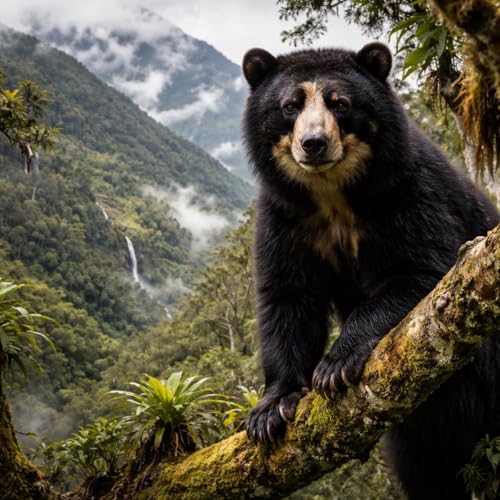
  • Spectacled Bear: The Last Giant Predator
    Jan 29 2026
    The spectacled bear is a rare and elusive predator native to the rugged heights of the Andes Mountains in South America and represents the last living member of the short-faced bear lineage. It is easily recognized by the distinctive light markings around its eyes, which vary between individuals, and by its impressive ability to climb trees, a skill uncommon among large predators. Although smaller than many other bear species, the spectacled bear plays a crucial ecological role as an adaptable omnivore, helping disperse seeds and maintain forest balance. The species also holds deep cultural importance in indigenous traditions and folklore across the Andes. Today, however, it faces increasing conservation threats from habitat destruction, agricultural expansion, and conflicts with local farmers. Generally shy and non-aggressive, the spectacled bear avoids human contact, yet it remains a vulnerable species whose survival depends on continued research, habitat protection, and coexistence efforts.

    You can listen and download our episodes for free on more than 10 different platforms:
    https://linktr.ee/wild_wonders1

    Produced by:
    https://www.podcaistudio.com/
    Afficher plus Afficher moins
    13 min
  • Giant Hogweed Blinds and Burns Skin
    Jan 28 2026
    The giant hogweed is a towering invasive plant from the carrot family that can grow to heights rivaling a giraffe. Often associated with Hercules because of its immense size and toughness, it is especially dangerous due to its toxic sap, which can cause severe blistering and long-term skin damage, and may even lead to temporary or permanent blindness when the affected skin is exposed to sunlight. Native to the Caucasus region, the plant has spread rapidly across Europe and North America, where it thrives along riverbanks, roadsides, and forest edges. Its success comes from an aggressive reproductive strategy, producing tens of thousands of seeds that disperse easily through wind and water and can remain dormant in soil for years. Combined with a deep, resilient taproot, these traits make giant hogweed extremely difficult to eradicate once it becomes established, posing serious ecological and public health risks.

    You can listen and download our episodes for free on more than 10 different platforms:
    https://linktr.ee/wild_wonders1

    Produced by:
    https://www.podcaistudio.com/
    Afficher plus Afficher moins
    13 min
  • Bristlecone Pines Reveal Climate Change
    Jan 27 2026
    The Great Basin bristlecone pine is widely regarded as the longest-living individual organism on Earth. Native to high-altitude regions of the southwestern United States, these trees endure extreme conditions, including freezing temperatures, intense winds, and nutrient-poor soils, yet can survive for more than 5,000 years. Although some clonal organisms may persist longer through repeated regeneration, the bristlecone pine holds the record for non-clonal longevity, meaning each tree has remained a single continuous individual throughout its lifespan. To safeguard these ancient trees from damage or exploitation, scientists deliberately keep the exact locations of the oldest known specimens secret. Beyond their extraordinary age, bristlecone pines are invaluable to science, as their growth rings provide precise, long-term records of past climate patterns and offer critical insight into historical and modern climate change.

    You can listen and download our episodes for free on more than 10 different platforms:
    https://linktr.ee/wild_wonders1

    Produced by:
    https://www.podcaistudio.com/
    Afficher plus Afficher moins
    13 min
  • Australia's Marsupial Lion Evolutionary Puzzle
    Jan 26 2026
    Thylacoleo, commonly known as the marsupial lion, was one of Australia’s most formidable extinct predators. Although not related to modern lions, it possessed an exceptionally powerful bite force, rivaling that of an African lion, despite descending from plant-eating marsupial ancestors similar to koalas or wombats. Its anatomy was highly specialized for killing, featuring shearing, bolt-cutter-like teeth, strong forelimbs with retractable claws, and a muscular body built more like a tree-climbing bear than a running hunter. Rather than pursuing prey over long distances, Thylacoleo is thought to have been an ambush predator, attacking from trees with sudden, overwhelming force. The species disappeared around 50,000 years ago, a decline that likely coincided with human arrival in Australia and the resulting environmental and ecological disruptions.

    You can listen and download our episodes for free on more than 10 different platforms:
    https://linktr.ee/wild_wonders1

    Produced by:
    https://www.podcaistudio.com/
    Afficher plus Afficher moins
    11 min