

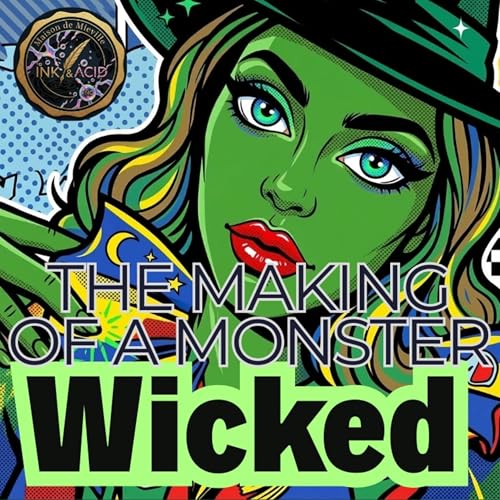
Wicked Explained: Propaganda, Conformity, and the Making of a Monster
Impossible d'ajouter des articles
Échec de l’élimination de la liste d'envies.
Impossible de suivre le podcast
Impossible de ne plus suivre le podcast

Wicked Explained: Propaganda, Conformity, and the Making of a Monster
-
Lu par :
-
De :
À propos de ce contenu audio
In this episode of Ink & Acid, Harmonie dives into Wicked as more than a film, more than a musical, and far more than a story about a misunderstood witch. This is a sharp cultural analysis of propaganda, conformity, social stigma, respectability, and the way societies manufacture monsters in order to protect their own moral comfort.
Through Elphaba, Glinda, and the political machinery of Oz, this episode explores how public enemies are created, why charm so often softens violence, and why audiences love stories that expose hypocrisy without ever feeling personally implicated. From collective psychology and social bias to narrative framing, halo effect, and the seductive power of social readability, this is a deep dive into what Wicked reveals about power, image, exclusion, and us.
If you love pop culture analysis, film essays, psychology in media, literary thinking, and cultural commentary with actual teeth, this episode is for you.
Music :
1. It's always been you (TFVC vol.2 : Crescendo)
2. Apocalypse With a Side of Toast (TFVC vol.3 : GLITCH)
3. Who Am I ?! (TFVC vol.3 : GLITCH)
Explore the full world of Ink & Acid on Maison de Mieville: books, essays, music, and full episode scripts. If this episode stayed with you, go further — read, listen, annotate, quote, and step deeper into the universe behind the microphone.Keyword : Wicked, Wicked movie, Wicked analysis, Wicked explained, Elphaba, Glinda, Wizard of Oz, propaganda, conformity, social stigma, social psychology, halo effect, implicit bias, scapegoat theory, René Girard, Erving Goffman, narrative framing, collective hypocrisy, public enemy, respectability politics, soft violence, charm and power, pop culture analysis, film analysis, movie essay, cultural criticism, media psychology, social bias, storytelling, symbolic violence, collective narratives, morality and power, Ink & Acid, Harmonie, Maison de Mieville