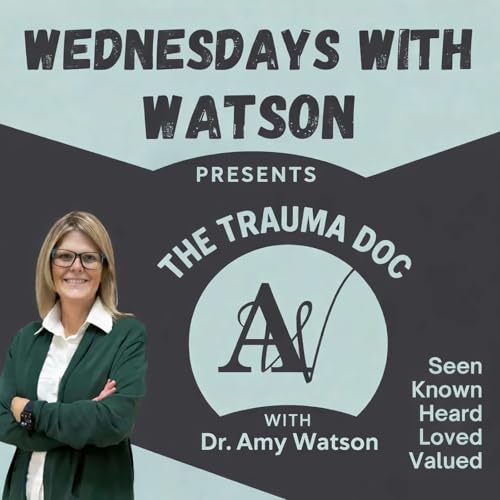
Couverture de Wednesdays with Watson

Wednesdays with Watson

Wednesdays with Watson

De : Amy Watson
Écouter gratuitement

À propos de ce contenu audio

There is much stigma to mental health issues in America and in the world. It is, perhaps, the most overlooked healthcare issue in society today. However, when we choose to address it and surround ourselves with people who refuse to let us ignore it, there IS healing and there IS Hope. This is a podcast hosted by a trauma survivor, a CPTSD patient, and a thriver. This raw and real podcast seeks to educate through story, science, and a faith that heals because of a God who understands our sufferings. Wednesdays With Watson podcast is a altruistic podcast that raises money for people who can afford counseling. Above all else, Jesus is the Star of all the stories. Come ito the healing zone! #PTSD #Anxiety #Depression #MentalHealthMatters #EMDR #RRT #LFS #Survivor #Jesus #CPTSD #Healing #enneagram© 2023 Wednesdays with Watson Hygiène et vie saine Psychologie Psychologie et psychiatrie
Épisodes
  • How Childhood Trauma Rewrites Adult Relationships
    May 13 2026

    Send us Fan Mail

    Contact Amy; amywatsonauthor@gmail.com

    Some of the most “normal” habits in adulthood are actually old survival skills. When childhood trauma or adverse childhood experiences shape the brain, kids learn protective behaviors that secure connection with caregivers, even if the connection is unsafe. Years later, those same patterns can show up as people pleasing, perfectionism, overgiving, or sabotaging closeness and they can quietly erode marriages, friendships, and family bonds.

    We respond to a listener who is living with someone with complex post-traumatic stress disorder (complex PTSD or CPTSD) and feels worn down and out of options. We break down why education matters for both survivors and the people who love them, using a clear definition of trauma rooted in compromised safety and lost choice. We also talk through the ACEs framework and how the adverse childhood experiences quiz can help survivors finally name their pain, reduce shame, and build self-compassion without dodging responsibility.

    From there, we get practical. We dig into people pleasing as a fear of separation, why “yes” can be automatic, and how honest conversations and a safe inner circle make it possible to say no without panic. We also unpack perfectionism, why it often brings external success, and how it can damage intimacy by turning love into a performance review. The bottom line is hard but hopeful: your trauma may not be your fault, but healing is your choice and real change is possible with support.

    If this resonates, share it with someone you love, subscribe so you do not miss the next conversation, and leave a review to help more survivors and loved ones find hope and help.

    You ARE:
    SEEN KNOWN HEARD LOVED VALUED

    Afficher plus Afficher moins
    25 min
  • Adult Responses to Adverse Childhood Experiences
    Apr 15 2026

    Send us Fan Mail

    Some of the behaviors you hate most about yourself might be proof that your brain did its job. Lauren Starnes joins me for a role-reversal conversation where she asks the questions and we go deep on adverse childhood experiences (ACEs), childhood trauma, and the nervous system patterns that can follow us into adulthood.

    We break down what an ACE score actually measures, why trauma is individual, and why the point is never comparison, it’s clarity. We connect the dots between early attachment wounds and the adult “protectors” so many of us live with: perfectionism, people pleasing, overgiving, control, and even self-sabotage. If you’ve ever felt ashamed of how you cope, I want you to hear this: those patterns often started as survival strategies designed to keep you connected and safe.

    We also talk about burnout and the window of tolerance, plus what it looks like to “grow” your nervous system instead of white-knuckling your way through life. Lauren shares why healing happens best in safe connection, not in isolation, and why practicing small, intentional imperfection can expand capacity over time. I also share why deeper memories can surface as we remove old survival blocks, and why you should never go to those places alone.

    If this conversation hits close to home, share it with someone you trust, subscribe so you don’t miss the next one, and leave a review to help more people find support and hope. What protector do you recognize most in yourself right now?

    What are ACEs and how do I know my score? Click here for quiz

    Lauren Contact:


    Adverse Childhood Experiences (ACEs) are potentially traumatic events that occur before age 18, including abuse, neglect, and household challenges. These experiences are strongly linked to long-term health, mental health, and relational outcomes.

    The 10 ACE Categories

    Abuse

    1. Emotional abuse
    2. Physical abuse
    3. Sexual abuse

    Neglect
    4. Emotional neglect
    5. Physical neglect

    Household Challenges
    6. Mother treated violently (domestic violence)
    7. Household substance abuse
    8. Household mental illness or suicide attempt
    9. Parental separation or divorce
    10. Incarcerated household member

    “This quiz isn’t about labeling yourself—it’s about understanding your story with more clarity and compassion.”

    You ARE:
    SEEN KNOWN HEARD LOVED VALUED

    Afficher plus Afficher moins
    57 min
  • Healing Is A Choice: Choose Life with Lauren Starnes
    Apr 1 2026

    Send us Fan Mail

    One sentence can split your life into before and after: “If you keep doing what you’re doing, you will die.” That’s the moment Amy Watson remembers from a visit with Lauren Starns, a medically trained physician assistant turned nervous system specialist, and it becomes the doorway into a deeper conversation about trauma, the body, and what it really takes to get free.

    We talk about why so many high-functioning people with PTSD, chronic stress, and burnout live in their heads while their bodies carry the cost. Lauren explains how the nervous system holds what we were not resourced to process, and why healing often works better when we stop obsessing over the trauma narrative and start listening to what is happening in the present. Amy connects that to trauma science, the window of tolerance, and what it looks like when the thinking brain goes offline and survival takes over.

    We also dig into co-regulation and why humans cannot heal in isolation. Connection is not a bonus feature, it is biology. When someone else’s steady presence helps your system settle, you can finally access choice, build resources, and decide what comes next with clarity. If you want practical language for the mind-body connection, nervous system regulation that doesn’t feel like a trend, and a path toward a healthier, abundant, free life, press play.

    Subscribe for the next conversations, share this with someone who feels stuck, and leave a review so more people can find the support they need.

    You ARE:
    SEEN KNOWN HEARD LOVED VALUED

    Afficher plus Afficher moins
    1 h et 5 min
adbl_web_anon_alc_button_suppression_c
Aucun commentaire pour le moment