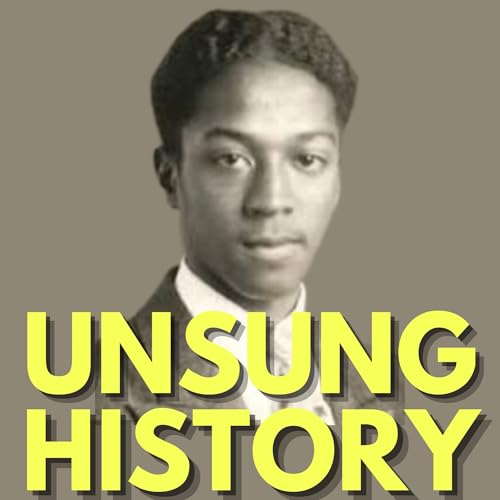
Couverture de Unsung History

Unsung History

Unsung History

De : Kelly Therese Pollock
Écouter gratuitement

À propos de ce contenu audio

A podcast about people and events in American history you may not know much about. Yet.

© 2024 Unsung History

Sciences sociales
Les membres Amazon Prime bénéficient automatiquement de 2 livres audio offerts chez Audible.

Vous êtes membre Amazon Prime ?

Bénéficiez automatiquement de 2 livres audio offerts.
Bonne écoute !
    Épisodes
    • Reed Peggram
      Jan 26 2026

      Reed Peggram, born in Boston in 1914, a gay Black man in a world that put up barriers to his success, excelled at Harvard before heading to a Europe on the brink of war. In Europe he fell in love with a Danist artist, and despite pleas from everyone in his life and from the US government to leave the war-torn continent, Reed refused to depart without Arne, leading to his imprisonment in an Italian concentration camp. Even then, Reed overcame the barriers in his way, escaping with Arne and surviving until they were rescued by the US Army. Joining me in this episode is Dr. Ethelene Whitmire, Professor of African American Studies at the University of Wisconsin–Madison, and author of The Remarkable Life of Reed Peggram: The Man Who Stared Down World War II in the Name of Love.


      Our theme song is Frogs Legs Rag, composed by James Scott and performed by Kevin MacLeod, licensed under Creative Commons. The mid-episode audio is “Do it Again!” composed by George Gershwin and performed by the Paul Whiteman Orchestra; the piece, which is in the public domain, was recorded on March 28, 1922 in New York, and is available via the Library of Congress National Jukebox. The episode image is a 1935 photograph of Reed Peggram retrieved from Reed Peggram's Harvard student records in the Harvard University archives; it is in the public domain and available via Wikimedia Commons.


      Additional source:

      • “Unpacking Reed Peggram’s Library,” by Ethelene Whitmire, Journal of Cultural Analytics, vol. 9, no. 2, May 2024.


      Advertising Inquiries: https://redcircle.com/brands
      Afficher plus Afficher moins
      41 min
    • Charles C. Diggs, Jr.
      Jan 12 2026

      Charles C. Diggs, Jr., founder of the Congressional Black Caucus, spent 25 years in Congress, pushing for change, on issues from segregation in commercial aviation to home-rule for the residents of Washington, DC, to the anti-apartheid movement. His legislative accomplishments were overshadowed by his downfall, and today his story doesn’t receive the attention of other Civil Rights heroes. Joining me in this episode is Dr. Marion Orr, Frederick Lippitt Professor of Public Policy and Professor of Political Science at Brown University and author of House of Diggs: The Rise and Fall of America's Most Consequential Black Congressman, Charles C. Diggs Jr.


      Our theme song is Frogs Legs Rag, composed by James Scott and performed by Kevin MacLeod, licensed under Creative Commons. The mid-audio is “Bad Luck Blues,” performed by Gertrude “Ma” Rainey in 1923; the performance is in the public domain. The episode image is an official Congressional photo of Charles Diggs, Jr., in the public domain and available via Wikimedia Commons.


      Additional sources:

      • “DIGGS, Charles Coles, Jr.,” Office of the Historian, United States House of Representatives.
      • “Charles Diggs, 75, Congressman Censured Over Kickbacks,” by Irvin Molotsky, The New York Times, August 26, 1998.
      • “Eyes on the Prize; Interview with Charles Coles Diggs Jr., 1985-11-06 [video],” Film and Media Archive, Washington University in St. Louis, American Archive of Public Broadcasting (GBH and the Library of Congress), Boston, MA and Washington, DC.
      • “Regional Council of Negro Leadership,” by Ten Ownby, Mississippi Encyclopedia.
      • “Mound Bayou (1887- ),” by Herbert G. Ruffin II, BlackPast, January 18, 2007.
      • “Emmett Till's Death Inspired a Movement,” Smithsonian’s National Museum of African American History & Culture.
      • “About the CBC,” Congressional Black Caucus.
      • “D.C. Home Rule,” Council of the District of Columbia.


      Advertising Inquiries: https://redcircle.com/brands
      Afficher plus Afficher moins
      49 min
    • All in the Family
      Dec 30 2025

      When All in the Family premiered in January 1971, CBS was nervous enough about the content that they added an advisory message at the beginning. Despite their fears, the show was a success, quickly garnering both awards and top Nielsen ratings. All in the Family not only changed television in the United States but also the practice of politics. Joining me in this episode is Dr. Oscar Winberg, Postdoctoral Fellow at the Turku Institute for Advanced Studies and the John Morton Center for North American Studies at the University of Turku, and author of Archie Bunker for President: How One Television Show Remade American Politics.


      Our theme song is Frogs Legs Rag, composed by James Scott and performed by Kevin MacLeod, licensed under Creative Commons. The mid-episode music is “I Don’t Like Your Family,” composed by Joseph E. Howard, with lyrics by Will M. Hough and Frank R. Adams; this recording, from October 4, 1906, is in the public domain and is available via the Library of Congress National Jukebox. The episode image is a photo of the Cast of the television program All in the Family from a press release dated March 12, 1976; the photo is in the public domain and is available via Wikimedia Commons.


      All in the Family streaming:

      • Meet the Bunkers (Season 1, Episode 1) on YouTube
      • Seasons 2 and 3 on Pluto TV
      • Seasons 7 and 8 on Tubi


      Additional Sources:

      • “Till Death Us Do Part, 6 June 1966,” History of the BBC.
      • “Norman Lear, Whose Comedies Changed the Face of TV, Is Dead at 101,” by By Richard Severo and Peter Keepnews, The New York Times, December 6, 2023.
      • “For Good or Bad, Norman Lear Helped Erase Rural America from TV,” by Jeffrey H. Bloodworth, The Daily Yonder, February 22, 2024.
      • “How Archie Bunker Forever Changed in the American Sitcom,” by Sascha Cohen, Smithsonian Magazine, March 21, 2018.
      • “Looking Back on the Legacy of ‘All in the Family’ 50 Years Later,” by Tim Gray, Variety, January 12, 2021.
      • “Looking Back on “All in the Family,” the Sitcom That Reshaped America,” by Tim Brinkhof, The Progressive Magazine, May 30, 2024.
      • “Rob Reiner was more than a Hollywood liberal. He was a sophisticated political operator,” by Melanie Mason, Politico, December 15, 2025.


      Advertising Inquiries: https://redcircle.com/brands
      Afficher plus Afficher moins
      51 min
    Aucun commentaire pour le moment