Épisodes

  • Scaling IP Benefits: Tencent, the White House, and AI
    Mar 3 2026

    Send a text

    Danny Marti has navigated IP from the Obama White House to the boardrooms of some of the world's most powerful companies. As President Obama's intellectual property enforcement coordinator — the so-called "IP czar" — Danny helped shape a whole-of-government approach to IP strategy. Today, as Head of Public Affairs and Global Policy at Tencent, he oversees IP protection for the world's largest trademark filer and one of the top holders of AI patents globally.

    This conversation covers Tencent's remarkable transformation of music piracy in China, how the company built Weixin's crowdsourced IP enforcement platform, and why understanding the problem before reaching for a solution is the most underrated skill in IP — or any other field.

    Key Takeaways:

    1. Tencent is the world's largest trademark filer, operating a truly global portfolio across dozens of countries and product categories.
    2. China's music piracy rate dropped from roughly 97% to 2-3% in under a decade, driven largely by Tencent's investment in licensed streaming and aggressive enforcement.
    3. The Weixin Brand Protection Platform (Weishen) allows any user — not just rights holders — to report IP infringement, crowdsourcing enforcement at scale.
    4. Danny's time as IP czar centered on a whole-of-government IP strategy, coordinating more than a dozen departments, offices, and agencies.
    5. Tencent holds among the largest portfolios of AI patents of any company globally and is shifting focus toward agentic AI beyond generative models.
    6. Global video game development requires deep localization — culture, color, humor, and gameplay mechanics all vary significantly by region.
    7. IP laws have historically proven resilient in adapting to new technologies, but the speed and scale of AI may test that resilience in new ways.
    8. Existing copyright and trademark frameworks still apply meaningfully in the AI era; new regulation may be needed but isn't inevitable.
    9. Danny's IP origin story began as a poetry fellow and intern at the USPTO — a reminder that IP touches creative fields from the start.
    10. The core lesson Danny carries from the Situation Room: spend time understanding the full scope of a problem before proposing solutions.

    Subscribe on your platform of choice or email us at explore@understandingip.org.

    Content provided is for informational purposes only and does not represent the views of CIPU or its affiliates.


    00:00 - Cold open: The Situation Room and IP
    01:32 - Why Tencent isn't a US household name
    05:35 - Danny's role and Tencent's IP portfolio
    07:00 - Largest trademark filer in the world
    08:30 - Tencent's AI patent strategy
    10:55 - Copyright evolution in China
    12:00 - Music piracy transformation
    14:10 - Life as the Obama White House IP czar
    17:59 - Whole-of-government IP strategy
    21:01 - Government to global industry
    22:35 - IP challenges at RELX and LexisNexis
    27:21 - Protecting value-added content
    28:33 - Global gaming and localization
    32:33 - The Weixin Brand Protection Platform
    35:07 - Why users self-report IP violations
    37:51 - Agentic AI and the future of IP law
    39:16 - Will AI require new regulation?
    41:53 - Danny's IP origin story
    44:13 - Understand the problem first

    Understanding IP Matters is brought to you by the nonprofit Center for Intellectual Property Understanding (CIPU) with generous support from its partners and sponsors. The podcast provides leading innovators and experts the space to share their IP stories.

    Afficher plus Afficher moins
    47 min
  • Greenhouses for Innovation: Balancing Patent Rights and Public Good with Laura Peter
    Feb 17 2026

    Send a text

    Laura Peters provides rare perspective to intellectual property awareness, having served as Deputy Director at the U.S. Patent and Trademark Office under Andre Iancu before becoming Executive Director of Research at UNC Charlotte. She tackles persistent misconceptions about patents in university settings, where publication incentives often overshadow commercialization opportunities.

    Peters explains how patents function as temporary greenhouses for innovators—protecting ideas for 20 years before releasing them to public knowledge. Her work focuses on helping researchers understand that intellectual property extends far beyond patents and that securing rights doesn't conflict with open knowledge principles.

    KEY TAKEAWAYS:

    • Universities reward publications over patents, creating commercialization barriers
    • Researchers often conflate all IP rights with patents, missing broader protections
    • Open knowledge advocates can still benefit from patent rights and public dedication
    • Patents publish after 18 months, contributing to collective innovation knowledge
    • Trade secrets are rising as patent uncertainty increases in AI and other sectors
    • Subject matter eligibility reforms could strengthen innovation protection
    • University culture change requires extensive education and community building
    • Patents preserve innovator legacy across global innovation records

      00:00 Patents as innovation greenhouses for public benefit
      01:24 Leading USPTO operations during transformational period
      02:37 Building IP culture at UNC Charlotte
      04:34 Publication versus patents in tenure
      06:06 Open knowledge myths in research
      07:01 Constitutional patent philosophy
      10:00 IP awareness summit mission
      15:32 Understanding competitive intelligence
      19:22 Patent valuation complexity
      22:28 Subject matter eligibility challenges
      25:12 AI and biotechnology protection
      27:46 Teaching patent process fundamentals
      30:08 USPTO examiner training evolution
      34:40 Mining claim analogy for claims
      36:08 Patent portfolio investor value
      38:00 Provisional filing strategy
      39:05 Trade secret trend analysis
      40:38 Future of innovation protection

    Understanding IP Matters is brought to you by the nonprofit Center for Intellectual Property Understanding (CIPU) with generous support from its partners and sponsors. The podcast provides leading innovators and experts the space to share their IP stories.
    Afficher plus Afficher moins
    43 min
  • AI and IP Law, A Cautious Embrace
    Feb 3 2026

    Send us a text

    Wayne Stacy brings a unique perspective from his role as executive director of Berkeley Center for Law and Technology. From his early days as a patent litigator to directing the Silicon Valley USPTO office and earning a Fulbright to work in Nepal, Wayne has witnessed dramatic changes in how technology affects legal practice. This conversation explores how AI is transforming legal education, the evolution of patent litigation costs, and why future lawyers need different skills than previous generations.

    Key Takeaways:

    • AI enables lawyers to focus on higher-value work by automating routine tasks
    • Legal education must teach AI integration rather than AI avoidance
    • Cross-disciplinary collaboration between law and engineering drives innovation policy
    • Future lawyers need policy development skills alongside traditional legal training
    • Berkeley's position in Silicon Valley creates unique opportunities for public discussions
    • Entry-level lawyers must scale up capabilities to remain relevant in AI era

    Understanding IP Matters is brought to you by the nonprofit Center for Intellectual Property Understanding (CIPU) with generous support from its partners and sponsors. The podcast provides leading innovators and experts the space to share their IP stories.

    Afficher plus Afficher moins
    41 min
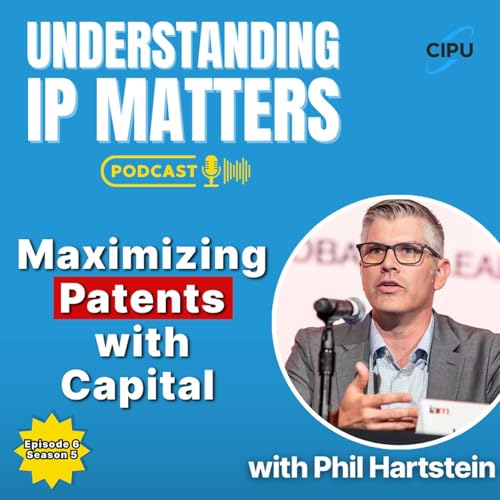
  • Capital Can Transform Invention Rights
    Jan 14 2026

    Send us a text

    Why do many businesses prefer lawsuits over licensing deals — and what does IP capital mean for innovation?

    Phil Hartstein, co-founder of Soryn IP Capital and former CEO of Finjan Holdings, shares insights from orchestrating almost $500 million in licensing deals. He explains why patent licensing has shifted from corporate boardrooms to courtrooms, and discusses the economics of patent enforcement, the role of litigation finance in supporting legitimate innovators, and how AI is transforming IP strategy.

    Phil reveals what makes patents valuable, why most portfolios contain only single-digit percentages of enforceable assets, and his perspective on patent monetization as a strategic responsibility rather than defensive last resort.

    Key Takeaways:

    • Most patent portfolios derive value from only single-digit percentages of total assets
    • Corporate defendants now manage 50-100 active patent lawsuits simultaneously
    • Patent litigation costs range from $2-20+ million and take 3-5+ years to resolve
    • Licensing discussions once happened in boardrooms over 9-12 month periods
    • Modern product cycles compress multiple technology clusters into shorter timeframes
    • IP capital helps innovators compete against well-funded corporate defendants
    • AI tools like ChatGPT are transforming patent analysis and claim construction workflows
    • Patent monetization strengthens both business balance sheets and the broader innovation ecosystem
    • The U.S. patent system's constitutional foundation drives American technology development
    • Strategic patent enforcement requires demonstrating credibility, capability, and resources

    About the Guest:

    Phil Hartstein is a technology investor, inventor, and intellectual property strategist. He co-founded Soryn IP Capital and previously served as CEO of Finjan Holdings, a public company now owned by Fortress. At Finjen, he oversaw licensing and enforcement of pioneering cybersecurity patents, orchestrating more than $300 million in licensing deals. Phil holds more than two dozen pending and issued patents and has been twice recognized as a top 40 IP dealmaker.

    00:00 - Introduction to Phil Hartstein
    01:44 - Why companies prefer lawsuits to licenses
    03:03 - Boardroom licensing era vs today
    04:16 - Soryn IP Capital's role in leveling field
    06:35 - Corporate litigation dockets explained
    08:47 - Patent lawsuit economics and timelines
    10:23 - Funding plaintiffs vs bad actors debate
    13:10 - Making capital available for innovators
    15:36 - Patent quality and portfolio value
    18:07 - Supreme Court's Unwired Planet decision
    20:16 - The Alice decision's ongoing impact
    23:40 - Patent valuation and market adoption
    26:25 - PTAB's role in patent examination
    29:14 - Working with litigation finance
    31:40 - Evaluating patent portfolio strength
    34:22 - International IP enforcement landscape
    37:08 - Germany's patent system advantages
    39:30 - AI's impact on patent prosecution
    42:42 - Racing vintage cars as analog escape
    44:40 - Patent monetization as strategic duty

    Understanding IP Matters is brought to you by the nonprofit Center for Intellectual Property Understanding (CIPU) with generous support from its partners and sponsors. The podcast provides leading innovators and experts the space to share their IP stories.

    Afficher plus Afficher moins
    47 min
  • 3-D Chess: AI's Race for Market Share and IP Supremacy
    Dec 10 2025

    Send us a text

    Allison Gaul, senior counsel at BCG-X, an invention development and commercialization company, discusses the evolving AI landscape, where intellectual awareness meets real-world strategy.

    As both a former patent examiner and litigator with a Harvard graduate degree in business analytics, she offers insider perspectives on how companies secure IP rights, why investors now prioritize AI risk policies, and how open source licensing drives market adoption.

    The conversation explores copyrighted training data challenges, how small learning models compete with foundational LLMs, and why publicly available doesn't mean free to use. Gaul shares practical IP protection strategies for startups and established companies navigating content attribution, energy-efficient blockchain solutions, and the misconceptions engineers hold about software patents.

    Key Takeaways:
    • Small, targeted-use models (SLMs) trained on specific datasets are gaining traction because of their relevance and efficiency
    • Investors are now scrutinizing AI startup' risk and compliance policies more carefully
    • Open source licensing has become a significant tool for capturing market share
    • Publicly available content is not automatically free to use; not all LLMs ascribe to this
    • Blockchain offers potentially reliable solutions for IP tracking despite energy concerns
    • IP and AI strategy require balancing innovation with responsible ethics
    • Gen AI adoption began with easy productivity wins across industries
    • Businesses that are mindful of AI risk are in a better position to attract capital

    Subscribe to Understanding IP Matters on your preferred platform or visit understandingip.org for more episodes exploring intellectual property with leading innovators and experts.

    00:00 - Introduction to Allison Gaul
    01:07 - AI race and investor expectations
    02:36 - Risk policies investors demand
    03:01 - How companies leverage Gen AI
    04:21 - Working with foundational model providers
    05:34 - Day in the life of a product attorney
    06:40 - Multi-dimensional AI competition
    08:34 - Open source as market strategy
    09:10 - Small learning models vs LLMs
    11:02 - Copyright challenges in AI training
    13:29 - Content attribution and data rights
    15:41 - Licensing deals and fair use debate
    17:34 - Legal frameworks catching up
    19:20 - Transparency in AI systems
    21:25 - Attribution standards discussion
    23:38 - Geographic variations in AI law
    25:44 - EU regulations and global impact
    27:50 - Cross-border compliance challenges
    29:33 - Energy concerns in AI development
    31:18 - IP education for engineers
    33:11 - Patents in software development
    35:27 - Ethical IP strategy and responsibility
    37:54 - Patent troll misconceptions
    39:50 - Attribution vs permission clarified
    40:54 - Blockchain solutions and limitations
    42:08 - First exposure to IP rights

    Understanding IP Matters is brought to you by the nonprofit Center for Intellectual Property Understanding (CIPU) with generous support from its partners and sponsors. The podcast provides leading innovators and experts the space to share their IP stories.

    Afficher plus Afficher moins
    45 min
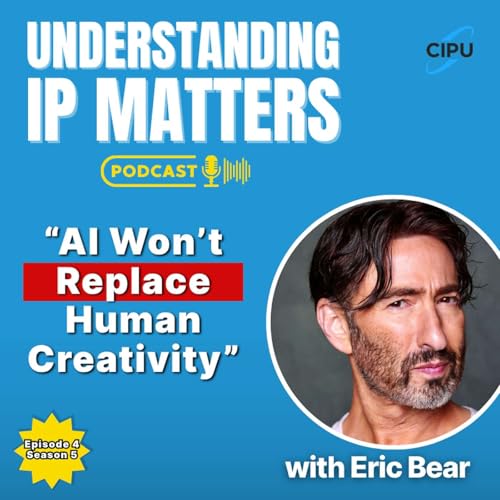
  • Man of 1000 Faces: The Renaissance Journey of Eric Bear
    Nov 19 2025

    Send us a text

    When creativity meets intellectual property, innovation has no boundaries.

    Eric Bear has licensed intellectual property to all major U.S. studios and Fortune 500 companies while maintaining a successful acting career. With over 100 patents covering software and video technology, Eric's seamless expansion invention was popularized by The Matrix and licensed to Disney, Fox, and other major studios. This conversation explores how he balances roles as inventor, entrepreneur, actor, and university professor while navigating patent litigation and startup IP protection. Discover how unconventional career paths can drive business trademark protection and commercial success.

    Key Takeaways:

    • How Eric licensed technology to all major Hollywood studios
    • The connection between acting, invention, and entrepreneurial thinking
    • Navigating patent litigation while maintaining creative pursuits
    • Building companies around intellectual property course principles
    • The role of performance capture technology in modern filmmaking
    • Protecting IP rights while collaborating with Fortune 500 companies
    • Career advice for young creators balancing art and business
    • How AI impacts creative industries and performer rights
    • The importance of following passion over financial incentives
    • Screen Actors Guild protections for digital likeness rights

    Understanding IP Matters is brought to you by the nonprofit Center for Intellectual Property Understanding (CIPU) with generous support from its partners and sponsors. The podcast provides leading innovators and experts the space to share their IP stories.

    Afficher plus Afficher moins
    43 min
  • Copyright Piracy Costs America up to $71 Billion: Hollywood Producer Ruth Vitale Speaks Out
    Nov 5 2025

    Send us a text

    Ruth Vitale, Oscar-winning producer and CEO of Creative Future, reveals the devastating impact of copyright piracy on America's entertainment workforce. Piracy costs the economy up to $71 billion annually and threatens 560,000 jobs across film and television. Ruth explains how small business IP protection matters for the 122,000 companies serving Hollywood, why copyright law basics must evolve for the digital age, and what IP protection strategies could save the industry. From malware risks on pirate sites to AI's threat to actor rights, this conversation exposes hard truths about intellectual property education and the urgent need for site blocking legislation.


    Key Takeaways:

    • Piracy costs the US economy between $29 to 71 billion annually
    • Film and television employ 2.3 million Americans (down from 2.7 million)
    • 92% of entertainment businesses employ fewer than 10 people
    • Google receives 58 million takedown requests weekly—yet pirate sites flourish
    • 60 countries have site blocking laws; the US does not
    • Visiting pirate sites carries a 30%+ risk of downloading malware
    • Movie theaters keep 50% of box office revenue
    • Average entertainment industry salary: $141,000 vs $94,000 nationally
    • Independent filmmakers finance projects with credit cards, can lose everything to piracy
    • AI companies train models on copyrighted content without permission


    Listen to discover how intellectual property course advocates like Ruth are fighting to protect creative workers and why copyright training matters for every entrepreneur.

    Understanding IP Matters is brought to you by the nonprofit Center for Intellectual Property Understanding (CIPU) with generous support from its partners and sponsors. The podcast provides leading innovators and experts the space to share their IP stories.

    Afficher plus Afficher moins
    40 min
  • AI Adoption Moves At The Speed of Trust
    Oct 22 2025

    Send us a text

    Award-winning educator and IP advocate Daryl Lim joins Bruce Berman to explore the intersection of artificial intelligence and intellectual property education. Broadcasting from Singapore, Daryl shares his global perspective on how AI is reshaping IP frameworks, from the $1.5 billion Anthropic settlement to the emergence of new data rights. This conversation examines IP leadership challenges, the role of blockchain in patent processes, and why marginalized communities need better access to intellectual property protection. Daryl discusses China's rapid IP development, the importance of equity by design in technology governance, and practical startup IP strategies for navigating an increasingly complex landscape.

    Key Takeaways:

    • AI and IP rights are fundamentally interconnected and evolving together
    • The $1.5 billion Anthropic case settlement sets precedent at $3,000 per book
    • IP leadership requires moving ahead of trends, not following them
    • China has transformed from IP pirate nation to major player in 20 years
    • Blockchain technology can reduce friction in IP transactions
    • Universities became IP believers after the Bayh-Dole Act enabled monetization
    • Content creators must embrace technology as ally, not enemy
    • Government frameworks should align AI development with societal values
    • Patent education and copyright training need to be more inclusive
    • Small creators need better tools to participate in large-scale licensing

    Understanding IP Matters is brought to you by the nonprofit Center for Intellectual Property Understanding (CIPU) with generous support from its partners and sponsors. The podcast provides leading innovators and experts the space to share their IP stories.

    Afficher plus Afficher moins
    47 min