Épisodes

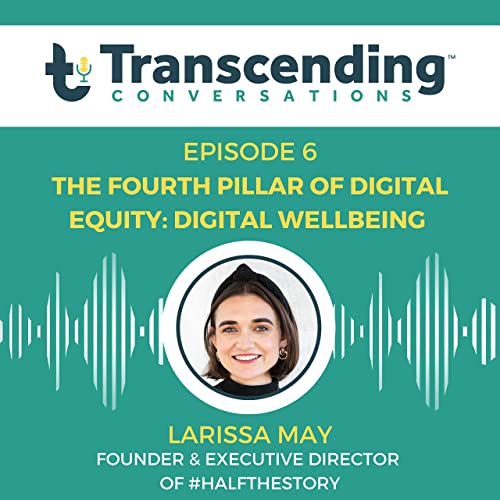
  • The Fourth Pillar of Digital Equity: Digital Wellbeing
    Jan 30 2023

    Larissa “Lars” May is a digital wellbeing activist. She started working in the space seven years ago. 

    She’s the founder of #HalfTheStory, a global youth nonprofit at the intersection of mental health and technology. Her vision is to make digital wellbeing accessible to everyone, and her mission is to empower the next generation's relationship with tech by giving them the resources, advocacy, and opportunities to be at the center of conversations rather than just be the victims of the decisions that others make.

    Episode Quotes

    On her experience with mental illness

    [2:44]  The story that I told the world was that everything was going well. And what people didn't see was that I was in my dorm room. I didn't go to class for two weeks. My roommate moved out because I was depressed. My room was a mess, and everything was really crumbling, to the point where I wound up experiencing suicidal ideation.

    On growing her nonprofit

    [6:37] I started with a $250 grant in my dorm room. And now, we have worked all around the world. We do both state and national policymaking and have really been the first movers in this space.

    On engaging young people

    [15:09] This is a new program that we're building with a partner youth organization. It’s a digital civil rights academy, and we want to revolutionize the movement by actually educating youth and getting them to take clear action steps on a local and global level.

    Show Links:
    • #HalfTheStory
    Afficher plus Afficher moins
    35 min
  • Innovative Solutions for Inner City Internet
    Jan 24 2023

    Chelsea, Massachusetts is one of the oldest cities in the United States. It is home to a large Latino population and has long provided shelter work and support to refugees.

    Carl Allen works hard to help Chelsea’s residents seek solutions to the problems they face. Carl had a successful career in the software industry, then returned to school to study resource economics and urban planning.

    He has used that degree as a springboard, devoting the latter part of his career to public service. Carl now serves as an economic development planner for the city of Chelsea. Carl has been working tirelessly to bring more equitable opportunities to his community. Recently, he has crafted an innovative plan to provide public broadband access to the residents of Chelsea. He hopes the initiative will help people to engage more effectively in the digital world. 

    Episode Quotes:

    On gentrification

    [13:43]  My one worry in all of this is that, when we implement [Chelsea’s digital equity plan], it will mean that the people of Chelsea will have access to much better broadband than anyone else in Greater Boston at a much lower price point. We don't need additional gentrification pressures, but this'll suddenly become an ideal place to work from home.

    On community buy-in

    [18:25] You want to see your local leaders focusing on issues that are really important to you. And so, I think it's very important to get the public's buy-in on those issues and make sure that not only are you finding solutions, but you're finding solutions that they're excited about, that they're willing to operate in. Because if they're not invested in the solution, it's not gonna solve anything.

    On the long term

    [19:30] The most exciting part is that we will be able to deliver symmetrical gigabit connections to every household in Chelsea. And the preliminary estimates are, assuming we can get capital funding for most of the buildout, which I think we can, the monthly costs will be somewhere in the mid-thirties. That is insane.

    Show Links:
    • Chelsea, MA
    Afficher plus Afficher moins
    32 min
  • Opportunity Lives Online
    Jan 13 2023

    Autumn Evans is the Deputy Director of Digital Equity and Inclusion for the City of Detroit. She’s also the Operations Director for Connect 313.

    At the height of the pandemic, she was working for a Detroit nonprofit that delivered food to home-bound and low-income seniors. The city approached her and asked her to help facilitate the distribution of 4,000 internet-connected devices to seniors in less than six weeks.

    That was her introduction to the digital divide.

    Episode Quotes

    On scaling

    [10:45] We're gonna scale on more of the resource side for any resident, where they can call a 313 Detroit number and it's a call center: press one to get internet access, press two to get a device, press three for technical support, and really just standardize the way that we support everyone on their journey to being more digitally connected and more confident in their ability to navigate the digital world.

    On Connect 313’s Community Ambassador program

    [16:31] We have partnered with anchor organizations in order to hire local residents to be ‘digital divide ambassadors.’ What that means is that that person in that specific district is responsible for making sure that everyone in that district is aware of the digital divide– the ways that it manifests. They bring resources into that area, whether it be digital literacy classes or even device distribution and giveaways.

    On sharing ideas

    [18:04] I have no problem doing one-on-ones, or speaking at different conferences and sharing the stage with other great professionals. I'll be at the National Digital Inclusion Alliance in February. I'm really looking forward to that, because it's like the family reunion of all digital inclusion people.

    Show Links:
    • Connect 313
    • Autumn’s email: autumn.evans@detroitmi.gov
    Afficher plus Afficher moins
    31 min
  • The Internet Isn’t Getting Where It’s Needed Most
    Jan 5 2023

    Kenneth Luzzatto’s background is in telecommunications infrastructure. He started working for internet service providers in the 1990s when the technology first started coming to the forefront. Since then, he’s stayed within the world of data and fiber. 

    He became tuned in to digital divide issues several years ago when he was driving through Baltimore and saw kids sitting in their parents' cars outside of a McDonald's trying to get their homework done. 

    In this episode, we talk with Ken about why some towns and neighborhoods in America still have really bad internet service– or no service at all. And we learn how to fix it.

    Episode Quotes

    On the pervasiveness of the internet

    [3:10] I went to buy a birthday present, a piece of art, for a friend, and the only way to do it was through their website. The only way to communicate with them is email. There's no phone number. 

    Everything that you do, from ordering pizza to signing up for social services, is done online now.

    On how the United States has managed broadband rollout

    [4:17] If you look where we are compared to, say, South Korea– South Korea has fiber to pretty much every home in the country. It’s not as large as the United States, but you would've thought that we could have done a little better as a country in getting this technology out to people that really need it. And those are people that are not in the urban centers. 

    On people who exclusively use cell phones to access the internet

    [13:46] They miss out on their educational experiences. They miss out on being able to apply for social services. And– I don't know if you've ever tried to use a cell phone outside of an urban area. In a city, you're probably fine using a cell phone. But if you're out in a rural community where 5G is not available, you're gonna find that it's almost painfully slow.

    Show Links:
    • Student Freedom Initiative
    Afficher plus Afficher moins
    30 min
  • It’s Time to Fix the Internet
    Dec 8 2022

    According to a recent consumer report survey, three out of four Americans believe that broadband should be treated the same as sewer, water, and roads. That means the internet would be publicly owned and operated rather than caught up in a privatized monopoly. As this statistic illustrates, community members want to see change but are often unaware of how vital their input and support is in actually fixing our internet.

    Our guest today is Bruce Patterson, director of Solution Services at Entry Point, a company that envisions a world where broadband infrastructure is more reliable, faster, safer, and increasingly consumer-focused. He is recognized as a thought leader behind the Amon model, which includes automated open access and a business model that mitigates risk for cities and creates local network ownership, treating it as a true public utility for 15 years. 

    Listen as Bruce talks about this topic a little bit more, what we can do to help minimize its effects in our own communities, and provide additional clarity on what it means to try to tackle the digital divide.

    Episode Quotes

    On a study examining broadband access and educational attainment

    [6:41] They looked at who did the best at school, who was the most likely to go on to higher education, and so forth. What they found was: those that had substantial bandwidth hardwired into the home did very well. They were much more likely to go onto higher education. They scored higher, and they were able to complete their classroom assignments. Those that actually only had a mobile connection actually scored exactly the same as those that had no broadband at their home.

    On the role of the private sector

    [22:59] Longer terms, lower interest rate, more public participation, and we can get the public side out of the services side and just leave that to private. Just like package delivery, we might have some role for some government service like the US Postal Service, but there's always gonna be a role for the private sector, because we're gonna want it faster or we’re gonna want it a certain way. That's where I think we can really start to separate infrastructure from service. 

    On digital literacy

    [11:55] The truth is, we need to push those things down. As we think about connectivity, we emphasize that a college or a university needs a really robust connection. But why would an elementary school need it?

    We could make a counter-argument that those elementary schools actually need the strongest connection because that's where it's gonna start.

    Show Links:
    • Benton Institute
    • Pew Research Center
    • Education Superhighway
    • Consumer Reports
    • Muni Networks
    Afficher plus Afficher moins
    35 min
  • Joining the Conversation
    Dec 2 2022

    Leaders at Transcend International discuss how an increasingly digital world presents unique opportunities– and serious obstacles– for social equity efforts. 

    Episode Quotes

    On current broadband access efforts

    [14:29] Sarah: The federal government, local governments, you go to any state, they're all putting together digital equity coalitions and they're looking at state broadband initiatives.

    We've got $45 to $65 billion coming down in infrastructure, with a bunch of that earmarked for broadband internet access. So– how can we get in front of that, and put the playbook together and fill in those gaps so that we can best equip communities and individuals to go out and advocate for themselves and to take control of that infrastructure?

    On the long-term nature of the work

    [20:03] Sarah: We're making investments in projects that we expect to take a long time to solve because they're massive, complex issues, and it's going it take some time to iterate and ideate. But that's where we're going to start. We're going to start to quantify impact on communities and to engage with the communities, and coalition-build.

    On community meetings in Detroit

    [21:17] Steve: The passionate description came from a gentleman who lives in a community where they suffered a 45 day outage in the heart of the pandemic, and just a street over had full service. 

    Different community, different socioeconomic status, different decisions being made.

    Afficher plus Afficher moins
    30 min
  • Trailer
    Nov 21 2022

    Welcome to Transcending Conversations. Enjoy the episodes!

    Afficher plus Afficher moins
    1 min