Épisodes

  • Story Tazria Metzora
    May 29 2026
    0:00 - Introduction to "Torah with Simcha" and "The Shul Without a Clock"

    0:27 - The concept of timelessness on Shabbos and its impact on the evening routine

    1:27 - The absence of clocks and its effect on Friday night activities, like walking

    1:58 - Security concerns in Chicago vs. the perceived safety of Friday night due to community security

    3:00 - The role of cell phones, or lack thereof, on Shabbos and its relation to security measures

    4:06 - Devorah's preparedness for her walk, including pepper spray and her mother's unusual permission

    4:38 - A late-night knock from Malky Trachman and the unexpected reunion of friends

    5:41 - The confusion and half-sleep state of the narrator upon Malky's arrival

    6:43 - The narrator's internal conflict about worrying for Devorah's safety and calling 911

    7:52 - Deciding against calling the police and heading to Malky Trachman's house for answers

    8:50 - Mrs. Trachman's calm response and her own experiences with children staying out late

    9:54 - Checking Devorah's room, only to find it empty at 12:30 AM

    10:15 - A suspicious walk through the neighborhood, searching for Michal's house

    11:19 - Devorah's unexpected return and her unique "midnight" hairstyle

    12:25 - The significance of things happening around "Hazos" (midnight/1 AM)

    12:53 - The full story: Devorah sought shelter from the rain and snuck back in

    13:55 - The kindness and care demonstrated in the story, including the narrator's search for Devorah

    14:41 - Comparing the story to a past experience in Yerushalayim where kindness was absent

    15:47 - The narrator's experience playing tennis at Iner Yisroel and the different atmosphere of Yeshiva

    16:47 - A prank gone wrong: being chased by "gangsters" who turned out to be fellow Yeshiva students

    18:34 - The importance of caring and opening doors for those in need, especially at night

    19:41 - The act of caring in evaluating safety on Friday night and making informed decisions

    20:29 - Devorah's caring heart: choosing to enter through the back to avoid waking anyone

    21:37 - The idea that "disasters" can be caused by caring intentions and the importance of context

    22:41 - The paradox of caring people and criminals sometimes ending up in similar situations

    23:38 - The blessings of community and friendship on Shabbos

    24:44 - Applying the lessons of care to professional life and beyond

    25:46 - The challenge of balancing care with efficiency in certain professions

    27:07 - The story as a spiritual reflection, increasing cultural awareness of Orthodox Judaism

    28:08 - Grounding people and focusing on important things, illustrated by a chaplain's experience

    29:09 - Overcoming fear and anti-Semitism to provide spiritual care, even in challenging environments

    30:09 - The power of the neshama (soul) and meaningful encounters with patients

    31:13 - Recognizing special opportunities and the "Sutton's" attempts to prevent good deeds

    32:47 - Conclusion of "Torah with Simcha" #ShulWithoutAClock #ShabbosTimelessness #FridayNightWalks #CommunitySecurity #NoCellPhones #PepperSpray #LateNightKnocks #WorryAndFaith #Calling911 #CaringHeart #MidnightMystery #YeshivaPranks #KindnessInAction #OrthodoxJudaism #CulturalAwareness #SpiritualReflection #ChaplainLife #HolocaustSurvivor #NeshamaPower #SuttonsObstacles

    Become a supporter of this podcast: https://www.spreaker.com/podcast/torah-with-simcha--4985090/support.

    Toro with Simcha is produced by Kol Simcha Productions.
    New episodes released regularly — exploring Torah, Jewish thought, and the wisdom that connects ancient text to everyday life.
    Contact: kolsimchaproductions@outlook.com
    Content is shared for educational, spiritual, and inspirational purposes. Sources are cited to the best of our ability. If you find an error or have a question about a source, please email kolsimchaproductions@outlook.com and we will look into it promptly.
    Support the show — exclusive bonus content available to subscribers for just $2/month at spreaker.com/organization/kol-simcha
    Not affiliated with any synagogue, rabbinical organization, or academic institution. All Torah discussion is offered in the spirit of learning — with meaning.
    Afficher plus Afficher moins
    33 min
  • The Unbelievable Van Story: A Tale of Faith and Miracles
    May 29 2026
    The Unbelievable Van Story: A Tale of Faith and Miracles

    Timestamp Breakdown:
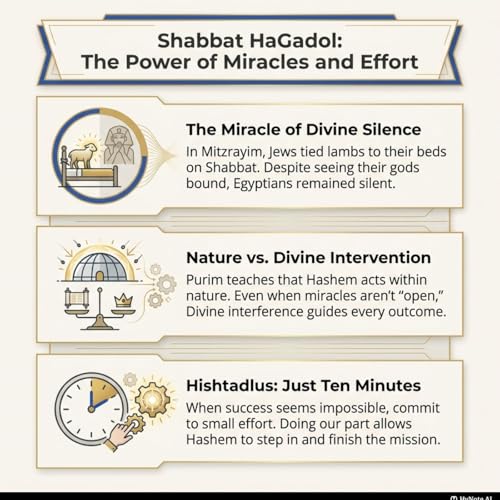
    • 00:00-01:08: Introduction to an unbelievable story, relating it to the miracle of Shabbos Hagadol and the previous year's miracle in Israel.
    • 01:09-03:11: The connection between Shabbos and miracles, specifically the story of the Paschal lamb in Egypt and the Egyptians' silence.
    • 03:12-04:16: Different types of miracles, contrasting open miracles with hidden miracles (like Purim) and their inspiring messages.
    • 04:17-06:23: The importance of believing in divine intervention (Hashgacha Pratis) and how it empowers us to attempt seemingly impossible tasks.
    • 06:24-09:39: Two personal stories illustrating the "do it for 10 minutes" approach when faced with impossible situations, emphasizing our effort (Hishtadlus) and God doing the rest.
    • 09:40-11:51: The beginning of the van story: discovering the van is missing and speculating on possibilities (stolen, towed, or daughter drove it).
    • 11:52-14:59: The wife's visit to the police station and the shocking phone call from a woman who found the stolen van, hot-wired, with the wife's contact info.
    • 15:00-17:08: The "Tevadicker" (natural) reason for the van's theft (a Kia vulnerability) and the amazing "Hashkacha" (Divine Providence) involved in its discovery.
    • 17:09-19:17: The unbelievable twist: the van is stolen again from the parking lot, and the police's dismissive reaction.
    • 19:18-22:37: Reflections on the repeated theft, the clear sign of divine intervention, and the meaning of "best possible outcome" (Kedushas Hashem, financial loss vs. human life).
    • 22:38-25:42: Introspection and the question of Hishtadlus (effort) vs. trusting in God, with a reference to a Gemara regarding learning Torah.
    • 25:43-29:57: The decision to search for the van again, considering different strategies (neighborhood search, relying on a child's "Ruach Hakodesh").
    • 29:58-33:07: The influence of Rav Chaim Tversky's teaching on connecting all observations to divine messages, leading to a search around Warren Park based on a Shabbos announcement.
    • 33:08-37:25: The use of AI (WhatsApp police character) for advice on finding the van, generating specific locations and strategies.
    • 37:26-40:38: The idea of using the car's remote panic button to locate the van, following AI's specific instructions.
    • 40:39-41:40: The successful discovery of the van, still intact with license plates and even a special Chumash, further highlighting the Hashgacha.
    • 41:41-47:59: The complications of retrieving the van: non-functional key, insurance requirements, potential danger from the criminal, and the bizarre interaction with the tow truck driver and police.
    • 48:00-49:59: The criminal's confrontation with the tow truck driver, the van's eventual towing, and the "inconvenience" leading to deeper reflection.
    • 50:00-57:36: The most important part of the story: the power of prayer, specifically the child's heartfelt Tehillim (Psalms) with Kavanah (intention) that ultimately led to the van's discovery. The contrast between the first and second search.
    • 57:37-59:59: Concluding thoughts on the meaning of "luck," the ongoing nature of the story, the connection to the month of Nissan and its inherent miracles, and the importance of drawing strength from such events.
    20 Hashtags: #HashgachaPratis #DivineProvidence #MiracleStory #StolenVan #JewishFaith #EmunahAndBitachon #Tehillim #PowerOfPrayer #ShabbosHagadol #Purim #KiaBoys #InconvenienceToBlessing #KidsPrayers #KiddushHashem #Chumash #SpiritualGrowth #UnexpectedTwist #NeverGiveUp #LessonsFromLife #NissanMonth

    Become a supporter of this podcast: https://www.spreaker.com/podcast/torah-with-simcha--4985090/support.

    Toro with Simcha is produced by Kol Simcha Productions.
    New episodes released regularly — exploring Torah, Jewish thought, and the wisdom that connects ancient text to everyday life.
    Contact: kolsimchaproductions@outlook.com
    Content is shared for educational, spiritual, and inspirational purposes. Sources are cited to the best of our ability. If you find an error or have a question about a source, please email kolsimchaproductions@outlook.com and we will look into it promptly.
    Support the show — exclusive bonus content available to subscribers for just $2/month at spreaker.com/organization/kol-simcha
    Not affiliated with any synagogue, rabbinical organization, or academic institution. All Torah discussion is offered in the spirit of learning — with meaning.
    Afficher plus Afficher moins
    1 h et 1 min
  • Pirkei Avos Perek 3, Mishna 1 - 3.
    Apr 29 2026
    Mishnaic Insights on Self-Improvement and Spirituality

    00:00 - 00:25: Introduction to the Omer & Shabbos Discussion

    00:26 - 02:26: Akavia Ben Mahal: Understanding Three Key Principles (Mishnah Aleph)
    Know from where you come, where you're going, and to whom you'll give judgment.
    The concept of aveira and cheshbon
    Learning the Mishnah: Second half answering the first.

    02:27 - 05:41: The Iranian Connection to Yerei Shamayim & The King of Kings

    Rabbi Calnen Weinreb ZTL perspective on Iranians in Ner Yisroel and their understanding of royalty.

    How physical experience reflects spiritual understanding.

    05:42 - 07:05: Modern Interpretation of Akavia Ben Mahal:

    Self-Esteem and Hashem's Love
    Shifting focus from *gaiva* to low self-esteem.
    "Know that Hashem loves you."
    07:06 - 08:52: The Meiri's Interpretation: Developing Traits and Reaching Perfection
    Mishnah's role in personal growth, not just avoiding aveira.
    Remembering our humble origins guards against gaiva.

    08:53 - 11:02: The Deeper Meaning of "Putrid Drop": Humility through Bodily Functions**
    * Relating physical functions to our non-divine nature.
    * Pharaoh as an example of denying natural bodily functions.

    11:03 - 12:23: Further Insights on Bodily Functions and Mishnah Interpretation**
    * Avos Drumnasan and different interpretations.
    * The open interpretation of the first part of the Mishnah.

    12:24 - 15:58: Rabbi Hanina Skanakonim: Davening for the Government (Mishnah Bet)**
    * The importance of government for societal order.
    * The impact of the COVID lockdown and the absence of communal *tefillah*.
    * The role of *tefillah* in empowering leadership.

    15:59 - 17:51: Greatness in Leaders: Dale Carnegie vs. Gedolim**
    Comparing secular self-help to the wisdom of the *gedolim*.
    The personal embodiment of traits in *Perkei Avos*.

    17:52 - 23:25: Rabbi Chanin bin Tradyin: The "Moshev Leitzim" and the Presence of Torah (Mishnah Gimel)**
    * Redefining "clown" (*leitzin*) in a Torah context.
    * Degrading Torah through absence of discussion.
    * The concept of *divrei Torah* in everyday conversation.
    * The distinction between humor and degrading words.

    23:26 - 28:57: The Solitary Learner and "Kuyveser Hara": Reward and Continuous Blessings**
    * The case of the individual *osek b'Torah* even without a *chavrusah*.
    * Connecting *kuyveser hara* (conquering one's evil inclination) to continuous blessings.
    * The unique merit of learning Torah through struggle.

    28:58 - 30:44: Three People at One Table: The Sacredness of Shared Meals (Mishnah Gimel revisited)**
    * The significance of *mazumin* and the absence of Torah discussion.
    * Alternate interpretation of *Moshev Leitzim*: lacking mutual respect for Torah.

    30:45 - 34:39: The Table as a Mizbeach: Atonement and the Power of Torah at Meals**
    * Comparing the table to an altar.
    * *Kapara* (atonement) through Torah discussion during meals.
    * The importance of choosing lifestyles that incorporate Torah-filled meals.


    #PerkeiAvos #TorahStudy #JewishWisdom #Omer #ShabbosLessons #SelfImprovement #Humility #YerShamayim #Leadership #Tefillah #DivinePresence #ConqueringTheYetzerHara #Atonement #JewishSpirituality #Mishnah #RabbinicTeachings #EthicalLiving #SpiritualGrowth #Mitzvah #Hashem

    Become a supporter of this podcast: https://www.spreaker.com/podcast/torah-with-simcha--4985090/support.

    Toro with Simcha is produced by Kol Simcha Productions.
    New episodes released regularly — exploring Torah, Jewish thought, and the wisdom that connects ancient text to everyday life.
    Contact: kolsimchaproductions@outlook.com
    Content is shared for educational, spiritual, and inspirational purposes. Sources are cited to the best of our ability. If you find an error or have a question about a source, please email kolsimchaproductions@outlook.com and we will look into it promptly.
    Support the show — exclusive bonus content available to subscribers for just $2/month at spreaker.com/organization/kol-simcha
    Not affiliated with any synagogue, rabbinical organization, or academic institution. All Torah discussion is offered in the spirit of learning — with meaning.
    Afficher plus Afficher moins
    35 min
  • Tefila betzibur, kovei itim, parnasa part 1
    Apr 26 2026
    You're asking for a chapter breakdown with timestamps for this specific audio based on its content, even if it's not the story of Joseph. Got it! Here's a breakdown of the key topics discussed in the audio, with timestamps: Podcast Description (for easy copy-pasting): This episode explores the deep connection between spiritual practices and material sustenance (Parnassah) in Judaism. Discover how davening (prayer) with a minyan (congregation), Torah study, faithful business conduct, and tzedakah (charity) are not just religious obligations but also profound pathways to blessing and abundance. We delve into ancient texts and rabbinic insights, including a unique interpretation involving Joseph's brothers, to illuminate how prioritizing the spiritual can profoundly impact the physical. Learn about the special blessings associated with expenses for Shabbat, holidays, and children's Torah education, and why aligning with divine will through these practices can guarantee abundance. Chapter Breakdown with Timestamps:00:00 - Introduction: Connecting Spiritual Practices to ParnassahBegins discussing the topic: communal prayer (minyan), Torah study, and their impact on Parnassah (livelihood).References sources and a "phenomenal Dvar Torah" from "Jewish zoos" (likely meant "Jewish sages" or a specific commentary).00:46 - The Zohar & Davening with a Minyan for ParnassahThe Zohar states Yaakov instructed his children to daven with a minyan.Introduces the idea that davening with a minyan is a segula (spiritual remedy/blessing) for Parnassah.01:07 - Joseph's Brothers & the Minyan Connection (Divrei Yisrael of Mozut)Discusses Rashi's question on why the Torah specifies "10 brothers" going to Egypt.The Divrei Yisrael of Mozut answers that their mission for food (Parnassah) was dependent on their tefilot (prayers) with a minyan.01:46 - Exodus 23:25 and Plural "Worship" for MinyanQuoting "You shall worship Hashem your God, and He will bless your bread and your water."The Rabbi of Radish interprets "worship" in plural as referring to davening with a minyan, linking it to Parnassah and health.02:30 - The Maor of Hashem & Guarantee of Abundant ParnassahStates that serving Hashem with the congregation applies to all aspects (Torah, prayer, charity).Emphasizes davening with a minyan guarantees abundant Parnassah and blessings.03:17 - Historical Sources & The Importance of Prioritizing PrayerReferences the Gemara in Brachot (about Vasikin prayer).Connects Parnassah to work, even going back to Adam HaRishon.A letter from a Rebbe (Yizmachis) to his Hasidim encouraging waiting for a minyan, guaranteeing no loss and bringing blessing to Parnassah.04:36 - Additional Benefits of Minyan: Divine PresenceMentions that Hashem is present wherever there is a minyan, changing the spiritual reality of the place.05:27 - Shulchan Aruch & Rabbinic Prayer (O.C. 90:5)Shulchan Aruch instructs making an effort to daven with the congregation."Behold, Hashem is mighty and does not despise" applied to the Tefila of the Rabbim (prayer of the many).06:10 - Shechina with 10 People & Prioritizing TefillahThe Shechina (Divine Presence) is with 10 people davening.Ohr HaChaim (O.C. 98) and Gemara Brachot: Do not involve oneself in personal needs before prayer."Mida K'neged Mida" - if you prioritize Tefillah, Hashem prioritizes you.06:54 - Torah Study (Talmud Torah) - Fixed Times & ObligationsThe second question asked in Shamayim: "Did you set fixed times for Torah study?"The first question: "Did you conduct your business faithfully?"Shulchan Aruch (Y.D. 246:1): Every Jew is obligated to study Torah, regardless of status.Obligation to establish times for Torah study day and night (Menachot 99b).Minimal fulfillment: reciting Shema morning and evening.08:26 - "No Flour, No Torah; No Torah, No Flour"The interdependence of sustenance and Torah study.Advice to teach a son a clean trade and pray for mercy.Reiterates conducting business faithfully.08:57 - Tzedakah (Charity) & Its BlessingsA person will never become poor from giving Tzedakah.The highest level of Tzedakah: helping a person become self-sufficient before they fall.Quoting the Rambam (Mishneh Torah, Hilchot Matanot Aniyim 10:7-12) on different levels of charity.10:15 - Special Expenses for Shabbat, Yamim Tovim, & Children's Torah StudyAll sustenance is allotted from Rosh Hashanah to Rosh Hashanah.Exception: Expenses for Shabbat, Yamim Tovim (holidays), and children's Torah study.Spending more on these guarantees more (a tremendous segula for Parnassah).Gemara in Shabbat ("watched with full handfuls of water...") illustrating this principle.10:59 - Recap: Serving Hashem with Avodah (Work of the Heart)Returns to Exodus 23:25 and the plural "avodah" (worship) as the "work of the heart" (davening).Connects this again to the minyan and Joseph's brothers (as discussed earlier in the episode).11:59 - Concluding Remarks & Music CreditsBrief reflection that this isn't a complete episode but covers key ...
    Afficher plus Afficher moins
    13 min
  • The Ordered Life: Minyan, Torah, and Parnassah
    Apr 26 2026
    This episode explores the deep connection between spiritual practices and material sustenance (Parnassah) in Judaism. Discover how davening (prayer) with a minyan (congregation), Torah study, faithful business conduct, and tzedakah (charity) are not just religious obligations but also profound pathways to blessing and abundance. We delve into ancient texts and rabbinic insights, including a unique interpretation involving Joseph's brothers, to illuminate how prioritizing the spiritual can profoundly impact the physical. Learn about the special blessings associated with expenses for Shabbat, holidays, and children's Torah education, and why aligning with divine will through these practices can guarantee abundance. Chapter Breakdown with Timestamps:00:00 - Introduction: Connecting Spiritual Practices to ParnassahBegins discussing the topic: communal prayer (minyan), Torah study, and their impact on Parnassah (livelihood).References sources and a "phenomenal Dvar Torah" from "Jewish zoos" (likely meant "Jewish sages" or a specific commentary).00:46 - The Zohar & Davening with a Minyan for ParnassahThe Zohar states Yaakov instructed his children to daven with a minyan.Introduces the idea that davening with a minyan is a segula (spiritual remedy/blessing) for Parnassah.01:07 - Joseph's Brothers & the Minyan Connection (Divrei Yisrael of Mozut)Discusses Rashi's question on why the Torah specifies "10 brothers" going to Egypt.The Divrei Yisrael of Mozut answers that their mission for food (Parnassah) was dependent on their tefilot (prayers) with a minyan.01:46 - Exodus 23:25 and Plural "Worship" for MinyanQuoting "You shall worship Hashem your God, and He will bless your bread and your water."The Rabbi of Radish interprets "worship" in plural as referring to davening with a minyan, linking it to Parnassah and health.02:30 - The Maor of Hashem & Guarantee of Abundant ParnassahStates that serving Hashem with the congregation applies to all aspects (Torah, prayer, charity).Emphasizes davening with a minyan guarantees abundant Parnassah and blessings.03:17 - Historical Sources & The Importance of Prioritizing PrayerReferences the Gemara in Brachot (about Vasikin prayer).Connects Parnassah to work, even going back to Adam HaRishon.A letter from a Rebbe (Yizmachis) to his Hasidim encouraging waiting for a minyan, guaranteeing no loss and bringing blessing to Parnassah.04:36 - Additional Benefits of Minyan: Divine PresenceMentions that Hashem is present wherever there is a minyan, changing the spiritual reality of the place.05:27 - Shulchan Aruch & Rabbinic Prayer (O.C. 90:5)Shulchan Aruch instructs making an effort to daven with the congregation."Behold, Hashem is mighty and does not despise" applied to the Tefila of the Rabbim (prayer of the many).06:10 - Shechina with 10 People & Prioritizing TefillahThe Shechina (Divine Presence) is with 10 people davening.Ohr HaChaim (O.C. 98) and Gemara Brachot: Do not involve oneself in personal needs before prayer."Mida K'neged Mida" - if you prioritize Tefillah, Hashem prioritizes you.06:54 - Torah Study (Talmud Torah) - Fixed Times & ObligationsThe second question asked in Shamayim: "Did you set fixed times for Torah study?"The first question: "Did you conduct your business faithfully?"Shulchan Aruch (Y.D. 246:1): Every Jew is obligated to study Torah, regardless of status.Obligation to establish times for Torah study day and night (Menachot 99b).Minimal fulfillment: reciting Shema morning and evening.08:26 - "No Flour, No Torah; No Torah, No Flour"The interdependence of sustenance and Torah study.Advice to teach a son a clean trade and pray for mercy.Reiterates conducting business faithfully.08:57 - Tzedakah (Charity) & Its BlessingsA person will never become poor from giving Tzedakah.The highest level of Tzedakah: helping a person become self-sufficient before they fall.Quoting the Rambam (Mishneh Torah, Hilchot Matanot Aniyim 10:7-12) on different levels of charity.10:15 - Special Expenses for Shabbat, Yamim Tovim, & Children's Torah StudyAll sustenance is allotted from Rosh Hashanah to Rosh Hashanah.Exception: Expenses for Shabbat, Yamim Tovim (holidays), and children's Torah study.Spending more on these guarantees more (a tremendous segula for Parnassah).Gemara in Shabbat ("watched with full handfuls of water...") illustrating this principle.10:59 - Recap: Serving Hashem with Avodah (Work of the Heart)Returns to Exodus 23:25 and the plural "avodah" (worship) as the "work of the heart" (davening).Connects this again to the minyan and Joseph's brothers (as discussed earlier in the episode).11:59 - Concluding Remarks & Music CreditsBrief reflection that this isn't a complete episode but covers key sources.Music credits for the podcast.Become a supporter of this podcast: https://www.spreaker.com/podcast/torah-with-simcha--4985090/support.Toro with Simcha is produced by Kol Simcha Productions.New episodes released regularly — exploring Torah, Jewish thought, and the ...
    Afficher plus Afficher moins
    13 min
  • The Covenant of Purity: Unlocking Spiritual Power
    Apr 26 2026
    The Covenant of Purity: Unlocking Spiritual Power

    00:00 - 01:04: Introduction - You Are Loved & Valued: Setting the stage for an open, honest, and uplifting discussion about Shmirat HaBrit.

    01:04 - 02:10: The Foundation of Kedusha: Shmirat HaBrit in Torah & Chazal: Exploring the profound significance of Shmirat HaBrit from Bereshit to the Vilna Gaon and Baal Hatanya.

    02:10 - 03:15: Understanding Zera Levatala: The Seriousness & Kabbalistic View: Addressing the halachic and spiritual weight of Zera Levatala.

    03:15 - 04:18: The Yetzer Hara's Strategy: Don't Despair! Emphasizing Rabbi Nachman's eternal motto: "Ain shum Yiush ba'olam klal."

    04:18 - 05:19: Today is Pure: Rebbe Nachman & The Lubavitcher Rebbe on Moving Forward: Focusing on the power of the present moment and Hashem's unconditional love.

    05:19 - 06:21: The Uniqueness of This Nisayon: Hashem Understands: Acknowledging the unprecedented challenges of our generation and Hashem's compassion.

    06:21 - 07:28: The Yeshiva Bachur's Fight: Hashem Brags About You! Chizuk for young men struggling, highlighting the Gemara's praise for those who withstand temptation.

    07:28 - 08:32: The Reward for Difficulty: Building Palaces in Shamayim: Connecting the increased difficulty of our generation's challenges to greater reward.

    08:32 - 09:35: The Adult Man's Battle: Not Weak, But Strong Neshamot: Encouraging single and married men, recognizing their unique strength and purpose in this generation.

    09:35 - 10:37: Halachic Distinctions: Zera Levatala vs. Involuntary Emissions & Marital Context:. Clarifying different halachic situations related to purity.

    10:37 - 11:37: Practical Eitzot: Drag Him to the Beit Midrash & Building Fences: Concrete advice for overcoming temptation, including Torah study and digital protection.

    11:37 - 12:45: Powerful Weapons: Tefillah, Tikkun Haklali & Mikvah: Exploring the spiritual tools for purification and growth.

    12:45 - 13:47: The Rewards of Shmirat HaBrit: Sod Hashem L'Yire'av: Delving into the spiritual insights and closeness to Hashem gained through guarding the covenant.

    13:47 - 14:54: Yosef HaTzadik's Light: Splitting Seas in Our Lives: Learning from Yosef's example and the cosmic impact of every act of restraint.

    14:54 - 15:56: Tzaddikei Yesod Olam: Holding Up the World & Hastening Geulah: Recognizing the vital role of those who guard the Brit in sustaining the world and bringing Mashiach.

    15:56 - 16:59: Teshuvah Me'Ahava: Transforming Sins into Merits: The profound teaching of higher Teshuvah that turns stumbles into strength.

    16:59 - 17:59: The Path Forward: Get Up, Smile, You Are Precious: A summary of encouragement, emphasizing perseverance, joy, and Hashem's unwavering love.

    17:59 - 21:10: For the Women: Shmirat HaBrit, Tzniyut & Their Redemptive Power: Addressing the unique and powerful role of Jewish women in guarding Kedusha and bringing Geulah.

    21:10 - 23:19: The Covenant of the Tongue: Shmirat Halashon & Its Connection to Shmirat HaBrit: Unveiling the deep mystical link between guarding speech and guarding personal purity.

    23:19 - 25:29: Holiness Spreads: Shabbat, Chesed & Other Mitzvot as Aids to Kedusha: How observing other mitzvot strengthens Shmirat HaBrit.

    25:29 - 28:49: Sigulot and Avodot: Practical Steps for Building Kedusha: A quick list of practical advice from Gedolim, including learning, Tehillim, Kiryat Shema, Kibud Av V'Eim, Hachnasat Orchim, and Simcha.

    28:49 - 30:08: Conclusion: You Are Infinitely Precious & Bringing Mashiach: A final inspiring message affirming the listener's value, the impact of their efforts, and the promise of Geulah.

    Become a supporter of this podcast: https://www.spreaker.com/podcast/torah-with-simcha--4985090/support.

    Toro with Simcha is produced by Kol Simcha Productions.
    New episodes released regularly — exploring Torah, Jewish thought, and the wisdom that connects ancient text to everyday life.
    Contact: kolsimchaproductions@outlook.com
    Content is shared for educational, spiritual, and inspirational purposes. Sources are cited to the best of our ability. If you find an error or have a question about a source, please email kolsimchaproductions@outlook.com and we will look into it promptly.
    Support the show — exclusive bonus content available to subscribers for just $2/month at spreaker.com/organization/kol-simcha
    Not affiliated with any synagogue, rabbinical organization, or academic institution. All Torah discussion is offered in the spirit of learning — with meaning.

    This episode includes AI-generated content.
    Afficher plus Afficher moins
    31 min
  • Story from the Magid- hishtadlus, humility, Va'nitzak, giving Kavod to Takmidei chachamim, trust in relationships, hired as manager. The po
    Apr 1 2026
    Become a supporter of this podcast: https://www.spreaker.com/podcast/torah-with-simcha--4985090/support.

    Toro with Simcha is produced by Kol Simcha Productions.
    New episodes released regularly — exploring Torah, Jewish thought, and the wisdom that connects ancient text to everyday life.
    Contact: kolsimchaproductions@outlook.com
    Content is shared for educational, spiritual, and inspirational purposes. Sources are cited to the best of our ability. If you find an error or have a question about a source, please email kolsimchaproductions@outlook.com and we will look into it promptly.
    Support the show — exclusive bonus content available to subscribers for just $2/month at spreaker.com/organization/kol-simcha
    Not affiliated with any synagogue, rabbinical organization, or academic institution. All Torah discussion is offered in the spirit of learning — with meaning.
    Afficher plus Afficher moins
    11 min
  • purpose of seder 3-21-26
    Apr 1 2026
    Here's a table of contents with timestamps for the provided audio: Table of Contents
    • 00:00 - The "Hasimah is in the Ain T Sicha" Concept (End resembles the beginning, example with Tractate Brachos)
    • 01:08 - Purpose of the Seder (What are we trying to accomplish?)
    • 02:09 - Inspiration and Sources (How the speaker gets his divrei Torah)
    • 03:11 - The Egg on the Seder Plate (Hard-boiled or raw, and its meaning)
    • 03:52 - Connection Between Pesach and Tisha B'Av (Same day of the week)
    • 04:14 - The Atbash Formula for Yomim Tovim (Connecting letters of the alphabet to days of the week)
    • 05:19 - Applying the Atbash Formula (Pesach to Tisha B'Av, Shavuos, Rosh Hashanah)
    • 06:14 - Continued Application of Atbash (Finding other holidays, discussion on Yom Kippur)
    • 07:17 - Simchas Torah and Hakafos (Connecting Kuf to Simchas Torah)
    • 08:32 - Seder Reminders: Tzom Esther and Yom Kippur
    • 09:33 - The Seventh Day of Pesach and Yom Ha'atzmaut (A joking, yet insightful connection)
    • 11:46 - Confirming Atbash with a Calendar (Pesach 2026 example)
    • 14:15 - Re-evaluating Yom Ha'atzmaut and Simchas Torah
    • 18:03 - Ramaz's Explanation of the Egg (Not just a coincidence, but a connection)
    • 19:05 - Seder's Theme: Galus (Connecting the beginning and end of the Seder)
    • 21:02 - Why We Are in Galus (Sinas Chinam and Ahavas Yisrael)
    • 22:06 - Pesach as a Symbol of Ahavas Yisrael (Most celebrated holiday by Jews)
    • 23:13 - Personal Story of Seder Inspiration
    • 24:14 - The Egg on the Seder Plate Revisited (A reminder of Tisha B'Av and the hope for change)
    • 25:18 - The Two Dippings in the Seder (Connecting to Yosef and blood libels)
    • 27:27 - Seder Reminders of Galus (Dippings, egg, and the goal of getting out of Galus)


    Become a supporter of this podcast: https://www.spreaker.com/podcast/torah-with-simcha--4985090/support.

    Toro with Simcha is produced by Kol Simcha Productions.
    New episodes released regularly — exploring Torah, Jewish thought, and the wisdom that connects ancient text to everyday life.
    Contact: kolsimchaproductions@outlook.com
    Content is shared for educational, spiritual, and inspirational purposes. Sources are cited to the best of our ability. If you find an error or have a question about a source, please email kolsimchaproductions@outlook.com and we will look into it promptly.
    Support the show — exclusive bonus content available to subscribers for just $2/month at spreaker.com/organization/kol-simcha
    Not affiliated with any synagogue, rabbinical organization, or academic institution. All Torah discussion is offered in the spirit of learning — with meaning.
    Afficher plus Afficher moins
    29 min