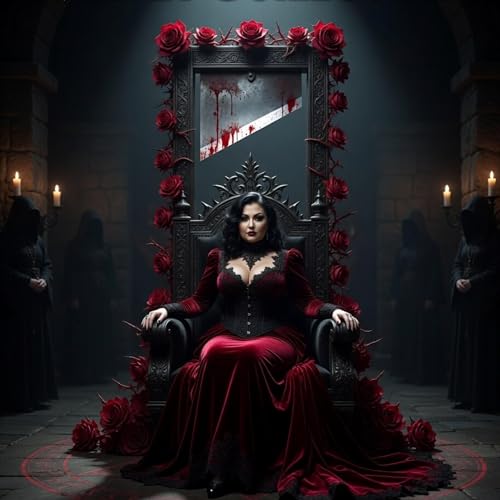
Couverture de The Velvet Guillotine

The Velvet Guillotine

The Velvet Guillotine

De : April Rain
Écouter gratuitement

History didn't ask permission. Neither do we. Velvet Guillotine goes where the textbooks didn't — the atrocities, the forgotten bodies, the power structures, and the questions that don't have clean answers. Every episode follows the thread from the past to the modern mirror, because history isn't safely contained. It never was. Hosted by April Rain. Listener discretion advised.April Rain
Épisodes
  • The Infallibility Machine — How the Papacy Constructed Absolute Authority (Dastardly Ideas)
    Jun 7 2026

    How does an institution convince the world that it cannot be wrong?

    Not that it is usually right — that it cannot be wrong, that there is a category of its pronouncements where error is impossible. That is not perfection. It is removing the smoke detector and calling the house fireproof. The Church made the claim formal in 1870; the machine behind it took eight hundred years to build. In this Dastardly Ideas, April Rain takes it apart — where papal infallibility came from, how it was built, what it costs.

    It starts with one sentence — Matthew 16, "on this rock I will build my church" — which never says Peter's successors inherit it, that Peter cannot err, or that it passes to an institution in Rome. All of that was added later, by people with a stake in the outcome.

    Then the Donation of Constantine: an eighth-century document granting the popes supremacy over Christendom, supposedly signed by Constantine centuries earlier. A forgery, unexposed until 1440, when Lorenzo Valla proved its Latin belonged to the eighth century, not the fourth. By then it had propped up papal authority for seven hundred years. A machine does not need to be true to run. It only needs to be believed.

    Then Gregory VII's Dictatus Papae (1075), proposition twenty-two: the Roman Church has never erred, and never will. Past tense, pointed forward like a weapon. It has no error-prevention parts; it does not prevent the fire, it redefines the smoke — reclassifying error as not-error after the fact. The doctrine was formalized at the First Vatican Council — limited to the pope speaking ex cathedra on faith and morals — the very year Italy seized Rome, ending its temporal power. The empire it could measure, lost; an unfalsifiable one, declared in the same breath.

    Then the cost, played straight. When an institution cannot be wrong, the people it harms have no standing to name it — "we were wrong, we are responsible" is the sentence the architecture was built to make unnecessary. The Magdalene Laundries. The clerical abuse crisis. The same pattern: the sinning individual conceded, the institution spotless. Not that the Church did no good — only that this one idea runs from a corpse on a throne in 897 to now, and the people who pay are the ones it harms and cannot quite say it harmed.

    The Cadaver Synod was corrected in 897 — not by anything in the doctrine, which has no self-correcting part, but the oldest way: people decided it was wrong and acted. Which leaves the question the machine never answers. What happens when the people who could correct the error are the ones committing it? That question has no ninth-century answer. It has a present-tense one.

    Pairs with 3A (Cadaver Synod), 3B (Papacy's Hall of Shame), and DP Ep. 3 (Lateran) — listen as a set.

    Velvet Guillotine is a podcast about dark history and institutional cover-ups. Dastardly Ideas takes apart the frameworks we use to understand history; some have agendas. New episodes every Wednesday. Part of The Downpour podcast network. Hosted by April Rain.

    DISCLAIMER: The content of this episode is for entertainment purposes only. Historical events, documents, and doctrines discussed are based on documented records, scholarly research, and primary sources. This episode examines the historical and political construction of institutional and doctrinal authority, including matters of forgery and the abuse of power. Velvet Guillotine does not endorse any political, religious, or ideological interpretation of events portrayed, and makes no claim regarding the theological truth or validity of any doctrine, scripture, or belief discussed. The analysis offered here concerns the documented historical development of an institution — not the faith, sincerity, or beliefs of any religious community or its adherents. Listener discretion is advised.

    Sources and research rabbit holes: thevelvetguillotine.substack.comSupport the show: patreon.com/thedownpourEverything else: linktr.ee/thedownpour

    Stay dark. — April

    Afficher plus Afficher moins
    22 min
  • The Papacy's Hall of Shame — When the Vatican Went Off the Rails (Postscript)
    Jun 7 2026

    You have just come from the Cadaver Synod — a pope digging up his dead predecessor, propping the body on a throne in full vestments, convicting it, and throwing it in the Tiber. You may think that is as bad as it ever got. That there is nowhere to go from a corpse in a chair.

    Oh, darlings. There is so much further to go.

    In this postscript, April Rain runs a guided tour through the most unhinged stretch of papal history — because if we are going to discuss institutional corruption, we may as well visit the institution with the best-documented record of people doing staggering things in the name of God. The Cadaver Synod was the symptom. This is the diagnosis.

    The tour:

    The Year of Four Popes (896) — four pontiffs in twelve months, a revolving door someone set on fire. Ten popes in thirty-two years, at least three murdered, including John VIII — poisoned, then beaten to death when the poison ran slow.

    Sergius III — back from exile with an army, who found his two predecessors conveniently imprisoned and conveniently dead, and fathered a child with a fifteen-year-old girl who became Pope John XI.

    Marozia — and here the tour goes dead straight. She installed popes, had one smothered with a pillow in the Castel Sant'Angelo, and ran Rome for three decades through the only channels a world that gave women no formal power left her. When men do this, history calls it statecraft. When she did it, history reached for "pornocracy." April corrects the record.

    John XII — pope at eighteen. The charges Otto I read against him in 963 are one of the great documents in recorded history: ordaining a deacon in a horse stable, ordaining a ten-year-old bishop for money, blinding his confessor, castrating and murdering a cardinal, toasting the devil by name at a gambling table, and turning the Lateran Palace into a brothel.

    Benedict IX — who reduced the throne of Saint Peter to a line item. Made pope as a boy, he held the office three times and once sold it — to his own godfather, for cash — leaving three men at once claiming the papacy.

    And how did the institution survive all of it? Partly through a theology walling the office's authority off from the man holding it — either a profound insight about grace or the most effective self-protection an institution ever built. Probably both. But the part to carry home is this: reform never came from within. Every time, it came from outside — from emperors the institution could not outvote, excommunicate, or bury in a monastery. External accountability. Every single time.

    Any institution that says it needs no outside oversight — trust the procedure, never mind the outcomes — is walking a road the ninth-century papacy mapped in detail. We have the map. The only question is whether we read it.

    Pairs with Episode 3A (The Cadaver Synod) — start there.

    Velvet Guillotine is a podcast about dark history and institutional cover-ups. The Postscript is the companion to each main episode — sources, tangents, and the parts that didn't fit. New episodes every Sunday. Part of The Downpour podcast network. Hosted by April Rain.

    DISCLAIMER: The content of this episode is for entertainment purposes only. Historical events and figures discussed are based on documented records, scholarly research, and primary sources. This episode contains discussions of murder, assassination, sexual misconduct involving a minor, and the systematic abuse of institutional and ecclesiastical power. Velvet Guillotine does not endorse any political, religious, or ideological interpretation of events portrayed. The criticism offered here is directed at the documented conduct of specific historical figures and the institutional structures of a particular era — not at any faith, religious community, or the beliefs of its adherents. Listener discretion is advised.

    Sources and research rabbit holes: thevelvetguillotine.substack.comSupport the show: patreon.com/thedownpourEverything else: linktr.ee/thedownpour

    Stay dark. — April

    Afficher plus Afficher moins
    25 min
  • The Corpse on the Throne — The Cadaver Synod of 897 AD
    Jun 6 2026

    January, 897. Rome. A sitting pope had his dead predecessor exhumed, dressed in full papal regalia, propped upright on a throne, and put on trial. A deacon was appointed to speak for the corpse. The corpse lost.

    This is the Cadaver Synod, and it is not a metaphor. Pope Stephen VI dug Pope Formosus out of the ground — nine months dead — convicted him on every charge, cut the blessing fingers from his right hand, and threw the body in the Tiber. It is one of the most unhinged spectacles in the history of organized religion. The moment you stop laughing, it becomes something colder: a study of what an institution does when no one left alive has the power to tell it no.

    April Rain walks you onto the crime scene — the collapse of Charlemagne's empire, the street-fight papacy of the ninth century, and the politics of revenge under the theater — and asks the only question a crime scene ever really asks: who benefited.

    History is a crime scene. This week, the body is a pope.

    Listener note: institutional corruption, political violence, and the desecration of human remains. For entertainment purposes only.

    Sources and the research rabbit holes: thevelvetguillotine.substack.comSupport the show: patreon.com/thedownpourEverything else: linktr.ee/thedownpour

    Stay dark. — April

    Afficher plus Afficher moins
    59 min
adbl_web_anon_alc_button_suppression_t1
Aucun commentaire pour le moment