Épisodes

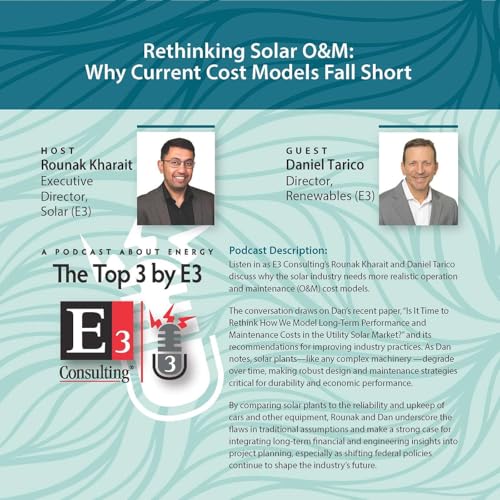
  • Rethinking Solar O&M: Why Current Cost Models Fall Short
    Sep 3 2025

    Send us a text

    Rounak Kharait, E3's Executive Director of Solar, and Daniel Tarico, E3's Director of Renewables, discuss solar O&M cost models, suggesting that they need to be changed and made more realistic to reflect the true lifecycle maintenance requirements of utility-scale projects. Some of the highlights of the podcast are shown below:

    • Daniel brings expertise from metallurgy, construction, and tracker manufacturing to solar O&M discussions
    • Early solar financing models incorrectly assumed minimal maintenance would be needed throughout project lifetimes
    • Solar plants experience increasing failure rates and maintenance costs as they age, similar to automobiles or other mechanical products
    • Standard assumptions ignore the wear-out aspect of aging equipment
    • Without the ITC, economic models must shift to focus on long-term performance and realistic maintenance budgeting
    • Projects in markets where production is the primary value driver need more accurate revenue and OPEX models
    • Major equipment can last a long time if designed well and properly maintained

    If you have questions or suggestions for future podcast topics, please reach out at to us at e3co@e3co.com. The full white paper on this topic is available for download on our website .


    Afficher plus Afficher moins
    16 min
  • Series Episode Four: PVsyst Parameters
    May 6 2025

    Send us a text

    In this final episode in the PVsyst series, Daniel Tarico and Frances Plourde discuss the impact of system design on photovoltaic (PV) system modeling, focusing particularly on shading losses and module mismatch within the context of using the PVsyst software.

    Frances also covers light-induced degradation (LID), which happens when PV modules are first exposed to sunlight, particularly affecting crystalline silicon modules with certain dopants. LID is a one-time effect but can reduce module efficiency by 1-3%. This factor must be accounted for when designing and modeling PV systems, especially for long-term performance projections.

    The conversation highlights the importance of considering the long-term effects of module degradation, mismatch losses, and shading when designing and financing PV systems.


    Afficher plus Afficher moins
    19 min
  • Series Episode Three: Understanding PVsyst Reports
    Apr 30 2025

    Send us a text

    In the third episode of the PVsyst series, Daniel Tarico and Frances Wilberg-Plourd from E3 discuss the interpretation of PVsyst reports and how they relate to PV system energy estimation, specifically focusing on how PVsyst calculates energy production using statistical probabilities.

    Key points:

    1. PVsyst Report Overview: The report begins with system inputs such as equipment, location, orientation, and shading factors, and then presents energy estimates, including monthly generation based on climate data. The final report includes an energy waterfall diagram showing energy production and losses on both the DC and AC sides of the system.
    2. P50 and Probabilistic Estimates: The P50 value represents the long-term average expected energy production. It's based on probabilistic modeling, considering weather variability. The system's actual performance will, in some years, exceed or fall short of the P50 estimate, with a 50/50 chance of being above or below the predicted value.
    3. Other Probabilistic Levels (P75, P99): Other probabilities, like P75 and P99, indicate more conservative estimates. The P99 represents energy production that the system is expected to exceed in 99% of years. These are useful for ensuring energy and revenue guarantees.
    4. Degradation and Performance Tracking: Module degradation typically leads to a half-percent annual decrease in energy production, impacting long-term projections. If system production drops faster than expected, it might indicate issues requiring attention.

    The episode emphasizes the importance of accurate and up-to-date data in PVsyst reports to ensure reliable energy and financial forecasts.

    Afficher plus Afficher moins
    15 min
  • Series Episode Two: Climate Data in PVsyst
    Apr 28 2025

    Send us a text

    Daniel Tarico and Frances Wilberg-Plourde delve into PV system modeling, specifically focusing on using climate data in PVsyst software. The discussion covers how climate data, such as irradiance, temperature, and wind speed, are critical for modeling PV system performance and affect energy production. The data is typically provided in an 8760 format, representing each hour of the year.

    Frances explains that PVsyst relies on typical meteorological year (TMY) files, which aggregate data from several years to represent an average year. These files are compiled from various data sources, each with its own methods and algorithms for processing weather data, including satellite and ground-based measurements.

    Three primary climate data sources are discussed: the National Solar Radiation Database (NSRDB), Meteonorm, and Solar Anywhere. The NSRDB offers free data with decent accuracy, though it tends to underestimate irradiance and is not recommended for final modeling. Meteonorm, a paid service, offers synthetic data that can be useful for preliminary models but may not be precise enough for financing decisions. Solar Anywhere is considered the most accurate but comes with a cost, providing high spatial and temporal resolution data, which is especially useful for detailed production estimates and project evaluations.

    Key takeaways include the importance of using location-specific data for accurate modeling, understanding the differences between data sources and their methods, and the potential benefits of paid data services for high-accuracy predictions, particularly for long-term financial planning.

    Afficher plus Afficher moins
    20 min
  • An Introduction to Photovoltaic (PV) Solar Modeling and Three-Part Overview of the PVsyst Model
    Apr 11 2025

    Send us a text

    Join Daniel Tarico and Frances Willberg Plourde as they kick off a discussion regarding the range of PV solar modeling programs available today. In this introductory episode, they explore the key differences between tools, setting the stage for a deep dive into PVsyst, the industry-standard software for PV system modeling. In a series of three following episodes, they provide an overview of PVsyst's capabilities, focusing on essential features that can help you design a customized model tailored to your specific PV project. Follow-on episodes in the series include:


    Series Episode 2: PVsyst – Climate Data Sources
    Series Episode 3: PVsyst – Interpreting Reports
    Series Episode 4: PVsyst – System Parameters


    Afficher plus Afficher moins
    18 min
  • Choosing the Right Inverter in 2025: Central vs. String
    Jan 16 2025

    Send us a text

    Ever wondered if central or string inverters are the way to go for your solar project? Join host Daniel Tarico, E3 director of renewables and Mike Kosmersky, E3 Consulting's head of field engineering services, as they discuss the impact of project size and location on inverter choice, sharing tales from our own experiences, including a one-megawatt project in rural India. They reflect on the importance of serviceability, reliability, and the changing landscape of inverter capacities, challenging the once-clear definitions of "central" and "string." Whether you're deep into the world of renewables or just curious about solar tech, this episode shines a light on the crucial decisions shaping solar energy today.

    Afficher plus Afficher moins
    14 min
  • Shifting Conversations: Updates on ESG, Part 2
    Nov 19 2024

    Send us a text

    Learn how Environmental, Social, and Governance (ESG) regulations are changing, with insights from Carol Ho, Executive Director of Environmental Services at E3. Carol and podcast host, Al Rettenmaier, Managing Director of Oil, Gas, Chemicals, CCS, and Hydrogen discuss the SEC's new climate disclosure rule, upcoming legal challenges, and how it might affect businesses. Carol also explains how the Inflation Reduction Act is reshaping project financing with incentives and tax credits, especially for environmental reviews. Carol and Al also discuss global efforts like the Equator Principles to standardize ESG practices and examine the role of ESG scores in business performance.

    Additionally, they explore why ESG metrics are becoming essential in business strategies and investments, especially in renewable energy projects. Carol shares advice on evaluating social and environmental impacts, from supply chain sustainability to risks like flooding and wildfires. The episode also highlights the EU's new Corporate Sustainability Due Diligence Directive, signaling a global move toward mandatory ESG assessments. As ESG factors become key in business decisions, this episode offers valuable insights for anyone navigating the changing ESG landscape. For more, visit our website at www.e3co.com.

    Afficher plus Afficher moins
    15 min
  • The Present State of PV Solar Recycling
    May 14 2024

    Join the conversation as we sit down with Francis Willberg, a Photovoltaic Analysis Engineer with E3, who discusses the challenge of solar panel retirement. As we approach a staggering 1 million metric tons of photovoltaic waste by 2030, discover how the industry is grappling with the financial and technological puzzles that come with recycling the complex "panini-like" layers of PV modules. In this episode, Frances and Al Rettenmaier, host of the Top 3 by E3 podcast, reveal how the development of bifacial modules and the reuse of still-functional panels can play pivotal roles in propelling us toward less waste. Learn about the proactive measures that are being taken to design new modules that are easier to recycle and how efficiency, reuse, and advanced recycling methods are steps helping with this effort.

    Afficher plus Afficher moins
    19 min