Épisodes

  • Interactive Data Visualisations in Smart Communities, with Melanie Thewlis
    Feb 22 2026

    Hi #SmartCommunity friends, in this episode of the Smart Community podcast I have a fantastic chat with Melanie Thewlis. Melanie is a Full Stack Engineer at Sitemate. At the time of the recording Melanie was Front End Developer at City of Melbourne on the City Data Experience team, specialising in interactive data visualisations in the browser, with 15 years of experience in the space.


    In this episode Melanie tells us about the City DNA platform, a giant 3D printed model of Melbourne where different data scenarios can be projected onto the map. We discuss the stormwater gamification project that transformed tense flood conversations into empowering community experiences, including how playing the ‘maintenance crew game’ built trust with concerned residents.


    We talk about mapping Aboriginal Melbourne with traditional owners and designing engagement websites for major projects like the Greenline and Royal Park Master Plan.


    We finish our chat discussing the power of embodied data through examples like climate scarves and Georgia Lupi's Long COVID diary, encouraging creative and playful ways to explore data beyond Excel. As always, we hope you enjoyed listening to this episode as much as we enjoyed making it.


    Connect with me via email: hello@mysmart.community


    Connect with My Smart Community via LinkedIn or Twitter and watch on YouTube

    Podcast Production by Perk Digital
    This podcast is recorded on the traditional lands of the  Kabi Kabi peoples and edited on the lands of the Gaibal peoples.   I pay my respects to traditional owners of country and their elders past and present. I also extend that respect to all Aboriginal and Torres Strait Islander peoples listening today. Here on the Smart Community Podcast, we talk about data, technology, communities and the future. First Nations peoples have been sharing knowledge, caring for country, and telling stories for tens of thousands of years. I honour that deep connection of storytelling and community connection as we continue our conversation together here today.
    Podcast Production by Perk Digital

    Afficher plus Afficher moins
    58 min
  • Embedding Data Culture in Local Government, with Michael Whereat
    Feb 15 2026

    Hi #SmartCommunity friends, in this episode of the Smart Community podcast I have an enlightening conversation with Michael Whereat. Michael is the Smart Cities Lead for Sunshine Coast Council, in Queensland, where he helps staff and people across the region access data and information to make informed decisions.


    In this episode Michael tells us about the problem statement methodology guiding all Smart Cities work at Sunshine Coast Council and evaluating projects through a rubric to deliver greatest organisational benefits.


    We discuss the Kings Beach playground renewal that used vibration sensors and WiFi counts to understand usage patterns, and the democratisation and publication of the data dashboards.


    We talk about edge processing for privacy protection, the data trailer with QR codes explaining data collection to community, and how technology reduces bias compared to staff counting.


    We finish our chat discussing curiosity and listening for gaps in data not just what you see, but what's not there that should be. As always, we hope you enjoy listening to this episode as much as we enjoyed making it.


    Connect with me via email: hello@mysmart.community


    Connect with My Smart Community via LinkedIn and watch on YouTube

    Podcast Production by Perk Digital


    This podcast is recorded on the traditional lands of the  Kabi Kabi peoples and edited on the lands of the Gaibal peoples.   I pay my respects to traditional owners of country and their elders past and present. I also extend that respect to all Aboriginal and Torres Strait Islander peoples listening today. Here on the Smart Community Podcast, we talk about data, technology, communities and the future. First Nations peoples have been sharing knowledge, caring for country, and telling stories for tens of thousands of years. I honour that deep connection of storytelling and community connection as we continue our conversation together here today.

    Disclaimer

    The views, opinions, and perspectives expressed by guests on The Smart Community Podcast are solely those of the individual speakers. They do not necessarily reflect the views, opinions, or positions of the host, Zoe Eather, or of The Smart Community Podcast as a whole.

    Any discussion of ideas, products, organisations, or services by podcast guests does not constitute endorsement or recommendation by the host or the podcast. Listeners are encouraged to form their own opinions and seek professional advice where appropriate.

    Afficher plus Afficher moins
    57 min
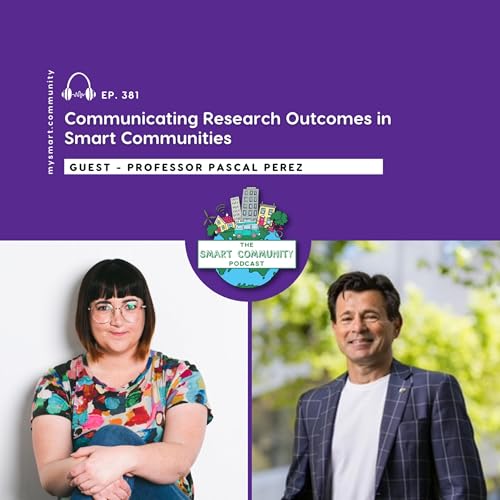
  • Communicating Research Outcomes in Smart Communities, with Professor Pascal Perez
    Feb 8 2026

    Hi #SmartCommunity friends, in this episode of the Smart Community podcast I have a great conversation with Professor Pascal Perez. Pascal is the Director of the Australian Urban Research Infrastructure Network (AURIN), a national research infrastructure facility funded by the Australian government that serves researchers across the country working on urban systems, infrastructure, and local communities.


    In this episode Pascal tells us about using story mapping tools to communicate research outcomes, mixing plain text, interactive maps, and traditional graphs. We discuss the Australian Urban Health Indicators project examining heat waves, including the challenge of creating better causation indicators while realising mobile location data is the missing piece.


    We talk about the Map of the Month project bringing global community engagement approaches to Melbourne and digital tools for urban design.


    We finish our chat discussing the critical difference between data, information, and knowledge, and why the hard yards are really between information and knowledge. As always, we hope you enjoy listening to this episode as much as we enjoyed making it.


    Connect with me via email: hello@mysmart.community


    Connect with My Smart Community via LinkedIn and watch on YouTube

    Podcast Production by Perk Digital


    This podcast is recorded on the traditional lands of the  Kabi Kabi peoples and edited on the lands of the Gaibal peoples.   I pay my respects to traditional owners of country and their elders past and present. I also extend that respect to all Aboriginal and Torres Strait Islander peoples listening today. Here on the Smart Community Podcast, we talk about data, technology, communities and the future. First Nations peoples have been sharing knowledge, caring for country, and telling stories for tens of thousands of years. I honour that deep connection of storytelling and community connection as we continue our conversation together here today.

    Disclaimer

    The views, opinions, and perspectives expressed by guests on The Smart Community Podcast are solely those of the individual speakers. They do not necessarily reflect the views, opinions, or positions of the host, Zoe Eather, or of The Smart Community Podcast as a whole.

    Any discussion of ideas, products, organisations, or services by podcast guests does not constitute endorsement or recommendation by the host or the podcast. Listeners are encouraged to form their own opinions and seek professional advice where appropriate.

    Afficher plus Afficher moins
    53 min
  • Design Decisions and Collaboration in Data Visualisation, with Professor Alberto Cairo
    Feb 1 2026

    Hi #SmartCommunity friends, in this episode of the Smart Community podcast I have an incredible conversation with Prof. Alberto Cairo. Alberto is the Knight Chair in Visual Journalism at the School of Communication of the University of Miami and Director of Visualization at the Frost Institute for Data Science and Computing, plus author of several influential books including The Functional Art, The Truthful Art, How Charts Lie, and The Art of Insight.


    In this episode Alberto tells us about his work with the National Hurricane Center designing graphics to convey hurricane risks to Miami's diverse multilingual population. We discuss why visualisation design needs decision-making processes rather than rigid rules, and why those decisions should be subjective but never arbitrary. We talk about collaboration being essential since designers acknowledge they often know nothing about the data and must ask experts tons of questions.


    We finish our chat discussing the gap between expert designers and general public readers, encouraging everyone to just get started making graphics when they wish a story or spreadsheet was clearer. As always, we hope you enjoy listening to this episode as much as we enjoyed making it.


    Connect with me via email: hello@mysmart.community


    Connect with My Smart Community via LinkedIn and watch on YouTube

    Podcast Production by Perk Digital


    This podcast is recorded on the traditional lands of the  Kabi Kabi peoples and edited on the lands of the Gaibal peoples.   I pay my respects to traditional owners of country and their elders past and present. I also extend that respect to all Aboriginal and Torres Strait Islander peoples listening today. Here on the Smart Community Podcast, we talk about data, technology, communities and the future. First Nations peoples have been sharing knowledge, caring for country, and telling stories for tens of thousands of years. I honour that deep connection of storytelling and community connection as we continue our conversation together here today.


    Disclaimer

    The views, opinions, and perspectives expressed by guests on The Smart Community Podcast are solely those of the individual speakers. They do not necessarily reflect the views, opinions, or positions of the host, Zoe Eather, or of The Smart Community Podcast as a whole.

    Any discussion of ideas, products, organisations, or services by podcast guests does not constitute endorsement or recommendation by the host or the podcast. Listeners are encouraged to form their own opinions and seek professional advice where appropriate.

    Afficher plus Afficher moins
    49 min
  • Audience-First Storytelling in Smart Communities, with Paul Hodge
    Jan 26 2026

    Hi #SmartCommunity friends, in this episode of the Smart Community podcast I have a brilliant discussion with Paul Hodge, also known as The Data Vis Guy. Paul is an independent consultant specialising in education and mentoring around data visualisation and storytelling, working with global organisations and state and federal government agencies.

    In this episode Paul tells us about the three core principles of his training: engaging and holding audience attention, delivering insights rather than just data, and bringing it all together through design thinking. We discuss the importance of defining specific audiences rather than being too general, including a detailed case study of a data asset portfolio that used a heat map to identify high-risk assets. We talk about Randy Olson's ABT structure (And, But, Therefore) as the simplest form of storytelling.

    We finish our chat discussing impactful visualisations like the 9/11 Memorial's algorithmically determined name placement and the Periscopic gun deaths visualisation showing lost years to society. As always, we hope you enjoy listening to this episode as much as we enjoyed making it.


    Connect with me via email: hello@mysmart.community


    Connect with My Smart Community via LinkedIn and watch on YouTube

    Podcast Production by Perk Digital
    This podcast is recorded on the traditional lands of the  Kabi Kabi peoples and edited on the lands of the Gaibal peoples.   I pay my respects to traditional owners of country and their elders past and present. I also extend that respect to all Aboriginal and Torres Strait Islander peoples listening today. Here on the Smart Community Podcast, we talk about data, technology, communities and the future. First Nations peoples have been sharing knowledge, caring for country, and telling stories for tens of thousands of years. I honour that deep connection of storytelling and community connection as we continue our conversation together here today.

    Disclaimer

    The views, opinions, and perspectives expressed by guests on The Smart Community Podcast are solely those of the individual speakers. They do not necessarily reflect the views, opinions, or positions of the host, Zoe Eather, or of The Smart Community Podcast as a whole.

    Any discussion of ideas, products, organisations, or services by podcast guests does not constitute endorsement or recommendation by the host or the podcast. Listeners are encouraged to form their own opinions and seek professional advice where appropriate.

    Afficher plus Afficher moins
    57 min
  • Embedding Technology and Quantifying Placemaking in Smart Communities, with Eshita Dutia
    Jan 18 2026

    Hi #SmartCommunity friends, in this episode of the Smart Community podcast I have a wonderful conversation with Eshita Dutia.

    Eshita is the Principal Smart Places Officer at Cumberland City Council, bringing her background as an architect, planner, and urban designer to the smart city space with a focus on putting community first.

    In this episode Eshita tells us about actioning Cumberland's Smart Places Strategy and Action Plan, embedding smart technology into placemaking projects to collect data and show impact. We discuss the Guilford Laneway project as part of Transport for NSW's Safer Cities Her Way program, including how the team moved from ad hoc data collection to a streamlined Data for Places methodology.

    We talk about combining qualitative feedback like perception of safety surveys with quantitative data including footfall, dwell time, and economic spend.

    We finish our chat discussing the power of simplified data and how small-scale interventions can have significant impact when documented through data storytelling. As always, we hope you enjoy listening to this episode as much as we enjoyed making it.


    Connect with me via email: hello@mysmart.community


    Connect with My Smart Community via LinkedIn and watch on YouTube

    Podcast Production by Perk Digital


    This podcast is recorded on the traditional lands of the  Kabi Kabi peoples and edited on the lands of the Gaibal peoples.   I pay my respects to traditional owners of country and their elders past and present. I also extend that respect to all Aboriginal and Torres Strait Islander peoples listening today. Here on the Smart Community Podcast, we talk about data, technology, communities and the future. First Nations peoples have been sharing knowledge, caring for country, and telling stories for tens of thousands of years. I honour that deep connection of storytelling and community connection as we continue our conversation together here today.

    Disclaimer

    The views, opinions, and perspectives expressed by guests on The Smart Community Podcast are solely those of the individual speakers. They do not necessarily reflect the views, opinions, or positions of the host, Zoe Eather, or of The Smart Community Podcast as a whole.

    Any discussion of ideas, products, organisations, or services by podcast guests does not constitute endorsement or recommendation by the host or the podcast. Listeners are encouraged to form their own opinions and seek professional advice where appropriate.

    Afficher plus Afficher moins
    46 min
  • Creative Approaches to Data Storytelling and Research Communication, with Dr. Jessamyn Fairfield

    Dec 7 2025

    Hi #SmartCommunity friends, in this episode of the Smart Community podcast I have a great conversation with Dr. Jessamyn Fairfield. Jessamyn is a lecturer in natural sciences at the University of Galway in Ireland. Jessamyn’s work specialises in art-science collaboration with a focus on performing arts and thinking differently about how people can engage with science, technology, and research.

    In this episode Jessamyn tells us about Bright Club Ireland, a research comedy variety night where she trained 300+ academics to do standup about their research. We discuss We Built the City on Rock and Coal, an improvised climate change show touring rural Ireland, including how improv creates co-created experiences with audiences and removes perceived power dynamics. We talk about using dance theater to explore concepts like particle-wave duality and local ecologies.

    We finish our chat discussing the perception that changing data from graphs and equations is "dumbing it down" and the importance of listening to audiences to discover if your message is actually getting across. As always, we hope you enjoy listening to this episode as much as we enjoyed making it.


    Oh also a little heads up that we’ll be taking a few weeks break over the Christmas/New Year season but we will be back in January with more episodes in this PhD series of The Smart Community Podcast!


    Connect with me via email: hello@mysmart.community


    Connect with My Smart Community via LinkedIn and watch on YouTube

    Podcast Production by Perk Digital
    This podcast is recorded on the traditional lands of the  Kabi Kabi peoples and edited on the lands of the Gaibal peoples.   I pay my respects to traditional owners of country and their elders past and present. I also extend that respect to all Aboriginal and Torres Strait Islander peoples listening today. Here on the Smart Community Podcast, we talk about data, technology, communities and the future. First Nations peoples have been sharing knowledge, caring for country, and telling stories for tens of thousands of years. I honour that deep connection of storytelling and community connection as we continue our conversation together here today.

    Afficher plus Afficher moins
    59 min
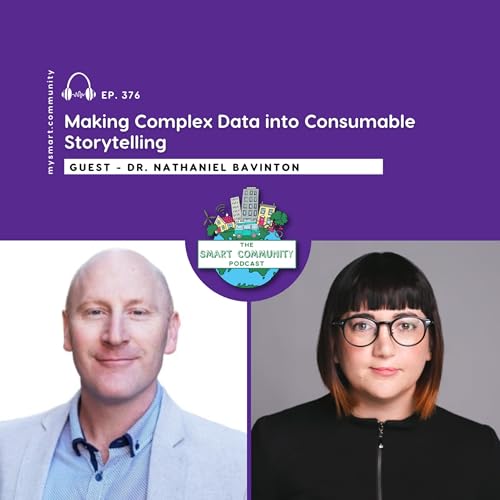
  • Making Complex Data into Consumable Storytelling, with Dr. Nathaniel Bavinton
    Nov 30 2025

    Hi #SmartCommunity friends, in this episode of the Smart Community podcast I have a great conversation with Dr. Nathaniel Bavinton, who you may remember from way back in Episode 183. Nathaniel is an urban sociologist and Associate Director at Urbis, working in their Smart and Sustainable Places team.

    In this episode Nathaniel tells us about data visualization as an essential tool for making complex information accessible and about COVID-era advocacy work combining data with local stories. We discuss the City Intelligence platform and designing for business communities, including lessons about simplifying map-based visualizations. We talk about creative applications of data through AR/VR experiences for Indigenous dual naming projects.

    We finish our chat discussing the collision of skillsets needed for effective data storytelling and the importance of thinking about narrative structure when working with data. As always, we hope you enjoyed listening to this episode as much as we enjoyed making it.


    Connect with me via email: hello@mysmart.community

    Connect with My Smart Community via LinkedIn and watch on YouTube

    Podcast Production by Perk Digital
    This podcast is recorded on the traditional lands of the  Kabi Kabi peoples and edited on the lands of the Gaibal peoples.   I pay my respects to traditional owners of country and their elders past and present. I also extend that respect to all Aboriginal and Torres Strait Islander peoples listening today. Here on the Smart Community Podcast, we talk about data, technology, communities and the future. First Nations peoples have been sharing knowledge, caring for country, and telling stories for tens of thousands of years. I honour that deep connection of storytelling and community connection as we continue our conversation together here today.


    Disclaimer

    The views, opinions, and perspectives expressed by guests on The Smart Community Podcast are solely those of the individual speakers. They do not necessarily reflect the views, opinions, or positions of the host, Zoe Eather, or of The Smart Community Podcast as a whole.

    Any discussion of ideas, products, organisations, or services by podcast guests does not constitute endorsement or recommendation by the host or the podcast. Listeners are encouraged to form their own opinions and seek professional advice where appropriate.


    Afficher plus Afficher moins
    55 min